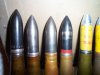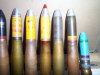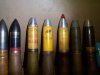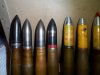
Very nice rounds! I haven't seen that fuze before, but I would venture that Erhard and company will be able to ID it for you. I have the feeling it isn't German. So why are these your favorites? They have very nice paint, I will give you that.
John
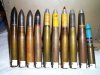
A few of my favorite 2cm rounds. Does anyone know anything about the fuze on shell #7?? And feel free to ask any questions about shell markings,I'll answer best as I can. More to come later!!!
Very nice rounds! I haven't seen that fuze before, but I would venture that Erhard and company will be able to ID it for you. I have the feeling it isn't German. So why are these your favorites? They have very nice paint, I will give you that.
John
Well besides the shape they are in,one really interesting thing to me is that if I were to line them up by year of manufacture,you can watch the quality of the round decrease year by year.From the quality of machining,from the paint,from the transition of copper marked driving bands to soft iron.It fasinating that they could keep making the round work even though they kept loosing materials and quality control.
That and they look really cool in the magazine I have for them![]()
That makes sense. I'm always facinated by all the colors used on the 20-30mm ammo. And of course having nice German rounds with the eagle and swastika waffenstamp are nice. Manufacturing wise, I really noticed it in U.S. Mortar ammo. They have screwed around with obturating gas-check rings since WWII, adding, subtracting, and moving them around, till they landed on the latest plastic piston ring design. I'm looking forward to seeing your other favorites.
John
Hi Lou,
Nice collection of solothurn rounds you have, As you say it is is interesting to see the transition from well machined projectiles with copper driving bands and brass cases on through to the sinstered iron bands and washed steel cases. It can't ident the fuze for you either although i would venture that it is not original.
Thanks for posting, Best Weasel.
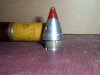
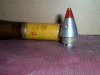
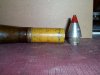
Well Im not totally sure or originality,but it did come to me as one unit.Heres better info and closer pics.
The fuze is marked 2cm kpfZ zerl fg cxh 24143 WaA379
Stamped in the metal of the projectile eeY21f43 WaA339
Inked on the projectile eeyz/644 WaA??9 Br ?? SDur 115g
Case head stamped Wg * 43 93 WaA865
I might move this to the Identify thread
To me the fuze on #7 ( aluminium part ) and it's markings look a normal. "2 cm KpfZ zerl fg" ( self-destructing fuze with centrifugal device ). The brass tip looks odd, may be added ( later on ? ) for some purpose. However if it would be a war time experimental I think markings should be different.
Inked on metal is most likely "Br. o. Lspur" = Brand ohne Lichtspur ( incendiary, without tracer ).
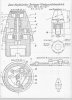
I agree with you.. (see attached drawing).
It would be very strange to produce something like this because of the simple construction and workings of this fuze..
Furthermore, after 1943 materials like brass, copper and aluminium were very hard to get in Germany. These were (if possible) replaced by plastics and the fuze desings were simplified to a minimum.
I think this is a nice example of creative lath work to make it more interesting for a willing buyer.
Any Live or Dug ordnance shown by me has been disposed of by military EOD personnel.
Hmmm,I dont like forgeries,or additions for the sake of sales.So I got my tools out and removed the thread set "the little steel ball or rod thats inserted at the edge of the threads,to keep the bottom of the fuse on and locked tight".It released the internals.There are some matches to the line drawing above,and some differences.The thing I cant quite explain,is that there is about 2mm more aluminum at the tip of this fuze.Interesting. I'll get my camera issues sorted out and attempt some close ups.
Thank you for the line drawing too.This will really help me figure this out.
Last edited by Lou; 12th May 2009 at 04:31 AM.
Bookmarks