Welcome to the Inert Ordnance Collectors.
Page 3 of 4 FirstFirst 1234 LastLast
Results 21 to 30 of 39
  1. #21
    Senior Member
    Join Date
    Feb 2010
    Location
    Virginia, USA
    Posts
    531
    Thanks
    0
    Thanked 61 Times in 26 Posts
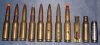
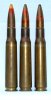
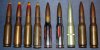
    I'll throw in my two cents on the BAT cartridges. In the US they were fielded for use in the M40 sereis 106mm recoilless rifles and are designated the M48 or M48A1. I think the US was the first to field the cartridge, but I do not know for sure. The spotter tracer bullet is easy to ID externally because it will have an open tip. The bullet has a tracer element in an aluminum cup and an igniter composition in a steel cup in a gilding metal jacket. Tony, I am surprised that with all the variations the British did that they never loaded a Ball version for testing at some point. The US did at one point and then fielded, for limited use, a Practice Ball and Practice Ball Tracer. We also loaded several other standard Cal. .50 bullets for testing. My first photo from l-r is a French loading (VE 4-63 S 12,7);; A Spanish Santa Barbara loading (12.7 M48A1 SB 71);; A South African loading (61 87);; A Belgian loading (FN 12.7); Two Kynoch dummies (K66 L10A1 and K 63 L10A1);; An Israeli Dummy (Hebrew letters 1-78 .50);; A South African loading with a Ball bullet, crimped in the case. (no headstamp) This was reportedly an experimental loading for a test helicopter gun system???;;A South African loading (61 85) that has a spotter bullet, but without any color code and no signs there ever was any. Not sure if the bullet is inert or not.
    The second photo l-r is a US loading (LC 54);; A US Practice Ball loading (LC 54) with an OD tip, without an open tip.;; A US Practice Ball Tracer (FA 52) wth an orange over OD tip, without an open tip.;; A US API test (FA 60) with a standard cal. .50 API bullet.;; A US loading with a standard ball loading crimped in (LC 54);; A US Practice Ball Dummy (FA 51) with a blank primer pocket, 3 case holes and OD tip.;; A US dummy (FA 59) with a drilled out primer pocket, 3 case holes and a wooden insert from the base that also forms the bullet.;; A US dummy (LC 69) with a drilled primer, 4 case holes and 4 bullet holes. It is hard to miss this as being inert.;; A US cutaway case (FAT 5) showing the primer tube.;; A US blank (LC 59).;; and a head space gauge. I've always found this to be a very interesting cartridge series.
    Attached Images Attached Images

  2. #22
    Senior Member
    Join Date
    Jul 2007
    Posts
    2,025
    Thanks
    9
    Thanked 372 Times in 203 Posts

    .50 bat

    There was a great deal of experimentation with the .50 BAT round undertaken by Kynoch in the UK, but the only British round that was approved for service was the L10A1 drill round. For operational use the US made M48A1 was adopted.

    Although there were inert filled British experimental rounds made, none of these saw service and I know of no use of American practice rounds in the UK.

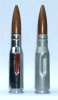
    British experimental rounds utilised both US type open nose projectiles with a primer/detonator inset or normal spitzer type with incendiary composition in the nose. There was also a case type with a screw in promer with flash tube.

    Here are some British examples.

    Regards
    TonyE
    Attached Images Attached Images
    Researcher, collector and pedant
    British military small arms and ammunition.

  3. #23
    Senior Member
    Join Date
    Apr 2010
    Location
    N.Ireland
    Posts
    131
    Thanks
    6
    Thanked 4 Times in 3 Posts

    L11a2

    Hi there,

    I just recieved a 50 cal round in the post headstamped K 70 L11A2, just going through the previous posts picking up from the one posted below, I take it this round is:

    Manufacturer: Kynoch, UK
    Date: 1970

    But are they spotting rounds? And if so are these the corrent bullets on the cartridge?

    Best Regards
    Michael


    Quote Originally Posted by TonyE View Post
    To expand a little on Tomsk's answer, the round was used in a ranging machine gun fitted to the Wombat, a light 120mm recoiless anti-tank weapon. The ranging gun was fitted co-axial with and matched the trajectory of the main gun. When the .50 round was fired, it traced and emitted a bright flash and puff of smoke when it hit. When that was on target the main gun was fired.

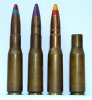
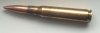
    A similar system was used on the early Chieftain tanks before laser range finding was fitted, but they used a spotter proj. in the normal 99mm case. These were the L11A1, L11A2 and L13A1 rounds (picture attached of two experimental and issue L13A1 plus .50 BAT drill rounds)

    details of Wombat here:
    L6 Wombat - Wikipedia, the free encyclopedia

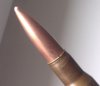
    If you pull your round and it is a spotter tracer, it will be a long boat tailed bullet with the base sealed with a celluloid/plastic material.

    I will post a picture when I find a loose bullet to scan.

    Regards
    TonyE
    Attached Images Attached Images

  4. #24
    Senior Member
    Join Date
    Jul 2007
    Posts
    2,025
    Thanks
    9
    Thanked 372 Times in 203 Posts

    L11a2

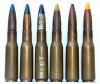
    The L11A1 and 2 were spotting rounds used by British main battle tamks with a trajectory matched to the main gun armament.

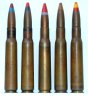
    When the 120mm gun was introduced to service a new spotting round was introduced, the L13A1. All had a red and yellow tip.

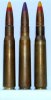
    Early trials rounds had a blue and red tip or a red and silver tip, and there were probably other colours. There was also an inert filled L11A1 with a mustard coloured tip and a pre-production L13 headstamped XL13E1 with a violet tip.

    Pictures show various L11A1, L11A2 and L13 rounds.

    Regards
    TonyE.
    Attached Images Attached Images
    Researcher, collector and pedant
    British military small arms and ammunition.

  5. #25
    Senior Member
    Join Date
    Apr 2010
    Location
    N.Ireland
    Posts
    131
    Thanks
    6
    Thanked 4 Times in 3 Posts
    Quote Originally Posted by TonyE View Post
    The L11A1 and 2 were spotting rounds used by British main battle tamks with a trajectory matched to the main gun armament.

    When the 120mm gun was introduced to service a new spotting round was introduced, the L13A1. All had a red and yellow tip.

    Early trials rounds had a blue and red tip or a red and silver tip, and there were probably other colours. There was also an inert filled L11A1 with a mustard coloured tip and a pre-production L13 headstamped XL13E1 with a violet tip.

    Pictures show various L11A1, L11A2 and L13 rounds.

    Regards
    TonyE.

    Thanks TonyE

  6. #26
    Premium Member
    Join Date
    Dec 2007
    Location
    Berkshire.
    Posts
    2,327
    Images
    100
    Thanks
    15
    Thanked 12 Times in 10 Posts

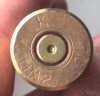
    Question Xl13e1

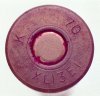
    I managed to get one of the XL13E1 rounds which I believe were the only Kynoch UK produced rounds that were ever given an experimental Headstamp !
    Is that correct Tony E ?
    Attached Images Attached Images
    CHRIS

  7. #27
    Senior Member
    Join Date
    Jul 2007
    Posts
    2,025
    Thanks
    9
    Thanked 372 Times in 203 Posts

    Experimentals

    AFAIK they were certainly th only ones given an "XL..E.." style of experimental headstamp. There are a number of other headstamps that were applied only to experimental ammuniyion.

    Regards
    TonyE
    Researcher, collector and pedant
    British military small arms and ammunition.

  8. #28
    Premium Member
    Join Date
    Dec 2007
    Location
    Berkshire.
    Posts
    2,327
    Images
    100
    Thanks
    15
    Thanked 12 Times in 10 Posts

    Exclamation Thank you Tony E

    Quote Originally Posted by TonyE View Post
    AFAIK they were certainly th only ones given an "XL..E.." style of experimental headstamp. There are a number of other headstamps that were applied only to experimental ammuniyion.

    Regards
    TonyE
    Many thanks for that reply Tony, the person who presented me with the round stated very clearly that it was an exceptional headstamp!
    Best regards
    CHRIS

  9. #29
    Premium Member
    Join Date
    Jul 2009
    Location
    Andover,England
    Posts
    1,997
    Images
    899
    Blog Entries
    1
    Thanks
    669
    Thanked 248 Times in 156 Posts
    Quote Originally Posted by EagleEyes View Post
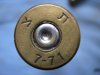
    Round 5: As the headstamp text has been identified as Hebrew (У Л 7-71) do we know what it translates to and the manufacturer other then Israeli?
    Hi,
    I have always understood this this headstamp to be crylic as you say, as found on Yugoslavian rounds.
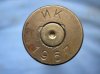
    Also the K 76 .50 with empty primer you have photo'd,I have just got hold of one of these and came to me as a factory dummy?

    Cheers
    Tony
    "Si vis pacem,para bellum"

    Member of COYCC

  10. #30
    Senior Member
    Join Date
    Jul 2007
    Posts
    2,025
    Thanks
    9
    Thanked 372 Times in 203 Posts

    K76

    There could be any of several reasons for an empty round like that. It could be a factory dummy, possibly to set up the machinery, or a sample to send to a prospective military customer.

    Regards
    TonyE
    Researcher, collector and pedant
    British military small arms and ammunition.


Page 3 of 4 FirstFirst 1234 LastLast

Bookmarks

Posting Permissions

  • You may not post new threads
  • You may not post replies
  • You may not post attachments
  • You may not edit your posts
  •  
Back to top
Website designed and maintained by Tucanoo Solutions Ltd