
pzgr40
Well-Known Member
Description of the clusterbombs (CBU / Cluster Bomb Unit):
CBU / Cluster Bomb Unit: Clusterbomb (container housing the clusterbombs)
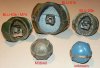
BLU / Bomb Live Unit : Single bomb from clusterbom container
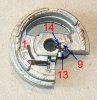
The BLU-26/B "Guava" was an air-dispensed APAM (anti-personnel/anti-material) fragmentation bomblet with 600 embedded steel fragments. The BLU-26/B had three different fuzing options. It could detonate immediately on impact, as an airburst 9 m (30 ft) above ground, or after a selectable but fixed time after impact. The externally identical BLU-36/B and BLU-59/B had random-delay fuzes.
The BLU-26/B was used as payload in the following cluster bombs:
Data for BLU-26/B:
Diameter: 64 mm (2.5 in)
Weight: 435 g (0.95 lb)
Explosive: 85 g (0.19 lb) Cyclotol
The BLU-36/B was a variant of the BLU-26/B APAM (anti-personnel/anti-material) fragmentation bomblet with a randomly timed delay fuze, i.e. it detonated at an unpredictable time after impact.
The BLU-36/B was used as payload in the following cluster bombs:
Diameter: 64 mm (2.5 in)
Weight: 435 g (0.95 lb)
Explosive: 85 g (0.19 lb) Cyclotol
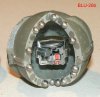
The BLU-61/B was an aerially dispensed anti-material fragmentation and incendiary bomblet. It was spin-armed and detonated on impact. The bomblet consisted of two hemispheres, both with a fragmentation liner of coined steel and a liner for zirconium-tin for the incendiary effect. There was also a BLU-61A/B version, but information about the differences is not available. The BLU-61A/B was apparently the primary (and possibly only) variant used in service.
The BLU-61A/B was used as payload in the following cluster bombs:
Diameter: 99 mm (3.9 in)
Weight: 1.2 kg (2.6 lb)
Explosive: 277 g (0.61 lb) Octol
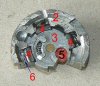
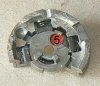
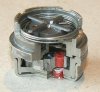
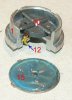
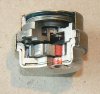
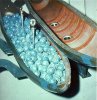
The BLU-63/B was an aerially dispensed, centrifugally-armed, impact-fired anti-personnel/anti-material fragmentation bomblet. There was also a BLU-63A/B version, but confirmed information about the differences is not available (the -63A/B possibly had a secondary incendiary effect). The BLU-86( )/B series was externally identical to the BLU-63( )/B, but had a time-delayed fuze.
The BLU-63( )/B was used as payload in the following cluster bombs:
Data for BLU-63/B:
Diameter: 76 mm (3 in)
Weight: 0.45 kg (1 lb)
Explosive: 113 g (0.25 lb) Cyclotol.
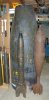
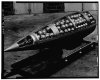
The BLU-63b was also used in Army Rocket artillery like the Lance missile and ATACMS, it was than called The M74 grenade. The fuse used in these missiles was the M219E2, which differs from the M219E1 in lubricant. 300pcs of M74 grenades were packed in the warhead of the Lance missile.
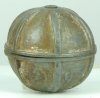
The M38/M40,
A smaller version of the ball shaped clusterbombs. The bomblet is also rotation armed. 950 pcs. these bomblets were packed in the warhead of the Lance missile.
Diameter: 45 mm
No further info about grenade or fuze is available. The M38/M40 in the picture is a dummy.
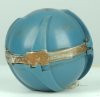
The blue dummy is of an unknown type designation , however of US manufacturing
Diameter: 48 mm
An interesting piece of movie where this type of CBU’s can be seen in action:
[ame="http://www.youtube.com/watch?v=bYXdk-qTl5U&feature=related"]http://www.youtube.com/watch?v=bYXdk-qTl5U&feature=related[/ame]
CBU / Cluster Bomb Unit: Clusterbomb (container housing the clusterbombs)
BLU / Bomb Live Unit : Single bomb from clusterbom container
The BLU-26/B "Guava" was an air-dispensed APAM (anti-personnel/anti-material) fragmentation bomblet with 600 embedded steel fragments. The BLU-26/B had three different fuzing options. It could detonate immediately on impact, as an airburst 9 m (30 ft) above ground, or after a selectable but fixed time after impact. The externally identical BLU-36/B and BLU-59/B had random-delay fuzes.
The BLU-26/B was used as payload in the following cluster bombs:
- CBU-23/B (BLU-26/B in SUU-31/B)
- CBU-24/B (665 BLU-26/B or BLU-36/B in SUU-30/B)
- CBU-24A/B (665 BLU-26/B or BLU-36/B in SUU-30A/B)
- CBU-24B/B (665 BLU-26/B or BLU-36/B in SUU-30B/B)
- CBU-24C/B (665 BLU-26/B or BLU-36/B in SUU-30C/B)
Data for BLU-26/B:
Diameter: 64 mm (2.5 in)
Weight: 435 g (0.95 lb)
Explosive: 85 g (0.19 lb) Cyclotol
The BLU-36/B was a variant of the BLU-26/B APAM (anti-personnel/anti-material) fragmentation bomblet with a randomly timed delay fuze, i.e. it detonated at an unpredictable time after impact.
The BLU-36/B was used as payload in the following cluster bombs:
- CBU-24/B (665 BLU-26/B or BLU-36/B in SUU-30/B)
- CBU-24A/B (665 BLU-26/B or BLU-36/B in SUU-30A/B)
- CBU-24B/B (665 BLU-26/B or BLU-36/B in SUU-30B/B)
- CBU-24C/B (665 BLU-26/B or BLU-36/B in SUU-30C/B)
- CBU-29/B (670 BLU-36/B in SUU-30/B)
- CBU-29A/B (670 BLU-36/B in SUU-30A/B)
- CBU-29B/B (670 BLU-36/B in SUU-30B/B)
- CBU-29C/B (670 BLU-36/B in SUU-30C/B)
Diameter: 64 mm (2.5 in)
Weight: 435 g (0.95 lb)
Explosive: 85 g (0.19 lb) Cyclotol
The BLU-61/B was an aerially dispensed anti-material fragmentation and incendiary bomblet. It was spin-armed and detonated on impact. The bomblet consisted of two hemispheres, both with a fragmentation liner of coined steel and a liner for zirconium-tin for the incendiary effect. There was also a BLU-61A/B version, but information about the differences is not available. The BLU-61A/B was apparently the primary (and possibly only) variant used in service.
The BLU-61A/B was used as payload in the following cluster bombs:
- CBU-52/B (217 BLU-61A/B in SUU-30B)
- CBU-52A/B (217 BLU-61A/B in SUU-30A/B)
- CBU-52B/B (217 BLU-61A/B in SUU-30B/B)
- CBU-76/B (290 BLU-61A/B in SUU-51B/B)
Diameter: 99 mm (3.9 in)
Weight: 1.2 kg (2.6 lb)
Explosive: 277 g (0.61 lb) Octol
The BLU-63/B was an aerially dispensed, centrifugally-armed, impact-fired anti-personnel/anti-material fragmentation bomblet. There was also a BLU-63A/B version, but confirmed information about the differences is not available (the -63A/B possibly had a secondary incendiary effect). The BLU-86( )/B series was externally identical to the BLU-63( )/B, but had a time-delayed fuze.
The BLU-63( )/B was used as payload in the following cluster bombs:
- CBU-58/B (650 BLU-63/B in SUU-30A/B)
- CBU-58A/B (650 BLU-63A/B in SUU-30A/B)
- CBU-75/B (1800 BLU-63/B in SUU-54A/B)
- CBU-75A/B (1420 BLU-63/B and 355 BLU-86/B in SUU-54A/B)
- CBU-77/B (790 BLU-63/B in SUU-51B/B)
Data for BLU-63/B:
Diameter: 76 mm (3 in)
Weight: 0.45 kg (1 lb)
Explosive: 113 g (0.25 lb) Cyclotol.
The BLU-63b was also used in Army Rocket artillery like the Lance missile and ATACMS, it was than called The M74 grenade. The fuse used in these missiles was the M219E2, which differs from the M219E1 in lubricant. 300pcs of M74 grenades were packed in the warhead of the Lance missile.
The M38/M40,
A smaller version of the ball shaped clusterbombs. The bomblet is also rotation armed. 950 pcs. these bomblets were packed in the warhead of the Lance missile.
Diameter: 45 mm
No further info about grenade or fuze is available. The M38/M40 in the picture is a dummy.
The blue dummy is of an unknown type designation , however of US manufacturing
Diameter: 48 mm
An interesting piece of movie where this type of CBU’s can be seen in action:
[ame="http://www.youtube.com/watch?v=bYXdk-qTl5U&feature=related"]http://www.youtube.com/watch?v=bYXdk-qTl5U&feature=related[/ame]
Attachments
-
 BLU-26b.JPG78.4 KB · Views: 258
 -
 M74 in Lance warhead.jpg72.3 KB · Views: 178
 -
 BLU-63b.jpg44.6 KB · Views: 210
 -
 C-BLU-Golfbal-USA-01.JPG38.9 KB · Views: 171
 -
 C-BLU M48-USA-01.JPG49.3 KB · Views: 155
 -
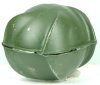 C-BLU-63 or M74.JPG72.7 KB · Views: 163
 -
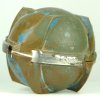 C-BLU-61.jpg82.8 KB · Views: 180
 -
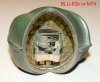 BLU-63b or M74.JPG93.5 KB · Views: 233
 -
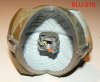 BLU-61b.jpg93.2 KB · Views: 233
 -
 BLU.JPG90.7 KB · Views: 270
Last edited: