Hi All,
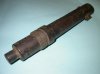
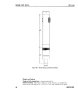
This one looks almost identical - missing some bits....
The markings are fairly corroded but looks like:
"SHALL SLOT T BOMB FUSE M103" (not 100% sure on the numbers)
Is this the same beast or another derivative?
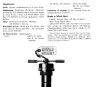
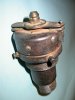
While were on aerial bombs fuses...any thoughts on the other pic?
Thanks
Cheers
Drew
Thank you Yoda!
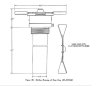
So it the AN-M103 related in any way to the M1A1? I can see similarities with the nose fuse in your posted diagram.
Thanks
Cheers
Drew
Hi Hazord,
Thank you for the clarification - the accompanying chart with the diagram indicated a different series of Mxxx fuses (& not the M103) but the nose fuse itself looked very similar to mine - hence my query.
Cheers
Drew
Good Dronic,
M 103 is the first fuze of a serie. The same fuze can have little difference (evolutins) and receive a new number.
Here the M 103 serie :
M103, AN-M103, AN-M103A1, M139, AN- M139A1, M140, AN-M140A1, M148, M163, M164, M165, M186, & M187.
It's the same system for all the fuzes.
Yoda
Any live or dug ordnance presented by me has been disposed of by EOD technicians.
They used M103 because M102 was already assigned to a different design model of fuze. M103A1 would be an upgraded design based on the original M103.
___HAZ/
_____/ORD Hazardous Ordnance Recognition
________Saving Lives Through Education
Hi All,
Couple more queries re the M103 /AN-M03 / AN-103A1 series bomb fuses............
1) The first drawing below implies that there were 2 types of arming vanes for these fuses - depending if the fuze was used with a "flat-nose depth bomb" or not - is this correct?
If so how were the vanes interchangeable with the fuse? ie Were they "pinned" in place and removal of the pin allowed the vane to be removed?
(The diagram displays two alignment pins on the underside of the vane, which seems to "match" up with the 2 alignment holes on a rotating arm on the central fuze spindle - refer to the photo of my M103 at the start of the this thread - yes the vane is missing in the photo. There also appears to be a pin shaft on the spindle which would "pin" a vane ontop of the fuze)
2) Were the vanes for each model (M103 /AN-M103 /AN-M103A1) the same type? Or did each variation had its own specific matching vane?
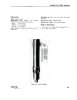
The second attachment indicates the differences between these 3 variations
M103 / AN-M103 >>> The AN-M103 required longer air travel to arm
AN-M103 / AN-M103A1 >>> The AN-M103 had inadequate arming features.
BUT doesn't state if the vanes were the same for all 3 or not....................would one assume they may be?
3) Has anyone a complete M103 to post a couple of pics of the top of the fuse, with and without the vane attached?
Any insight would be greatly appreciated!
Thanks
Cheers
Drew
Just to clarify, your M106 fuze is a short delay fuze, not long delay. Long delay fuzes take hours or days to function. The M106 was designed to delay only long enough for the bomber to get out of range, which was just a few seconds.
___HAZ/
_____/ORD Hazardous Ordnance Recognition
________Saving Lives Through Education
Dronic69 (4th April 2012)
Hi Hazord,
Thanks for the clarification re the M106.
Perhaps I "waffled on" re the M103 prior post.......
In a nutshell, would a AN-M103 vane fit a M103 fuse????
Anyone knows?
Also what was the production run of the earlier M103? - it seemed to be obsolete by WW2........
Thanks
Cheers
Drew
Bookmarks