What's new
British Ordnance Collectors Network

This is a sample guest message. Register a free account today to become a member! Once signed in, you'll be able to participate on this site by adding your own topics and posts, as well as connect with other members through your own private inbox!

British 12 Pounder projectile, weight 6 pounds!

Vasco Da Gama

Well-Known Member
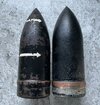
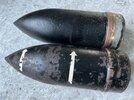
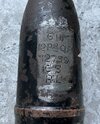
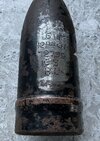
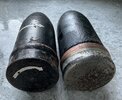
This projectile turned up recently, show alongside a projectile for the British 12 Pdr 12 Cwt naval gun. On picking it up it was obviously much lighter than 12 pounds, it actually weighs only 6 pounds. I am also unfamiliar with the paint markings, the arrow in white painted on the base and twice on the body. The paint appears to be original if a little tired. I decided to clean the area around the stamped markings and you will note the gun designation of 12 Pounder, but with a 6Lb weight making above it! As the 12 Pounder was usually a separate loading weapon I am further surprised with the stampings being on the side, normally a place used in fixed ammunition.
Any thoughts or explanations welcome!
 

Attachments

  • IMG_0931.jpeg
    IMG_0931.jpeg
    3.7 MB · Views: 50
  • IMG_0932.jpeg
    IMG_0932.jpeg
    3.5 MB · Views: 50
  • IMG_0933.jpeg
    IMG_0933.jpeg
    4.7 MB · Views: 52
  • IMG_0934.jpeg
    IMG_0934.jpeg
    3.1 MB · Views: 51
  • IMG_0935.jpeg
    IMG_0935.jpeg
    2.7 MB · Views: 53
Dunno.
Don't suppose its one of the versions tried for the Davis gun during the Great War. Hogg and Thurston seem to think that the 12 Pr was separate loading, and that may be so, with a cartridge case giving essentially a QF round. My own Davis gun 12 Pr cases show QF, and my thinking is that if the mass of the shell were to be less than a standard 12 Pr shell, then the mass of the counterweight would be less as well, proportionately. Ditto propellant. And if the shell were to be separately loaded, it might just explain the odd white arrows, wch do seem to be original to the finish.
But Barney is the expert on these guns, perhaps he has a view.
Alan1.
 
Thanks Alan, the recoiless 12pdr did cross my mind, I was hoping to find a date under the paint which would have helped. I will do some research, do you know how the counterweight was achieved? My initial thought was this lighter projectile, plus propellant gas could balance a true 12 pounder projectile. However, why the driving band and pointed nose when a solid lump would do the job, very confused!
 
I clearly did not make myself plain. According to ASDO Drawing 197 of November 1915, the recoil charge for the 2 Pr Davis gun consisted of 2lb 2oz of chilled drop shot and grease, and so far as I am aware the recoil charges for the other calibres were identical, save, of course, for weight. It did incorporate a copper gas check, as would be expected.
And, also so far as I am aware, the gas check/driving band of the shell itself was modified to avoid excessive breech pressure.
Your shell is a true shell in that it is projected out of the muzzle, so retains a gas check/driving band, as would any other shell of that type.
Hence my suggestion of a "light" 12 Pr shell which would require a significantly reduced recoil charge, bearing in mind that the concept of the Davis gun was to get a significant piece of artillery aloft in the flimsy and primitive aeroplanes of the time, and in which overall weight was a very considerable consideration.
But others in this forum are experts in this field, and I hope they will assist.
Alan1.
 
Top