
British Ordnance Collectors Network
You are using an out of date browser. It may not display this or other websites correctly.
You should upgrade or use an alternative browser.
You should upgrade or use an alternative browser.
Contact switch british no XVII sea mine
- Thread starter pzgr40
- Start date

pzgr40
Well-Known Member
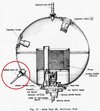
I've looked in wadlow, but I cannot find anything simmilar.
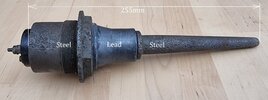
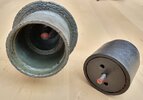
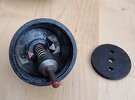
The fuze I have is 225 mm long and has a lead middle part. In this lead part a pin is placed (Pin 1) that pushed downward a pin (pin 2) in the bakelite box. As long as this pin is kept in downward position the wider pat with the chamfered edge will not touch the two contacts (C) closing the electric circuit.
As soon as force is applied to the steel rod, it bends the lead, bending away pin 1, allowing pin 2 to rise and close the electric circuit. It means that it is a "make ' contact, however a seperate electric souce is needed.
As the only mine I can find with a battery is the type XVIII , so, that is a possibillity.
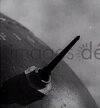
The second switch that could do is with the German GR mine and is called "switch horn". However , the mine has no battery , so it is not clear to me how it would be activated as on top are herzhorns that make current only after the glass ampoule is broken.
Or... does the switch horn have a different function , like rendereing the mine safe if damaged.
The fuze I have is 225 mm long and has a lead middle part. In this lead part a pin is placed (Pin 1) that pushed downward a pin (pin 2) in the bakelite box. As long as this pin is kept in downward position the wider pat with the chamfered edge will not touch the two contacts (C) closing the electric circuit.
As soon as force is applied to the steel rod, it bends the lead, bending away pin 1, allowing pin 2 to rise and close the electric circuit. It means that it is a "make ' contact, however a seperate electric souce is needed.
As the only mine I can find with a battery is the type XVIII , so, that is a possibillity.
The second switch that could do is with the German GR mine and is called "switch horn". However , the mine has no battery , so it is not clear to me how it would be activated as on top are herzhorns that make current only after the glass ampoule is broken.
Or... does the switch horn have a different function , like rendereing the mine safe if damaged.
Attachments
Last edited:
pzgr40
Well-Known Member
Today I learned a trick to seaily determine if a sea mine fuze is German; if the nut part for the spanner is octagonal (not a Hexagon), the fuze is German.
The fuze is definetely for the German GR mine.
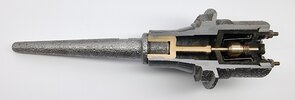
I cut the fuze and it does look quite interesting.
The fuze is definetely for the German GR mine.
I cut the fuze and it does look quite interesting.
Attachments


pzgr40
Well-Known Member
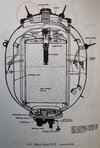
Very interesting. Thanks for posting.Here a drawing of the switch.
Greetings - Antoon
Another fuze for my wish list.