
British Ordnance Collectors Network
You are using an out of date browser. It may not display this or other websites correctly.
You should upgrade or use an alternative browser.
You should upgrade or use an alternative browser.
Cores!
- Thread starter AE501
- Start date
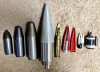

Core blimey mate that's a nice selection......

Are these cores for concern?View attachment 111321
Nice selection.
The one in the red plastic sabot may be DU.
Dave.
8.8zunder44
Member
Anyone here know the situation regarding AP Cores in the UK , seems like a good opportunity to ask
Anyone here know the situation regarding AP Cores in the UK , seems like a good opportunity to ask
Owning cores is fine in the UK, they are after all (usually) just solid pieces of tungsten alloy.
A few things to consider though.
If the core happens to be inside a FMJ small arms projectile then it counts as section 5 ammo so unless you have such a license you can't own it.
If the core is depleted urnanium then you don't really want that in your collection for health reasons (google it, there's loads of discussion regarding the toxic metal and radiation aspects of DU).
Dave.
At the time of the Trial involving Rounds 30mm MPDS, in the late 1980s, no DU was used in their construction. These were made of a Tungsten Alloy.
One of the other calibres involved in the Trial was made of a DU Alloy.
The Basic Body Colour (BBC) and markings are those of the country that made the projectile, in accordance with STANAG 3231 and AOP 2, and denote Armour Piercing solid, that is to say, no explosive content or tracer.
One of the other calibres involved in the Trial was made of a DU Alloy.
The Basic Body Colour (BBC) and markings are those of the country that made the projectile, in accordance with STANAG 3231 and AOP 2, and denote Armour Piercing solid, that is to say, no explosive content or tracer.
Last edited:
At the time of the Trial involving Rounds 30mm MPDS, in the late 1980s, no DU was used in their construction. These were made of a Tungsten Alloy.
One of the other calibres involved in the Trial was made of a DU Alloy.
Thanks for the info on the MPDS.
Which of the calibres in the trial was made of DU Alloy?
Dave.
27MMNUTTER42
Active Member
I've got one of those FMPDS projectiles , how would I go about removing the core ? 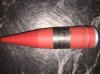
There are three equi-spaced vertical fracture lines in the sabot.
If you do not care about the sabot you can hit it with a hammer, rotating it until you find a weakness line at which time it should crack. There are three weakness lines.
Otherwise, look round the base rim and you should see a vertical nick. This is a weakness line. I did my section by running a sharp knife repeatedly along a central line, from the nick, to the tip. When I had a deep groove I got a fairly wide sharp flat head screwdriver and worked it up and down the groove until it started to open and a fracture line appeared round the other side. The plastic is quite brittle. It has to be to fracture on firing, but is retained in place by the bore of the gun, until it leaves the muzzle.
If you do not care about the sabot you can hit it with a hammer, rotating it until you find a weakness line at which time it should crack. There are three weakness lines.
Otherwise, look round the base rim and you should see a vertical nick. This is a weakness line. I did my section by running a sharp knife repeatedly along a central line, from the nick, to the tip. When I had a deep groove I got a fairly wide sharp flat head screwdriver and worked it up and down the groove until it started to open and a fracture line appeared round the other side. The plastic is quite brittle. It has to be to fracture on firing, but is retained in place by the bore of the gun, until it leaves the muzzle.