
As I understand, early colours of German bombs in normal climate were dark grey RAL 7021 dunkelgrau (the same as Panzergrau, much lighter than present RAL 7021) for SC bombs and RAL 6006 feldgrau (aka 3 RAL 840 B2) for e.g. SD and NC bombs. Save for thick walled frag bombs, which were green (allegedly RAL 6028).
From August 1, 1942 the colour of all bombs (except green ones and maybe some NC smoke bombs) was changed to RAL 7027 beigegrau, which is a generally a light (but not very bright) brown colour (say, with a slight shade of khaki) and, again, was also used for painting tanks, this time in Africa. Bombs are described as painted in beigegrau still in July 1944 pages of the L.Dv. 4200.
The problem I have is that many late war bombs documented by photos as well as preserved today in original colours are very bright in appearance, much lighter than the brown RAL 7027, being actually of pale sand colour.
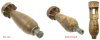
It's shown in the picture below, using small bomblets as examples, but the same colours were used for bigger bombs too - the bomb on the left is of a brownish colour, which seems to fit the RAL 7027 indeed. But two other bombs are of a mysterious bright sand colour.
I just wonder, what colour is this? Was it a new colour introduced officially late in the war, was it a variation of RAL 7027, or an unofficial replacement colour used by manufacturers?
From August 1, 1942 the colour of all bombs (except green ones and maybe some NC smoke bombs) was changed to RAL 7027 beigegrau, which is a generally a light (but not very bright) brown colour (say, with a slight shade of khaki) and, again, was also used for painting tanks, this time in Africa. Bombs are described as painted in beigegrau still in July 1944 pages of the L.Dv. 4200.
The problem I have is that many late war bombs documented by photos as well as preserved today in original colours are very bright in appearance, much lighter than the brown RAL 7027, being actually of pale sand colour.
It's shown in the picture below, using small bomblets as examples, but the same colours were used for bigger bombs too - the bomb on the left is of a brownish colour, which seems to fit the RAL 7027 indeed. But two other bombs are of a mysterious bright sand colour.
I just wonder, what colour is this? Was it a new colour introduced officially late in the war, was it a variation of RAL 7027, or an unofficial replacement colour used by manufacturers?