Join over 14,000 collectors of inert military ordnance. Get expert identification help for shells, fuzes, grenades, and more — plus access our classifieds marketplace and decades of archived knowledge. Free to register, takes seconds.
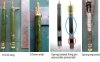
Looking for ID on this one, at first someone thought bklasting cap with shock tube, but shock tube didn't come about until the mid 70's (+/-). Some one thought chemical delay with the ampole being rusted away (wrong size in my opinion) and then someone thought lead sheer delay.
forgot to add, at the bottom is a plastic tube and it appears to be held into the device by a double crimp (that's why they thought shock tube at first), the spring loaded firing pin is facing a primer too
Web, can't see it well since I'm limited to my phone right now, but in the '70's there was a blasting system that used plastic tube that was charged with a gas at the time of the shot to detonate it. It didn't last too long since electric was as if not more reliable and less expensive. Possible that is a cap from that. Cheers, Bruce.
The detonator system that used Hydrogen gas had two tubes that went through the detonator, because the whole system had to be hooked up in series in order to flush the air out of the system, and then fill the tubes with hydrogen and oxygen gas. I have all three pieces of equipment that were used in this system, and some of the inert detonators.
There was a post on blasting cap display boards a few years ago, and some of those caps have been displayed on those boards that were made by the Institute of Makers of Explosives.
In this post, look at the middle of the 6th display board down to see the gas fired detonator:
gas was another thought, but this came from cambodia more then likely during the VN war or just after. If you look at the xray the shape of the firing pin tells me it is designed to hit a percussion primer.
could be it an igniter for a flare or something similiar??
Mike, could it be for an improvised Bangalore? The reason why I ask this is because both the NVA/VC & Pathet Lao used them from time to time as you already know.
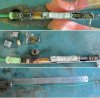
The team in Cambodia who found this item have cut it open. It’s definitely a percussion primer, the total length of the plastic tube is 35cm and it has no coating inside it, so the only purpose that it may serve is to transfer pressure down the tube onto something else. (personally I am not sure about this)
At the end of the plastic tube is the “something else” still a mystery. They are not really sure if there would be enough heat & shock transfer through the inside of this tubing to initiate a flash detonator, but the primer may likely create enough internal pressure to push a stab-type firing pin into some primary explosive compound,.. just a thought and seems like an odd method.
The item at the end of the plastic tube almost looks like a transfer lead you see in shock tube.
These were found in a former Vietnamese depot area which was in use when Vietnam was occupying parts of Cambodia. It is more likely that this item has no relation to the "original" Vietnam war and anything improvised can be excluded (as can be seen the item looks very factory).
As webereod says it looks much like a "flash conveyor" (likely no content in the tube as with shock tubes). Reminds me much of rocket engines which are ignited by the same system where a primer is located elsewhere while the felxible plastic tube reaches into the engine (see the LAW M72 and some Russian systems). This one here seems to have a relation to engineer munitions.
I pretty much agree - a demo item, but getting an actual ID would be great. And of course there is the time frame question. And I agree on't think it was just thought up in some jungle area, was made in a semi factory somewhere, color does tend to lead me to VN stuff
I'd notice the reference to a VN depot in the posting where I first saw it, just the Cambodia location. A lot of networking to help him find the answers going on now.
What leads us to the question if anybody has any info on post "Vietnam War" Vietnamese (made) ammunition in general. Guess this is our main problem as I see questions emerging every now and then and no real answers ever been given.
good point everyone goes after WWI and II stuff, but korea and Vietnam do not get addressed as such. Except for the US stuff like cluster bombs and bomblers, the enemy stuff is wide open for review. Two tours in Vietnam (seems like yesterday) - got lots of photos and lots of manuals and tech reports on NVA/VC stuff - try to stay away from books, most are written by historians and write only to what they read, and alot of what they read only scratched the surface sometimes you need to read 2, 3 or even 4 offical docs to understand. many write saying "here is a VC improvised rifle grenade" or here is a "NVA mine" and when you look close at the items they are talking about the true ordnance guy will see French, Soviet, chinese, Polish etc ordnance with some vietnamese writing on the sides. I saw the same in Central Ameria, Africa and far east - alot of European, Soviet Chinese stuff remarked with the country it was being used in or fired from
Regardless wouold still like to see what this item is
This site uses cookies to help personalise content, tailor your experience and to keep you logged in if you register.
By continuing to use this site, you are consenting to our use of cookies.