

Milan entered into service with the British Army in the late 1970s and was finally declared obsolete in about 2005. It was a second generation wire guided anti-tank missile with a minimum range of 25 metres and a maximum range of about 2000 metres. It replaced the recoilless Battalion Anti-Tank (BAT) series of weapons which had a maximum effective range of about 1000 metres. Its size and firing signature were much reduced compared with the BAT weapons. From 1988 - 1990 I attended various firing camps for this and other missiles and I have a few photos that I have scanned and would like to show.
In brief explanation, a propulsive gas generator (PGG) was integral in the rear of the launch tube and this was separate from the missile. Its purpose was to project the missile from the tube at a speed (about 50 metres per second if I remember correctly) that was fast enough for the missile's rocket motor to take over before the missile could ground. Its secondary purpose was to slow the missile launch tube to a stop about 2 metres behind the firing post. For these reasons the PGG was internally divided into high pressure and low pressure chambers; one to launch the missile; the other to slow the tube to a stop. The photo shows the skeleton of a PGG that was in a launch tube burned by fire.
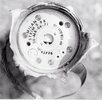
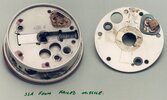
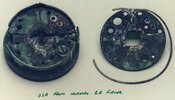
The fuze, known as the safety and arming mechanism (S & A mech), was positioned at the base of the warhead. The rocket motor was in the centre section behind the warhead. Guidance electronics, thermal battery and an infra-red day flare were in the rear section around the rocket motor exhaust tube. A length of circuit tape was glued to the exterior of the motor section, linking the electronics in the rear section with the S & A mech. On impact with something solid, such as a tank, the warhead crush contacts completed a firing circuit that allowed a current to flow from the thermal battery to the detonator (spring loaded sliding shutter type) in the S & A mech, firing the warhead. I was used to seeing the missiles pass through polystyrene sheets cut to tank silhouettes that were encased in wire mesh and run on a narrow gauge track. Often on passing through the target the external wiring was damaged and on hitting the ground behind the target the warhead failed to detonate. In this way one target could be used for a number of firings and the directing staff could determine what type of a hit it had been. I think I only saw it once where the missile hit the target and detonated on the wire mesh. The external circuit tape can be seen hanging off the remains of the missile in the first photo.
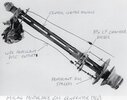
In brief explanation, a propulsive gas generator (PGG) was integral in the rear of the launch tube and this was separate from the missile. Its purpose was to project the missile from the tube at a speed (about 50 metres per second if I remember correctly) that was fast enough for the missile's rocket motor to take over before the missile could ground. Its secondary purpose was to slow the missile launch tube to a stop about 2 metres behind the firing post. For these reasons the PGG was internally divided into high pressure and low pressure chambers; one to launch the missile; the other to slow the tube to a stop. The photo shows the skeleton of a PGG that was in a launch tube burned by fire.
The fuze, known as the safety and arming mechanism (S & A mech), was positioned at the base of the warhead. The rocket motor was in the centre section behind the warhead. Guidance electronics, thermal battery and an infra-red day flare were in the rear section around the rocket motor exhaust tube. A length of circuit tape was glued to the exterior of the motor section, linking the electronics in the rear section with the S & A mech. On impact with something solid, such as a tank, the warhead crush contacts completed a firing circuit that allowed a current to flow from the thermal battery to the detonator (spring loaded sliding shutter type) in the S & A mech, firing the warhead. I was used to seeing the missiles pass through polystyrene sheets cut to tank silhouettes that were encased in wire mesh and run on a narrow gauge track. Often on passing through the target the external wiring was damaged and on hitting the ground behind the target the warhead failed to detonate. In this way one target could be used for a number of firings and the directing staff could determine what type of a hit it had been. I think I only saw it once where the missile hit the target and detonated on the wire mesh. The external circuit tape can be seen hanging off the remains of the missile in the first photo.