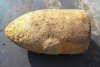
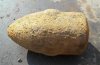
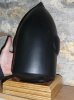
@Yodamaster Sorry for re-awakening a 13-year-old post, but this era of artillery is fascinating to me, and I have the documentation that you asked for!
So it is old and French, but much earlier than the Franco-Prussian War. Looks like it was made around 1854 for the French Navy. I've never actually seen one of these outside of blueprints, so thank you so much for sharing! Crimean War artillery shells are almost nonexistent in the US, so I'm very jealous of this!
The following writing and blueprints come from the "Military commission to Europe in 1855 and 1856"
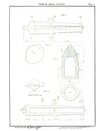
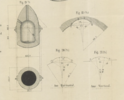
"The system of rifled cannon recently adopted in the French marine appears to have been suggested by the construction of the cylindro-ogival bullet used by the Russians for the two-grooved rifle. This rifle-cannon is made on the model of the 80-pounder bomb cannon (cast-iron) as to exterior dimensions, but is bored to the caliber of a 30-pounder (Plate 5, Fig. 1), corresponding to our 32-pounder; diameter of bore, 6.44 inches; length from base ring to muzzle, eight feet; weight, 8,600 pounds.
The bore is rifled with two circular grooves, 0.44 inch deep, as shown in the section, (Fig. 2

the twist of the grooves is one turn in six meters, (19.68 feet.) The projectile is cylindro-ogival, having on the cylindrical part two projections, in the form of spherical segments, which fit in the grooves of the gun.
The form and dimensions are shown in Fig. 3; weight, fifty-four pounds; windage, 0.08 inch. The shells are cast with the fuze holes down, and with a large sinking head, in order that the conical part may be perfectly sound. With a charge of powder of 7.7 pounds, the range of the shell, at 15° elevation, was said to be 5,000 meters; equal to 5,468 yards. The trials with these guns had proved so satisfactory that a large number of them had been made for the naval service, and were to be seen at Cherbourg in the spring of 1856. Many hands were employed at the same time in reaming the fuze holes of the shells, and cutting the threads in them for screwing in the metal fuze. Several of the new gun-boats were armed with these pieces, and it was understood that the plan would be extensively applied, both for naval and land service.
The spherical protuberance on these shot has the advantage over the longitudinal ribs of Cavalli's system of affording less resistance to the rotary motion of the projectile, and therefore, probably, lessening the drift or lateral deviation; but it may be doubted whether the two points of contact of these protuberances with the grooves will always give the requisite steadiness to the shot in passing out of the bore. The particular arrangement of the fuzes used in these shells is not fully known; they are metal fuzes, screwed into the apex of the shell, and closed on the exterior, so that the explosion depends on the impact of the shell against some firmly- resisting body. If the rifle motion is given to a shell, and the point of impact thus ascertained,there is no difficulty in arranging a concussion fuze, so that the shell shall explode immediately, or at a certain short interval, after striking a solid object, such as a bank of earth or the side of a ship. A very simple contrivance for this purpose was used with success in the experiments before mentioned, which were made at Fort Monroe Arsenal, under General Talcott's direction. This incidental advantage, and the increased range and capacity of elongated projectiles, (which can be fired with effect only from rifled guns,) make it desirable that experiments should be continued with such guns, with a view to remove the practical difficulties heretofore encountered in the service of the piece, and the accuracy of direction of the shot."