Join over 14,000 collectors of inert military ordnance. Get expert identification help for shells, fuzes, grenades, and more — plus access our classifieds marketplace and decades of archived knowledge. Free to register, takes seconds.
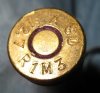
Based on this I did some further reading/digging. In the South African section of the 2012 edition of .50 BMG Cartridges (12.7 x 99mm) by Ron C. Fuchs and Ron J. Fuchs, they show 8 pages of .50 headstamps with the ‘A’ in the headstamp (i.e. PMP production). The ‘A’ designation in the headstamp replaced the ‘PMP’ in the headstamp starting in 1973. In addition starting with the 1973 headstamp was the new term/designation R1.M1 or R1M1 (example headstamp: A 73 12.7 R1M1). This was used through 1979 in headstamps; in the 1980 ‘R1M1’ was replaced by ‘R1M3’ in the headstamp (example headstamp: A 80 12.7 R1M3).
Only cartridges with a ball bullet have the R1M1 or R1M3 alone in the headstamp and ball loadings have a purple primer annulus.
Also from information provided in .50 BMG Cartridges, tracer loadings have a ‘G’ added to the headstamp, example: A74 12.7 G.R1.M1 (red primer annulus) until 1980 when the 'R1M1' was replace with 'R1M2' in the headstamp.
API loadings have ‘WB’ added to the headstamp, example: A 78 12.7 WB.R1.M1 (green primer annulus) until 1980 when the 'R1M1' was also replaced with 'R1M2' in the headstamp.
I’m guessing there was a modification of the .50 BMG bullet in 1979 – 1980 resulting in the new headstamp designations in 1980.
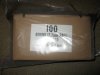
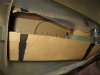
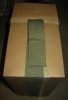
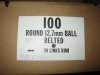
And since we're on the topic, here's the box it came in. Not a REAL ammo can. Thin cardboard (single ply), perforated tear strip, cloth carry strap all wrapped in a sealed plastic bag. I guess I'll save it with the rest of the cans and crates laying around here, as it might be rare in years to come, considering they're thrown away most of the time.
The R1M3 is a ball of the 3rd model.
Since 1983 they dropped the letters and use only the figures so the R1M3 is a 13 since then but the "R" designations were not all that well sorted like the post 1983 designations.
Post 1983: the first digit gives the projectile type like ball (1), tracer (2), API (3), Spotter Tracer (6), blank (4), grenade blank (5) etc. and the second digit gives the modification.
The early South African nomenclature was a variation on the NATO system (American M1A1, British L1A1 etc), whereby they allocated R1M1 to the first version of each store with an identifying character for that type of ammunition (e.g. G R1M1)
South Africa still used the old British identifying characters, so "G" is Tracer, "WB" is API (based on "W" for AP and "B" for incendiary), "L" is blank etc. They also continued with the British colour codes for primer annuli, red for tracer, green for AP etc.
As EOD says, post 1983 they changed and allocated a separate "R" number to each type.
The "A" in the headstamp stands for "Armscorp", the privatised name for PMP.
This site uses cookies to help personalise content, tailor your experience and to keep you logged in if you register.
By continuing to use this site, you are consenting to our use of cookies.