What's new
British Ordnance Collectors Network

This is a sample guest message. Register a free account today to become a member! Once signed in, you'll be able to participate on this site by adding your own topics and posts, as well as connect with other members through your own private inbox!

26 cm projectile

Nabob

Well-Known Member
Ordnance approved
Hello, Today I am looking for your help..again.
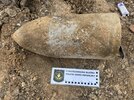
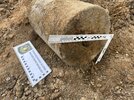
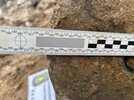
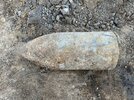
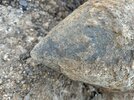
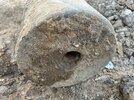
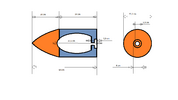
Please see attached pictures and a diagram.
I have a theory, but I do not misguide your thoughts.

Thanks, Bob.
 

Attachments

  • IMG_2445.JPG
    IMG_2445.JPG
    8.1 MB · Views: 87
  • IMG_2446.JPG
    IMG_2446.JPG
    5.9 MB · Views: 79
  • IMG_2448.JPG
    IMG_2448.JPG
    4.1 MB · Views: 72
  • IMG_2470.JPG
    IMG_2470.JPG
    8.5 MB · Views: 77
  • IMG_2471.JPG
    IMG_2471.JPG
    4.7 MB · Views: 68
  • IMG_2472.JPG
    IMG_2472.JPG
    4.8 MB · Views: 73
  • Rozměry nalezené munice.png
    Rozměry nalezené munice.png
    19.3 KB · Views: 84
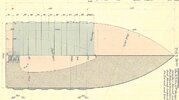
The whole cylindrical part is the driving band. It's a lead coated shell. The Prussian 26 cm C/69 fits very well. Were they used in the Austro-Hungarian Empire as well?

Wall thickness at the thinnest part 63 mm - weight should be impressive.
 

Attachments

  • 30.jpg
    30.jpg
    322.8 KB · Views: 54
1754990368760.png
26cm Ring Kanone L/20 , M 1870 Krupp
Introduction where did that caliber come from and what accompanied it...
According to the design it is a Krupp system and certainly an export version which is not the same as the version introduced in Prussia 26 cm RK L/20 approx. C/1871 (the predecessor of the gun was C/ 1869) introduced in the Prussian army (navy). As you can see on the original Prussian drawing (Alpini) there is a large number of grooves in the lead jacket (rim) which is definitely not on the photo and drawing of the sample (Bob) - therefore in my opinion it is an export license from Krupp for another country.Here for an idea of the naval version of the gun carriage and its location on the SMS Kaiser
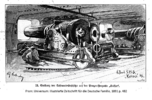
1754991417762.png

among others, another version in the 26cm caliber was demonstrated by Krupp in 1973 in Vienna (trade exhibition) i.e. 26cm (263mm) RK L/22 (projectile weight 184kg, and the shorter version of the projectile had 159kg)
-------------------------------------------------------------------------------------------------------------------------------------------------------------------------------------------------------------------------------------------
Because we have the caliber and dimensions, but we don't have the weight (which is mainly in the technical descriptions, not the shell length...) It will depend a lot on what symbols will be stamped on the body and the rim... if they clean it (and I hope they do), it would still be possible to measure the contents of the black powder chamber using water and a graduated cylinder...)Of course, we have the caliber 255 (254) :)
254mm:
The Krupp company sold production licenses in various calibers, for example 25.4cm (users of this caliber and Krupp license system: Russia, Italy, Japan....According to the smooth (Pb) rim, I am leaning towards the manufacturer: Russia (Obuchovsky plant - bought the license) and traditionally modified (simplified) the ammunition and then they had smooth,,Pb,, rims.Introduced to the Russian army under the designation 10 inch coastal gun. Here it is necessary to search for....
----------------------------------------
Because we have the caliber and dimensions, but we don't have the weight (which is mainly in the technical descriptions, not the bullet length...) It will depend a lot on what symbols will be stamped on the body and rim... if they clean it (and I hope they do), it would still be possible to measure the contents of the black powder chamber using water and a graduated cylinder...)Of course, we have the caliber 255 (254) :)254mm:The Krupp company sold production licenses in various calibers, for example 25.4cm (users of this caliber and Krupp license system: Russia, Italy, ....
Note: Skoda is not yet considered as a license buyer, it is a very old design... the purchase of the Krupp license was much later.

Caliber 26 cm in Austria: The ground forces, i.e. siege and fortress artillery, operated, among others, the Krupp and Armstrong systems, with the Krupp system they had it on among others caliber: 24; 28; 30.5; 42 cm ...

A different situation is the Austrian Navy, there was used the caliber of the ship's cannon 26 cm (not a smooth Pb rim)

The caliber of 254 mm is not as strange as it may seem, but we have to limit according to the design of the ammunition (i.e. Pb shells) that eliminates the construction with a copper rim ... and that will not leave us much if we reject spherical ammunition.Or the design of the projectile is different (mainly the concept, location, material and function of the rim, the only thing in common is the shape of the cavity inside the projectile. (i.e. Armstrong system)

 
Last edited:
Hello,
thanks for all the thoughts.
Alpini excellent picture, thank you!
It was also my line of thought.
The Austrian ship Custoza (sometimes also Custozza) had 8 guns 26 cm L/22 Krupp.
If there are any better pictures, I will post them here.

Best, Bob.
 
The whole cylindrical part is the driving band. It's a lead coated shell. The Prussian 26 cm C/69 fits very well. Were they used in the Austro-Hungarian Empire as well?

Wall thickness at the thinnest part 63 mm - weight should be impressive.

Alpini, what book is that ? Makes me think of something like "... zur kriegsfeuerwerkerei"
Is it available as a pdf ?

Cheers,

S.
 
Further information on the projectile.
It was found next to a +300kg iron ingot in the old foundations of a building in Kladno.
Poldi Kladno was one of the main steel producers since 1889 up to 1990s.

The projectile will not be destroyed :)

Bob
 
I managed to find even more information about this caliber of the Austrian Navy.
In 1874, the Navy's shooting was in Pula.
The cannon was transported from Pula near the shooting range on a pontoon ... then it was transferred by crane.
Therefore, at least 1 piece of the cannon was not built into the ship ... (out of a total of 8 pieces)
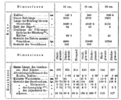
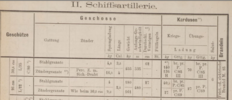
It states that 50 pieces of Z.Gr were prepared, 50 pieces of Ü Gr. (Cast iron, i.e. as a replacement for P.Gr aka Stahlgranate ).It was shot, among other things, up to 1800m.
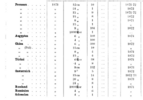
The weight of the powder was verified (it states about 300m / s).It states details about the ammunition.here is a preview:
1755088039640.png
------------------------------------------------------------------------------------------------------
SMS Custoza entered service O2/1875 ...
Akon
 
Last edited:
Hi
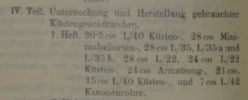
There is a service regulation called: : Instruktion zur untersuchung ,Klassifikation sowie Herstelung genbrauchter und Übernahme neuerzeugter Geschutzrohre . 4 Teil , 1 Heft - 30,5cm Küstenkanonerohre , 26cm Minimalschartenkanonrohre , 25cm Küstenkanonenrohre L/35 , L/22 .... Wien 1913.
So he was: : 26cm Minimalschartenkanon ... ?
Akon
 
26cm Minimalschartenkanon ... never was...
.An error occurred when transcribing the name in secondary sources.
The 26 cm is really not found outside the k.u.k Navy.
The correct name of the regulation is this ... Wien 1913 :
1755261881865.png
Akon
 
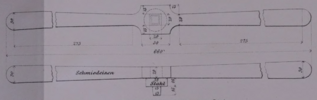
Maybe it will need a key and a plug :)
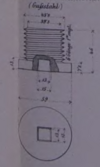
Due to the discrepancy of dimensions on the drawing and on the drawing, I give this drawing.Who has a different opinion here with it ...For Krupp 24cm P.Gr. should be the same as for 26 cm.
The plug for Z.Gr has a different diameter of both the thread and the body.
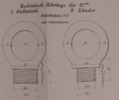
Eye for handling grenades. (24cm Krupp version) in the drawing.


1755439004520.png
1755439023886.png
For manipulation, the eye plug used in the 24cm Krupp is used: for the 26cm, only the one on the left applies
1755439355964.png

Akon
 
May be relevant or not - I am out of my field here - but the uncommon 260mm caliber was used by Schneider in 1915 for foreign esxport production such as the Italian ""Obice da 260 TR" (in the original French: "Obusier de 260 mm T.R. Schneider"), an heavy siege howitzer (or mortar) . Traino Ridotto = version adapted for towing by artillery tractors.
Ansaldo also produced, on the basis of Schneider design (the original Schneider designation was "Mortier Schneider de 260mm de Siege) , a simplified version, the Mortaio da 260/9 Modello 16 Heavy mortar and Siege Gun.
 
Last edited:
Hi Dreamk
These are working hypotheses ... as you write and I add: I completely agree with that.Everything written above and previews of documents is a form of abstract.Until the sample is cleaned (to search for marks) and accurately measured and weighed, we are in the phase of basic research :)I talked to the current "owners", and they plan to donate it to the museum. Although other than the subject of the collection, it has military ammunition as museum funds. Where it will be is irrelevant, it just splits (collections) into lobbying factions and that is wrong.The location of Poldi Kladno (PK ) is confirmed mainly by the place of discovery and by the fact that it produced k.u.k. ammunition, that is for sure.Comparison of the shape and design of the sealing ring is close (not identical) Krupp exported this caliber to several countries in the world.The ground forces were not equipped with such caliber (except mortars). What is important is the fact that PK steel was used to build towers, armor, etc.And now the bad news: the documents are scattered among 3 state institutions. None of them has the documents completely inventoried. So you can't search them except by leafing through them sheet by sheet... the scope is more than 4,000 pieces of cardboard (1855-1930... ) (count on 1,000 sheets in 1 cardboard) plus a collection of drawings which is also extensive and not inventoried.Therefore, another option is to search in KA Wien... my option is not there at the moment. I work on projects of domestic resources.
Akon
 
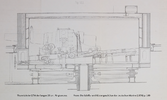
A drawing to give an idea of how the ship's tower was designed in the German Navy for the 26 cm caliber. It is certain that Austria-Hungary had a different design.
Thurmlafette_c_74_der_langen_26cm_Ringkanone.png
 
Top