

Darkman
Well-Known Member
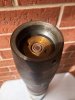
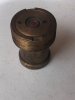
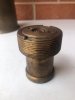
I recently purchased a small collection that included a few gaines. Here in Australia the No. 10 gaine was used under the No. 199 fuze on 3 inch 20 cwt land service AA rounds in WW2.
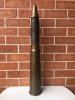
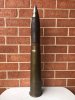
Here’s my 3” 20 cwt round with gaine fitted.
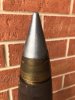
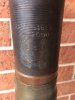
199 fuze made by Munitions Footscray (MF) 8/40. 16lb Mk IIB 3 IN 20 CWT shell made by Australian Glass Manufacturers (stylised AGM), Spotswood, Melbourne in 10/40. No. 10 gaine made by MF 3/41. Cart case made by MSF (Metal & Steel Factory), Ishapore, Calcutta (now known as Ichapur, Kolkata) in 1938. Primer made by MF and filled by ME in 1940. Fuze cover marked ME (Maribyrnong Explosives filling factory) 4/41.
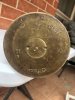
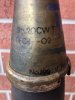
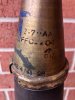
Very interesting to note the different Fuze Factor Corrections (FFC) on the fuze cover for the 199 fuze used on a 3” 20cwt gun compared to a 3.7” gun. The FFC for 3”20 is + .02, but for 3.7” is - .04. These were the corrections applied to the gun fuze setter for a particular batch (lot) of fuzes based on the powder burning time tested at the filling factory. I don’t know why the FFCs would be different if it was based on the batch powder burning time constant.
Graeme
Here’s my 3” 20 cwt round with gaine fitted.
199 fuze made by Munitions Footscray (MF) 8/40. 16lb Mk IIB 3 IN 20 CWT shell made by Australian Glass Manufacturers (stylised AGM), Spotswood, Melbourne in 10/40. No. 10 gaine made by MF 3/41. Cart case made by MSF (Metal & Steel Factory), Ishapore, Calcutta (now known as Ichapur, Kolkata) in 1938. Primer made by MF and filled by ME in 1940. Fuze cover marked ME (Maribyrnong Explosives filling factory) 4/41.
Very interesting to note the different Fuze Factor Corrections (FFC) on the fuze cover for the 199 fuze used on a 3” 20cwt gun compared to a 3.7” gun. The FFC for 3”20 is + .02, but for 3.7” is - .04. These were the corrections applied to the gun fuze setter for a particular batch (lot) of fuzes based on the powder burning time tested at the filling factory. I don’t know why the FFCs would be different if it was based on the batch powder burning time constant.
Graeme
Attachments
Last edited:
