What's new
British Ordnance Collectors Network

This is a sample guest message. Register a free account today to become a member! Once signed in, you'll be able to participate on this site by adding your own topics and posts, as well as connect with other members through your own private inbox!

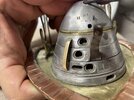
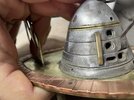
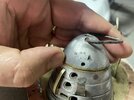
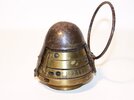
3 discs aluminium mystery fuze

Guns1418

Member
Hi everyone

I cannot say this one fuze 's identification got me sleepless for months, as I only found it to weeks ago on a French auction site. I was confident I would easily find the solution in my pretty extensive documentation, but there are life lessons where you grow up in humility...

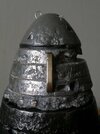
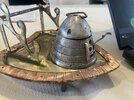
This one has been tranformed in an inkwell in trench art souvenir. The overall style and trench art habit makes me think of a WW1 production.

My initial certitude was coming from what I thought to be a typical British shape and material (aluminium), but once this said I stumbled on the identification very quickly

- Base diameter is around 65 mm,
- Tail thread diameter is about 45 mm
- Three discs design with fume escape holes in each, plus one in the base
- Discs 1 and 3 are entwinned with a brass bridge
- Main material is Aluminium
- There is a hole on the top of the cap
- Graduated disc ranges from 0 to 36.8, step 0.2, there is a cross mark for the percussion behavior
- No markings except the graduations and strange ones on the cap ; 'u' or '11, '=', '*' and some almost erased unreadable marks below
- The 'blade' has been added to lock the inkwell cap opening

I rely on this forum's gentlemen expertise to progress in this enigma !

Regards
IMG_7147.jpeg

IMG_7141.jpeg
IMG_7142.jpeg
IMG_7139.jpeg
 
Hello,
The logo below "二大“ looks like Osaka Arsenal logo to me. And I think "二大“ means the 2nd year of Taisho, which should be 1913.
 
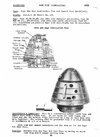
It looks like the Imperial Japanese Army Type 5th Year T&P fuze (three time rings, 0-36.6 seconds), albeit the one shown in the 1945 report (page attached below) is a later version made of brass rather than aluminium.
 

Attachments

  • Type 5th Year IJA.jpg
    Type 5th Year IJA.jpg
    239.8 KB · Views: 16
Last edited:
Thanks a lot Snufkin and DF-41A, the identification of the fuze looks done and clear !

Now the mystery is redirected in other fields : what is a Japanese fuze doing in a WW1 (supposedly) trench art inker found in a flea market in deep France ?

First of all, I have no idea if that fuze was already in use in WW1 (Snufkin's document is WW2), even if the technology involved makes it possible

I looked for some clues.

1. The easiest solution would be this this object is a post-war recomposition er even a modern fake. I do not believe in the latter as when I bought it, it was really corroded and I had to clean it. Moreover, tha fuze tail really fits in the brass base and the bolt system on the rear fixing it doesn't look like a DIY stuff.

2. Another one could be this is a WW2 souvenir, but this period was far less fertile in such things and the style looks really like start of XXth century one. Plus there are about no reason a Pacific war souvenir ends un in a flea market in France

Let's look to the possibilities of a genuine WW1 trench art object.

3. It seems Japan delivered some artillery material to UK and Russia during WW1. I saw on this Forum that Japaneses fuzes can be rarely found on Latvia battlefields or in Poland. Does anyone have more info about this historical fact ? What kind of ammo / guns ? Where was it used ? UK too ?

In that case my object could have been indeed made from a fuze coming from one of the British armies battlefields, not knowing where Japan weapons have been used, by a British soldier or a French soldier old sold / given after war to a French soldier.

Or the artefact is coming from the 1919 period where some allies trrops fought against red armies in Russia

4. Japanese warships helped the allies in the Mediterranean sea during WW1. I have no idea if this fuze was also for naval use. In that case, there has been some contacts between the armies in the harbours that might have induce some exchanges or sales of souvenirs between Japanese, French or British soldiers

Is anyone having some opinion or clue on these psooibilities ?

Best regards
 
Hello!

What you have there is a very interesting piece, with an interesting story.
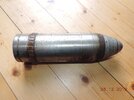
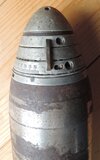
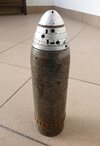
Basically, it is a version of the Taisho 5 (1916) japanese fuze, but made in aluminium and fitted to Russian 76,2mm shrapnel shells.
The japanese Taisho 5 fuzes are a common occurence in areas where the Russians used the japanese 75mm Type 31 (1898) mountain guns and their ammunition. These fuzes are made from brass always. Some people argue that this brass fuze was used also on 76,2mm, but so far there is no evidence of that.

However, what was instead used on the 76,2mm shells was the exact same model of fuze but made completely out of aluminium, just like the example you have. Yours is slightly modified and incorrect - the two brass rings between the top cap and the first ring should be made out of steel (they are circular spring washers) and the tongue coming from the middle ring is also a later addition. Also, the triangular hoop in the top cap is a later addition as well (but i think this was obvious).

Best regards.

Photo sources - internet forums (reibert + others).
 

Attachments

  • 4733314_c.jpg
    4733314_c.jpg
    358.3 KB · Views: 12
  • 4733314_d.jpg
    4733314_d.jpg
    183.5 KB · Views: 13
  • Taisho_4_Szrapnel 75mm Type 90.JPG
    Taisho_4_Szrapnel 75mm Type 90.JPG
    137.8 KB · Views: 12
  • Taisho_6_Szrapnel 75mm Type 90.JPG
    Taisho_6_Szrapnel 75mm Type 90.JPG
    162.1 KB · Views: 13
Thank you so much Irod7

Now the identification is clear and I can understand how that fuze was transformed into a war souvenir by a French soldier, most likely in 1919 qhen some units helped the White Russians

Best regards
 
Top