
British Ordnance Collectors Network
You are using an out of date browser. It may not display this or other websites correctly.
You should upgrade or use an alternative browser.
You should upgrade or use an alternative browser.
3 inch Probert AA projectiles
- Thread starter Gspragge
- Start date
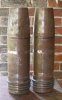

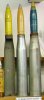
Well that's a casing Ive never seen over here, just projectiles. My projectiles do not have
spiral banding to match the cases so how would this work ? Is thare an earlier MK for 50 cal guns ?
Or are mine U.S. pattern which may be different ?
spiral banding to match the cases so how would this work ? Is thare an earlier MK for 50 cal guns ?
Or are mine U.S. pattern which may be different ?
Last edited:

The U.S. had 3 inch 70 cal guns for a brief period, I believe on aircraft carriers. Casings and projos were available in the early 80's. So they come up now and then.
Gordon, your projectiles don't look U.S. British design front rotating bands are different.
Gordon, your projectiles don't look U.S. British design front rotating bands are different.
Last edited:
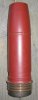
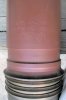
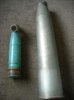
This was a joint British/American project that started in the early 50s. It was used on British Tiger class Cruisers and Canadian Restigouche and Mackenzie class destroyers. Apparently, there is a slight difference between the British and US cases.
That spiral banding is the neck of the case.
TimG
That spiral banding is the neck of the case.
TimG
Last edited:
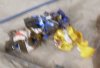
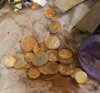
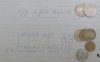
The Hoarde in the projectile ; I know it's not 10,000 gold Roman coins - but
some of it is still good - Not sure about the older Shillings ?
Hopefully some one can enlighten me ~
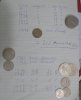
Looking into it I think I have 3pounds 15 pence =$5.64 Cdn ! + older shillings if they can be exchanged ~
Oddly I noticed this stamped around the edge of the one pound coin; PLEIDIOL WYF I'M GWLAD, it's Welsh for
something like this according to a poor translation; "Party I to my Country" , I'm sure that has missed the proper sense of it.
So are these British projectiles ? as I can't see how/why this would have gotten in there over here.
But the wrappers are all Canadian -
I found a marking, Drawing or design number ; KE12B6
The Austrian coins I imagine have been replaced by Euros now.
First old candy wrappers, then this lot fell out ~
some of it is still good - Not sure about the older Shillings ?
Hopefully some one can enlighten me ~
Looking into it I think I have 3pounds 15 pence =$5.64 Cdn ! + older shillings if they can be exchanged ~
Oddly I noticed this stamped around the edge of the one pound coin; PLEIDIOL WYF I'M GWLAD, it's Welsh for
something like this according to a poor translation; "Party I to my Country" , I'm sure that has missed the proper sense of it.
So are these British projectiles ? as I can't see how/why this would have gotten in there over here.
But the wrappers are all Canadian -
I found a marking, Drawing or design number ; KE12B6
The Austrian coins I imagine have been replaced by Euros now.
First old candy wrappers, then this lot fell out ~
Attachments

Last edited:

The two 20p are the only current UK coins you have. The other UK coins have all been replaced by newer designs of different sizes.
Tony Williams
Well-Known Member
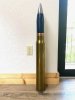
The U.S. had 3 inch 70 cal guns for a brief period, I believe on aircraft carriers.
A few types - see: http://www.navweaps.com/Weapons/WNUS_3-70_mk37.php

As far as I know steel cases were for home service only as there was worry aboout a brass shortage and it was a means to ensure that there was
enough brass cases for overseas use. Steel cases were made in 1943 - But please correct me on this if I am wrong.
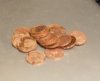
The projectile just keeps giving, these fell out as I was starting to clean the insides of it. A mix of Canadian and American pennies ~
enough brass cases for overseas use. Steel cases were made in 1943 - But please correct me on this if I am wrong.
The projectile just keeps giving, these fell out as I was starting to clean the insides of it. A mix of Canadian and American pennies ~
Attachments
@TimG
Typical large caliber U.S. Navy cases WWII to present are comprised of 40mm L/60 Bofors (Brass and Steel), 3 inch 50 cal (Brass and Steel), 3 inch 70 cal (Steel), 76.2mm Otto Malera (Brass and Steel) 5 inch 38 cal (Brass and Steel), 5 inch 54 cal (Brass and Steel), 6 inch 47 cal (Brass or Powder Bag), and 8 inch 47 cal (Brass or powder bag).
Observations:
40mm Both brass and steel post war. Biggest current user USAF.
3 inch 50 Brass from early 1900's thru WWII. Steel post war.
3 inch 70 Steel only.
76.2mm Otto post WWII. Early cases brass, later cases steel.
5 inch 38 cal Thru WWII brass, steel post war.
5 inch 54 cal scarce from WWII brass, steel post war. Only current Navy Gun. Norris was making steel cases in the late 80's.
6 inch 47 Brass only
8 inch 55 Brass only
Typical large caliber U.S. Navy cases WWII to present are comprised of 40mm L/60 Bofors (Brass and Steel), 3 inch 50 cal (Brass and Steel), 3 inch 70 cal (Steel), 76.2mm Otto Malera (Brass and Steel) 5 inch 38 cal (Brass and Steel), 5 inch 54 cal (Brass and Steel), 6 inch 47 cal (Brass or Powder Bag), and 8 inch 47 cal (Brass or powder bag).
Observations:
40mm Both brass and steel post war. Biggest current user USAF.
3 inch 50 Brass from early 1900's thru WWII. Steel post war.
3 inch 70 Steel only.
76.2mm Otto post WWII. Early cases brass, later cases steel.
5 inch 38 cal Thru WWII brass, steel post war.
5 inch 54 cal scarce from WWII brass, steel post war. Only current Navy Gun. Norris was making steel cases in the late 80's.
6 inch 47 Brass only
8 inch 55 Brass only
Last edited:
@TimG
During WWII, K.T. Norris (Norris Industries), perfected the process for ironing steel cartridge cases, I.E. the steel 3 inch Tank Destroyer case. That's how he made his millions. When I worked there we were making 5 inch 54, 105 tank gun cases, and 76.2mm Otto cases. Norris made a very diverse range of round/rotational ordnance items by forging and ironing, from MLRS rocket motor bodies to the grapefruit size aluminum GB Bomblet bodies.
During WWII, K.T. Norris (Norris Industries), perfected the process for ironing steel cartridge cases, I.E. the steel 3 inch Tank Destroyer case. That's how he made his millions. When I worked there we were making 5 inch 54, 105 tank gun cases, and 76.2mm Otto cases. Norris made a very diverse range of round/rotational ordnance items by forging and ironing, from MLRS rocket motor bodies to the grapefruit size aluminum GB Bomblet bodies.
zenawatson
New Member
hi i know they did a 3.7 probert for the uk aa guns this was a 4.5 case necked down to accept the 3.7 projectile