Join over 14,000 collectors of inert military ordnance. Get expert identification help for shells, fuzes, grenades, and more — plus access our classifieds marketplace and decades of archived knowledge. Free to register, takes seconds.
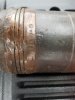
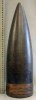
A little more info on this projectile. One of my SLICS purchases, it is approximately 5-inch, but has not been measured yet. I would be more likely to refer to it as a common projectile, but pending identification it could go either way. Any assistance is appreciated.
Joe, US-Subs, I have what appears to the same projectile based on general shape and drive band width and location. I believe it to be US Navy 5 inch Common Mk 15. Check to see if yours is 17.0 inches in height. I will check mine to see if the markings on the drive band are the same or similar. Bill
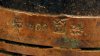
What about the D in the crown? The manufacture code does match US as well, but that D in a crown doesn't look like a stamp I've seen on US stuff before.
The document I used for the ID was "U.S. Explosive Ordnance," OP1664, May28, 1947, which states there several MODS of this projectile, but it doesn't explain the differences between them. For the ID, I relied on the measurements given in OP1664 including the band width of 1.67 inches. The band width on my shell ranges between 1.68 and 1.70 inches as it's been rolled around a bit. I believe I also weighed it when I first got it, but I didn't write that number down. Mine has a height of 17 1/8" as measured with a large caliper.
OP1664 states that this projectile was used in the 5"/50 and 5"/51 guns, both of which date from the early 1900s. The reason I acquired this shell is that it looked early and I have been trying to learn more about WWI era US projectiles.
The stampings on the drive band of mine are almost the same as the two shown in this thread. The two differences are that the beginning and ending horizontal anchors both contain the numerals 28 rather than 24 and the three letters are E.P.F. rather than W.D.C. The D within the crown is the same. My driving band also has a vertical anchor below the stampings. (I know it's time I learn to post photos.)
This site uses cookies to help personalise content, tailor your experience and to keep you logged in if you register.
By continuing to use this site, you are consenting to our use of cookies.