
pzgr40
Well-Known Member
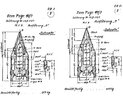
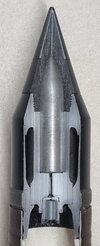
Cutaway of a German WW2 5cm PzGr40/1, the most powerfull of the armour piercing shells available for the 5cm Pak 38. It is the better streamlined follow up of the 5cm PzGr40 arrow shot, which also has the advantage that it used the normal 5cm Pak 38 shellcase and does not need a lengthened neck and a low crimp as with the 5cm PzGr40.
The projectile consists of a two piece steel body, housing a tungsten carbide core. The outer body houses the driving band, the inner body -which is screwed into the outer body- houses the tungsten core, the tracer element No.8, and the plastic nose cap. A thin sheet steel cap is placed over the nose to prevent the fragile nose from breaking.
The 420mm long brass clad steel shellcase is filled with 840 grams Gu Str P tape powder, consisting of strips 310 x10x1mm, and a small linnen bag of 10 grams Nz Man NP. 1,5x1,5 x 0,5 mm rifle powder tied to the base of the center bundle. A small bag with a flash inhibitor is placed on top of the powder charge. A cartboard bushing is placed between the top of the powder charge and the base of the projectile, fixating the powder charge.
Cartridge length : 549,5 mm.
Projectile length : 140 mm.
Projectile dia. : 50 mm.
Projectile weight : 1,07 Kg.
Vo : 1130 mtrs/sec.
Penetration on vertical steel plate:
132 mm @ 100 mtrs.
109 mm @ 300 mtrs.
90 mm @ 500 mtrs.
52 mm @ 1000 mtrs.
As the penetration decreases sharply after 500 mtrs, the projectile was to be used only on distances below 500 mtrs.
As Tungsten was a scarce metal in Germany in WW2, a choice had to be made to use it in cutting tools, drills etc , either -as General Guderain stated- ‘shoot it away over the Russian tundra’. Therefore German armour piercing projectiles using tungsten are scarce, and most often it was replaced by hardened steel, although this decreased penetration.
Penetration Data : WW II Ballistics Tank Gun Penetration - Germany
Regards, DJH
The projectile consists of a two piece steel body, housing a tungsten carbide core. The outer body houses the driving band, the inner body -which is screwed into the outer body- houses the tungsten core, the tracer element No.8, and the plastic nose cap. A thin sheet steel cap is placed over the nose to prevent the fragile nose from breaking.
The 420mm long brass clad steel shellcase is filled with 840 grams Gu Str P tape powder, consisting of strips 310 x10x1mm, and a small linnen bag of 10 grams Nz Man NP. 1,5x1,5 x 0,5 mm rifle powder tied to the base of the center bundle. A small bag with a flash inhibitor is placed on top of the powder charge. A cartboard bushing is placed between the top of the powder charge and the base of the projectile, fixating the powder charge.
Cartridge length : 549,5 mm.
Projectile length : 140 mm.
Projectile dia. : 50 mm.
Projectile weight : 1,07 Kg.
Vo : 1130 mtrs/sec.
Penetration on vertical steel plate:
132 mm @ 100 mtrs.
109 mm @ 300 mtrs.
90 mm @ 500 mtrs.
52 mm @ 1000 mtrs.
As the penetration decreases sharply after 500 mtrs, the projectile was to be used only on distances below 500 mtrs.
As Tungsten was a scarce metal in Germany in WW2, a choice had to be made to use it in cutting tools, drills etc , either -as General Guderain stated- ‘shoot it away over the Russian tundra’. Therefore German armour piercing projectiles using tungsten are scarce, and most often it was replaced by hardened steel, although this decreased penetration.
Penetration Data : WW II Ballistics Tank Gun Penetration - Germany
Regards, DJH
Attachments


Last edited: