
pzgr40
Well-Known Member
Purpose:
Anti personel rifle grenade
Construction:
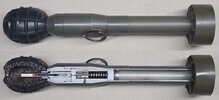
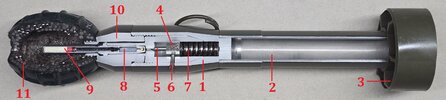
The 6cm Spreng- gewehrgranate consists of an aluminium fuze body (1) with an aluminium tail pipe (2). The ring shaped tail (3) is made from green soft PVC. Inside the fuze body a steel hexagon inertia weight (4) is placed with the upper part acting as the firing pin (5). In safe position the inertia weight is fixated by a split pin (6) stuck through the fuze body and the inertia weight of the firing pin. Below the inertia weight of the firing pin an -untensioned- pressure spring (7) is placed. In top of the fuze body a grenade type pyrotechnic delay fuze (8) with a delay of between 3,5 to 5,5 seconds is screwed with a detonator (9) on top. An aluminium chamfered intermediate piece (10) is placed between the fuze housing and the Arges 73 grenade (11) in top.
The Arges 73 grenade consists of an inner tranparant plastic cast with cast in approximatel 2600 pcs of 2,8 mm hardened steel balls. A soft PVC skin with grip rings is cast over the inner cast. The grenade body is filled with 40 grams of PETN. The lethal radius is 20 metres.
Function:
Before firing, the grenade is placed over the standard 22mm spigot/adapter on the end of the barrel of a rifle, and the propulsion cartridge is chambered. Before firing, the split pin is removed. Upon firing, the inertia weight of the firing pin moves backward, tensioning the pressure spring. When the acceleration stops, the spring launches the firing pin into the firing cap of the pyrotechnic delay fuze, igniting the pyrotechnic delay fuse. After time has expired, the detonator is activated, detonating the Arges-73 grenade. If the firing pin does not hit the firing cap with enough force after launc, the firing pin is swung forward upon impact, igniting the pyrotchnic delay.
Complete length : 300 mm.
Length grenade body Argos 73 grenade : 62 mm
Diameter grenade body : 55 mm
Diameter fuze body : 35 mm
Diameter tail tube : 27 mm
Tail diameter : 60 mm
Anti personel rifle grenade
Construction:
The 6cm Spreng- gewehrgranate consists of an aluminium fuze body (1) with an aluminium tail pipe (2). The ring shaped tail (3) is made from green soft PVC. Inside the fuze body a steel hexagon inertia weight (4) is placed with the upper part acting as the firing pin (5). In safe position the inertia weight is fixated by a split pin (6) stuck through the fuze body and the inertia weight of the firing pin. Below the inertia weight of the firing pin an -untensioned- pressure spring (7) is placed. In top of the fuze body a grenade type pyrotechnic delay fuze (8) with a delay of between 3,5 to 5,5 seconds is screwed with a detonator (9) on top. An aluminium chamfered intermediate piece (10) is placed between the fuze housing and the Arges 73 grenade (11) in top.
The Arges 73 grenade consists of an inner tranparant plastic cast with cast in approximatel 2600 pcs of 2,8 mm hardened steel balls. A soft PVC skin with grip rings is cast over the inner cast. The grenade body is filled with 40 grams of PETN. The lethal radius is 20 metres.
Function:
Before firing, the grenade is placed over the standard 22mm spigot/adapter on the end of the barrel of a rifle, and the propulsion cartridge is chambered. Before firing, the split pin is removed. Upon firing, the inertia weight of the firing pin moves backward, tensioning the pressure spring. When the acceleration stops, the spring launches the firing pin into the firing cap of the pyrotechnic delay fuze, igniting the pyrotechnic delay fuse. After time has expired, the detonator is activated, detonating the Arges-73 grenade. If the firing pin does not hit the firing cap with enough force after launc, the firing pin is swung forward upon impact, igniting the pyrotchnic delay.
Complete length : 300 mm.
Length grenade body Argos 73 grenade : 62 mm
Diameter grenade body : 55 mm
Diameter fuze body : 35 mm
Diameter tail tube : 27 mm
Tail diameter : 60 mm