
British Ordnance Collectors Network
You are using an out of date browser. It may not display this or other websites correctly.
You should upgrade or use an alternative browser.
You should upgrade or use an alternative browser.
6mm X 45 SAW
- Thread starter SpudGun
- Start date



Tony Williams
Well-Known Member
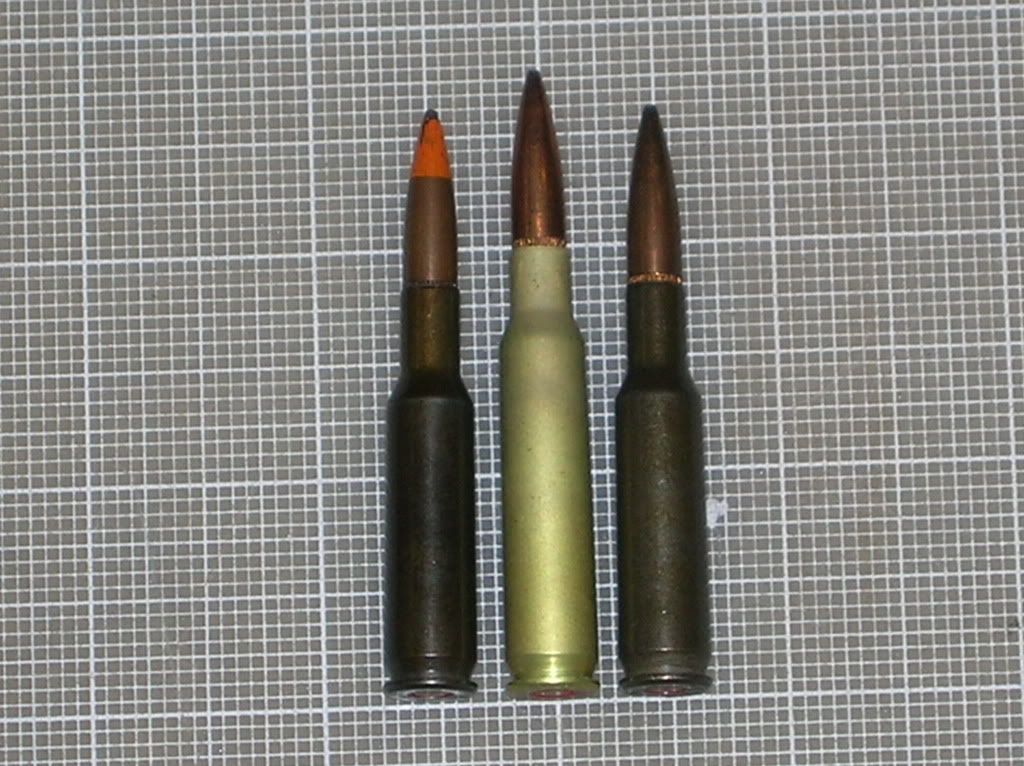
As you can see from the photos, the 6x50 used an aluminium-alloy case instead of a steel one. The reason for it being longer is that, aluminium being inflammable, it is necessary to line the inside of the case with a fireproof liner to prevent "burn through". This uses up propellant space so the case was made longer to compensate.
No-one has been able to make a success of light-alloy cases for small-arms ammo, despite constant efforts which are still going on today. This is rather curious since aluminium-cased 30x173 ammo for the GAU-8/A and 30x113B for the M230 Chain Gun has been in service for decades with no problems that I am aware of.
No-one has been able to make a success of light-alloy cases for small-arms ammo, despite constant efforts which are still going on today. This is rather curious since aluminium-cased 30x173 ammo for the GAU-8/A and 30x113B for the M230 Chain Gun has been in service for decades with no problems that I am aware of.

TonyE
HONOURED MEMBER RIP
The evolution of the 6mm SAW is interesting. Whilst it may be a coincidence, I am not convincd that the origins of the round were not based on earlier British work.
Collectors of British SAA will be familiar with the 6.25x45 experimental round of 1969-70 which was a .280/30 case necked to 6.25mm. This was however only an ballistic vehicle to verify performance with a range of 6.25mm bullets. (For ECRA members see my recent article in the Journal)
The proposed 6.25mm round was in fact a 6.25x46mm with a much slimmer case. In about 1968 the ballistics lab at RSAF Enfield had produced a series of optimised case designs for a range of calibres, 4.5x34mm, 5.0x38mm, 6.0x45mm, 6.25x46mm and 6.5x47mm. All were produced as turned aluminium or brass mock-ups but none were actually produced as actual rounds. Of these, the 6.25mm was deemed to show most promise and that led to the 6.25x45mm ballistic vehicle.
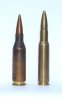
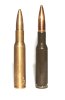
Now to the point of my post. The first picture shows the 6.25x45 compared to the mock-up of the 6.25x46mm proposal, whilst the second shows the mock-up compared with the SAW.
The case rests, m'Lord.
Regards
TonyE
Collectors of British SAA will be familiar with the 6.25x45 experimental round of 1969-70 which was a .280/30 case necked to 6.25mm. This was however only an ballistic vehicle to verify performance with a range of 6.25mm bullets. (For ECRA members see my recent article in the Journal)
The proposed 6.25mm round was in fact a 6.25x46mm with a much slimmer case. In about 1968 the ballistics lab at RSAF Enfield had produced a series of optimised case designs for a range of calibres, 4.5x34mm, 5.0x38mm, 6.0x45mm, 6.25x46mm and 6.5x47mm. All were produced as turned aluminium or brass mock-ups but none were actually produced as actual rounds. Of these, the 6.25mm was deemed to show most promise and that led to the 6.25x45mm ballistic vehicle.
Now to the point of my post. The first picture shows the 6.25x45 compared to the mock-up of the 6.25x46mm proposal, whilst the second shows the mock-up compared with the SAW.
The case rests, m'Lord.
Regards
TonyE
Attachments
Tony
Coincidence? Possibly. Likely? Probably not.
The SAW cartridge development at Frankford Arsenal beginning in 1971 was the first use of a computerized design analysis. The output was based on the input, obviously, but as far as I know there was no pre-conceived design or parent case. Design parameters included such things as bullet weight, bullet length, barrel length, muzzle velocity, chamber pressure, basic case dimensions, weapon system, etc. The resulting recommendations were developed into basic case designs that were tested. Four basic cases were fabricated and tested, the final iteration being the 6MM SAW as we know it today.
It’s interesting that, in the end, everything gave way to the practical realities of the real world. The current SAW weapon is chambered for the 5.56 x 45mm NATO cartridge.
Ray
Coincidence? Possibly. Likely? Probably not.
The SAW cartridge development at Frankford Arsenal beginning in 1971 was the first use of a computerized design analysis. The output was based on the input, obviously, but as far as I know there was no pre-conceived design or parent case. Design parameters included such things as bullet weight, bullet length, barrel length, muzzle velocity, chamber pressure, basic case dimensions, weapon system, etc. The resulting recommendations were developed into basic case designs that were tested. Four basic cases were fabricated and tested, the final iteration being the 6MM SAW as we know it today.
It’s interesting that, in the end, everything gave way to the practical realities of the real world. The current SAW weapon is chambered for the 5.56 x 45mm NATO cartridge.
Ray
Last edited:
TonyE
HONOURED MEMBER RIP
You are probably right Ray, but it is odd that the British work took place in 1969/70 and the SAW development started in 1971. The answer probably is that like so many other things, if the same problem is studied by similar groups of people, similar answers are found!
Regards
TonyE
Regards
TonyE
"Design parameters included such things as bullet weight, bullet length, barrel length, muzzle velocity, chamber pressure, basic case dimensions, weapon system, etc. The resulting recommendations..."
Well, where did all this stuff come from? Perhaps someone at FA had access to British testing info and had a "why-try-to-re-invent-the-wheel?" moment.
Well, where did all this stuff come from? Perhaps someone at FA had access to British testing info and had a "why-try-to-re-invent-the-wheel?" moment.
That is a very real possibility jonnyc. Feeding a computer with selected and/or slanted input didn't start with Algore and Global Warming. It's been around since the beginning. The 6MM SAW cartridge could have been the product of GIGO. But, I haven't seen anything that would indicate such. So, I am comforatble that Frankford Arsenal had enough experience in ammunition design that the results were as impartial as they could be.
JMHO
Ray
JMHO
Ray