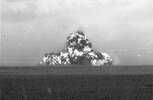
Propagation Trials.
9 B.A.D. (Base Ammunition Depot) Abu Sultan, Egypt. This was a very large British ammunition depot based at the head of the Great Bitter Lake. Abu Sultan
The depot covered about twenty seven square miles and the perimeter took about 45 minutes to drive around the inside perimeter in a Bren Gun Carrier. The depot also contained an R.N.A.D. Royal Naval Armaments Depot and 128 M.U. (Maintenance Unit) which is the RAF equivalent of an ammunition depot. The latter was for supplying the nearby RAF Deversoir. The latter purpose of 9 B.A.D. was that of being the principal source of ordnance for the Suez Canal Garrison, which in the mid 50s numbered about 80K troops – greater than the entire strength of todays British Army.
In the early fifties the British government took the decision to relinquish their presence in Egypt and hand back control to the Egyptians. In about ’55 it was decided to close the depot and as it was uneconomical to ship the stores back to the UK or elsewhere the decision was taken to destroy the stores. The depot was a veritable Aladin’s Cave and held all manner of stores that it shouldn’t really have had. One such example was that it held vast quantities of 18Pr Shrapnel, so great was the quantity that the powers that be directed they broken down to salvage the bullets, (that’s another story and I’ll have to check with Spotter).
The closure of the depot had come to the attention of the E.S.T.C. (Explosive Storage Transport Committee), which as the name suggests was responsible for the regulations regarding storage and transportation of explosives. Most, if not all of their safety distances for storage were based on educated guesses. They saw this as an ideal opportunity to do some experimentation to get accurate data. The staff at the depot was duly tasked to carry out experiments for the E.S.T.C. The experiments were to determine the safe distance for stacks of explosive ordnance in the event of a mass explosion of one stack.
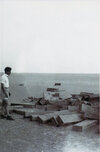
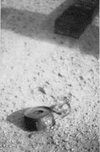
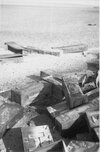
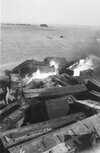
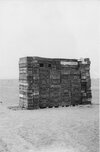
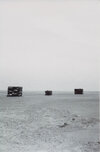
The method employed was to construct a 10 ton stack of anti-tank mines, this being most likely maximum quantity stored in the open. The Mine, A/Tk Mk V HC was chosen as it had one of the highest charge to weight ratios (~65%) of current Land Service stores. A second stack was constructed nearby and the primary stack detonated and the effect on the secondary stack noted. This was repeated with the distance being reduced until the second stack detonated.
A later variation was subjecting a stack of mines to intense fragmentation. For this the 5.5” HE shell was selected. These proved most reluctant to detonate en-masse. The solution chosen was to have the depot workshop drill a hole in the transit plugs. Det’ cord was passed through the hole. Alternate shells were so treated and the det’ cord lengths commoned together. That’s about 274 shells. Notwithstanding this arrangement it was wasn’t uncommon to find long lengths of 5.5” shell that had been completely crushed by the detonation of the adjacent shells.
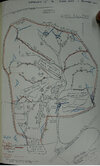
Map of 9 B.A.D.
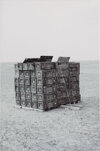
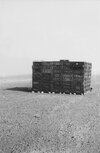
Primary stacks
Secondary stack
Stack arrangement.
9 B.A.D. (Base Ammunition Depot) Abu Sultan, Egypt. This was a very large British ammunition depot based at the head of the Great Bitter Lake. Abu Sultan
The depot covered about twenty seven square miles and the perimeter took about 45 minutes to drive around the inside perimeter in a Bren Gun Carrier. The depot also contained an R.N.A.D. Royal Naval Armaments Depot and 128 M.U. (Maintenance Unit) which is the RAF equivalent of an ammunition depot. The latter was for supplying the nearby RAF Deversoir. The latter purpose of 9 B.A.D. was that of being the principal source of ordnance for the Suez Canal Garrison, which in the mid 50s numbered about 80K troops – greater than the entire strength of todays British Army.
In the early fifties the British government took the decision to relinquish their presence in Egypt and hand back control to the Egyptians. In about ’55 it was decided to close the depot and as it was uneconomical to ship the stores back to the UK or elsewhere the decision was taken to destroy the stores. The depot was a veritable Aladin’s Cave and held all manner of stores that it shouldn’t really have had. One such example was that it held vast quantities of 18Pr Shrapnel, so great was the quantity that the powers that be directed they broken down to salvage the bullets, (that’s another story and I’ll have to check with Spotter).
The closure of the depot had come to the attention of the E.S.T.C. (Explosive Storage Transport Committee), which as the name suggests was responsible for the regulations regarding storage and transportation of explosives. Most, if not all of their safety distances for storage were based on educated guesses. They saw this as an ideal opportunity to do some experimentation to get accurate data. The staff at the depot was duly tasked to carry out experiments for the E.S.T.C. The experiments were to determine the safe distance for stacks of explosive ordnance in the event of a mass explosion of one stack.
The method employed was to construct a 10 ton stack of anti-tank mines, this being most likely maximum quantity stored in the open. The Mine, A/Tk Mk V HC was chosen as it had one of the highest charge to weight ratios (~65%) of current Land Service stores. A second stack was constructed nearby and the primary stack detonated and the effect on the secondary stack noted. This was repeated with the distance being reduced until the second stack detonated.
A later variation was subjecting a stack of mines to intense fragmentation. For this the 5.5” HE shell was selected. These proved most reluctant to detonate en-masse. The solution chosen was to have the depot workshop drill a hole in the transit plugs. Det’ cord was passed through the hole. Alternate shells were so treated and the det’ cord lengths commoned together. That’s about 274 shells. Notwithstanding this arrangement it was wasn’t uncommon to find long lengths of 5.5” shell that had been completely crushed by the detonation of the adjacent shells.
Map of 9 B.A.D.
Primary stacks
Secondary stack
Stack arrangement.
Last edited: