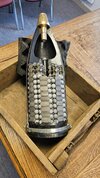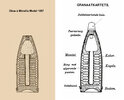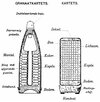
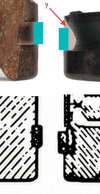
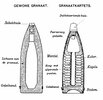
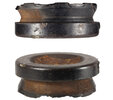
I recently acquired the base of a Boer War 155 mm Creusot "Long Tom" shrapnel shell and am trying to understand how the driving band was attached. The groove to take the band has an unusual, overly deep angled profile, which differs significantly from that on the common shell. A very poor reproduction of the diagram of the two types of projectile included in the handbook for the gun shows that the driving bands are identical, and that the additional space behind the band on the shrapnel shell is filled with an unidentified material.
Does anyone here know what that material was and how the driving band was fixed to the shell? Also, was this system unique to Creusot projectiles?
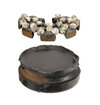
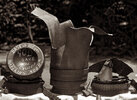
The final photograph below depicts five Creusot shrapnel shell bases. The one on the right shows the driving band detached, giving a partial view of the space behind it, which appears to be a void. Clearly this can't have been the case when the shell was fired.
Does anyone here know what that material was and how the driving band was fixed to the shell? Also, was this system unique to Creusot projectiles?
The final photograph below depicts five Creusot shrapnel shell bases. The one on the right shows the driving band detached, giving a partial view of the space behind it, which appears to be a void. Clearly this can't have been the case when the shell was fired.