
British Ordnance Collectors Network
You are using an out of date browser. It may not display this or other websites correctly.
You should upgrade or use an alternative browser.
You should upgrade or use an alternative browser.
Austro-Hungarian 21cm projectile
- Thread starter bombasz
- Start date
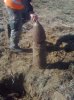



Can you give us the dimensions of your shell ?
Yoda
Yoda
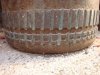
If the diameter of the shell is effectively 24 cm, it's very similar (to see the two driving bands) on the 24 cm Spgr L/4,1 m. Haube ! But,....... not evident !
Yoda
Yoda
Sorry, correction,
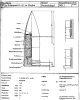
I've found it, it's not a Spgr shell, it's the 24 cm Schrapnell L/4,1 m. Haube with DoppZ 16 fuze.
I shall post picture tomorrow.
Yoda
I've found it, it's not a Spgr shell, it's the 24 cm Schrapnell L/4,1 m. Haube with DoppZ 16 fuze.
I shall post picture tomorrow.
Yoda
Hi,
construciont seems austrian, other GS was made in this way.
I never seen this kind of ammo on austrian 21cm...
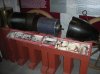
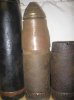
here a 10.5cm M14T GS, and a 30,5cm GS
that's exactly my opinion!
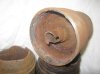
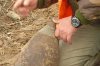
@Yoda: german WW1 naval shell on Gyr firing range? And compare the size of the fuze, it is larger than his hand, that a austro hungarian "Granatschrapnellznder".
Last edited:
Here the doc I promised.
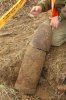
With only three pictures is it difficult to make a correct ID.
The 24cm Schrap L/4.1 is the most similar that I can see. That's the reason why I asked measurements.
Austro-Hungarians have used various german ammunitions (shells and fuzes). It's very possible that they have tested them on this range... or used in activity !
I hope the doc will be readable !
Yoda
With only three pictures is it difficult to make a correct ID.
The 24cm Schrap L/4.1 is the most similar that I can see. That's the reason why I asked measurements.
Austro-Hungarians have used various german ammunitions (shells and fuzes). It's very possible that they have tested them on this range... or used in activity !
I hope the doc will be readable !
Yoda
Attachments
Last edited:
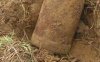
HI Bombas,
it's much likely a Granatschrapnell (shrapnell with high explosive head part). Did you meassure exact diameter? And also counting the number of grooves in the drivingband can help to identify the gun.
Such austrian Granatschrapnells are known in calibres 7,5 cm, 8 cm, 9 cm, 10 cm, 12 cm, 15 cm, 30,5 cm, and 38 cm but not jet in 21 cm. But the documents are incomplete and on Gyr firing range also trials are much possible. Most large austro-hungarian guns were tested on Gyr range.
it's much likely a Granatschrapnell (shrapnell with high explosive head part). Did you meassure exact diameter? And also counting the number of grooves in the drivingband can help to identify the gun.
Such austrian Granatschrapnells are known in calibres 7,5 cm, 8 cm, 9 cm, 10 cm, 12 cm, 15 cm, 30,5 cm, and 38 cm but not jet in 21 cm. But the documents are incomplete and on Gyr firing range also trials are much possible. Most large austro-hungarian guns were tested on Gyr range.
Last edited: