What's new
British Ordnance Collectors Network

Join over 14,000 collectors of inert military ordnance. Get expert identification help for shells, fuzes, grenades, and more — plus access our classifieds marketplace and decades of archived knowledge. Free to register, takes seconds.

British 12 Pounder projectile, weight 6 pounds!

Vasco Da Gama

Well-Known Member
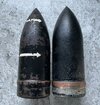
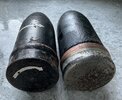
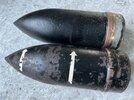
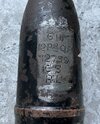
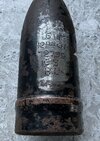
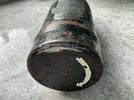
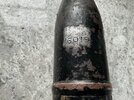
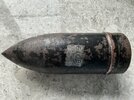
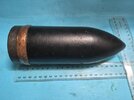
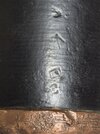
This projectile turned up recently, show alongside a projectile for the British 12 Pdr 12 Cwt naval gun. On picking it up it was obviously much lighter than 12 pounds, it actually weighs only 6 pounds. I am also unfamiliar with the paint markings, the arrow in white painted on the base and twice on the body. The paint appears to be original if a little tired. I decided to clean the area around the stamped markings and you will note the gun designation of 12 Pounder, but with a 6Lb weight making above it! As the 12 Pounder was usually a separate loading weapon I am further surprised with the stampings being on the side, normally a place used in fixed ammunition.
Any thoughts or explanations welcome!
 

Attachments

  • IMG_0931.jpeg
    IMG_0931.jpeg
    3.7 MB · Views: 92
  • IMG_0932.jpeg
    IMG_0932.jpeg
    3.5 MB · Views: 91
  • IMG_0933.jpeg
    IMG_0933.jpeg
    4.7 MB · Views: 101
  • IMG_0934.jpeg
    IMG_0934.jpeg
    3.1 MB · Views: 96
  • IMG_0935.jpeg
    IMG_0935.jpeg
    2.7 MB · Views: 100
Dunno.
Don't suppose its one of the versions tried for the Davis gun during the Great War. Hogg and Thurston seem to think that the 12 Pr was separate loading, and that may be so, with a cartridge case giving essentially a QF round. My own Davis gun 12 Pr cases show QF, and my thinking is that if the mass of the shell were to be less than a standard 12 Pr shell, then the mass of the counterweight would be less as well, proportionately. Ditto propellant. And if the shell were to be separately loaded, it might just explain the odd white arrows, wch do seem to be original to the finish.
But Barney is the expert on these guns, perhaps he has a view.
Alan1.
 
Thanks Alan, the recoiless 12pdr did cross my mind, I was hoping to find a date under the paint which would have helped. I will do some research, do you know how the counterweight was achieved? My initial thought was this lighter projectile, plus propellant gas could balance a true 12 pounder projectile. However, why the driving band and pointed nose when a solid lump would do the job, very confused!
 
I clearly did not make myself plain. According to ASDO Drawing 197 of November 1915, the recoil charge for the 2 Pr Davis gun consisted of 2lb 2oz of chilled drop shot and grease, and so far as I am aware the recoil charges for the other calibres were identical, save, of course, for weight. It did incorporate a copper gas check, as would be expected.
And, also so far as I am aware, the gas check/driving band of the shell itself was modified to avoid excessive breech pressure.
Your shell is a true shell in that it is projected out of the muzzle, so retains a gas check/driving band, as would any other shell of that type.
Hence my suggestion of a "light" 12 Pr shell which would require a significantly reduced recoil charge, bearing in mind that the concept of the Davis gun was to get a significant piece of artillery aloft in the flimsy and primitive aeroplanes of the time, and in which overall weight was a very considerable consideration.
But others in this forum are experts in this field, and I hope they will assist.
Alan1.
 
I can't add anything of value to the ID on this but do have questions. The projectile on the left looks like a 12pr practice, so would be solid and weigh circa 12lb. If the example on the left is Cast Steel, as indicated, I'm struggling to see how it would weigh 6lb and would conclude that it must be hollow. If this is the case then it would have a base plate screwed in or unscrew at some point on the body. If the arrows are original then perhaps that's the direction of thread.

Regarding Davis Gun use, like Alan, I also think that driving band would create too much pressure for the breach. The driving bands on Davis shells were minimal in profile.
 
When I saw the arrows the first thing I thought of is they might indicate the direction of rotation/spin of the projectile while in flight.

??
 
Just to complete the loop, or, rather, add another layer of complexity to this debate, the Drw to which I referred was correct as at 1915, but V D G is quite right to think of solid rear shot as counter-weights, and these were approved in 1917 (at least for the 12 Pr) and were probably introduced following complaints from the pilots and observers who were trialling the earlier lead shot and grease versions, and came back "with faces blackened and tempers to match" after firing.
The 12 Pr went to two Marks of rear shot, but both were flat ended at both ends and cylindrical as V D G suspects, and with the same form of gas check fitted.
Trials went on for some time and were still being pursued at the end of the War. And incendiary as well as case (!) shot were produced.
And Barney is quite right to refer to the driving bands on the shells to be minimal.
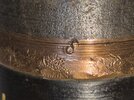
I can find no reference to a "light" 12 Pr shell, and as the driving band on the projectile V D G has appears to be a standard profile, this seems to rule out any connection to Davis.
Alan1
 
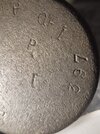
Thank you to both Allan and Daryl for your replies, it is great to have such knowledgeable people on the forum. I gave the base area a clean and there is clear evidence of a base plate fitted. So as suggested it is likely to be hollow, or at least filled with something lighter than steel! I also detected another set of numbers and cleaned this area. I thought to add a close up of the driving band, certainly appears to follow the pattern of normal 12 Pdr practice shot that I have seen before.
I hope you all have a good Christmas and best wishes foe 2026.
 

Attachments

  • IMG_0936.jpeg
    IMG_0936.jpeg
    4 MB · Views: 38
  • IMG_0937.jpeg
    IMG_0937.jpeg
    4.9 MB · Views: 36
  • IMG_0938.jpeg
    IMG_0938.jpeg
    4.9 MB · Views: 33
  • IMG_0939.jpeg
    IMG_0939.jpeg
    3.7 MB · Views: 34
Evening All,
Firstly, a great informative thread!
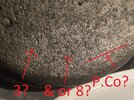
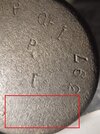
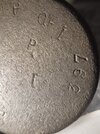
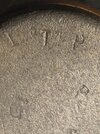
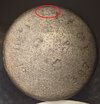
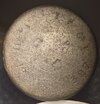
Speaking of 12 pdrs, I have one with interesting base markings - I'm not sure if it was "repurposed" in some way as there are a number of very faint stamps scattered around the base (a couple of which allures to it being stamped "15 pdr"? ), in conjuction with more defined markings. However there are a number of concerns if this indeed was stamped incorrectly as a 15 pdr:

1) Projectile weight is 5.6kg (12.5 lbs) which is the exact weight for a British QF 12-pdr solid /inert practice projectile;
2) Projectile diameter is approx 2.97" (75.49mm) [ same for both 12 & 15 pdrs]
3) Projectile driving band diamenter is approx. 3.088" (78.45mm) [same for both 12 & 15 pdrs - however there are distinct differences between the driving bands in general]
4) Projectile length is approx. 215mm

So, from above it looks like, smells like - must be a 12 pdr Practice Proj.

Examination of the base stamps certainly doesn't fall in line with the typical base markings as found on other corresponding 12 /15 pdr - for example shraphnel shells types which have the typical "12 Pdr ", "15pdr" and Forged Steel "F S" markings etc. Were practice projectiles marked differencely?

My queries are wrt to the interpretation of the base markings:

1) Is that a faint 15 pdr stamp?
2) Is that a faint "P.Co" stamp? [Projectile Company works in Battersea, London]
3) Is that "C I' in the base centre (Cast Iron which was commonly used for practice projectiles)
4) 3 97 > Date stamp: March, 1897?
5) "Q F I" > Mk 12 Quick Fire Mk 1?
6) "S" stamp on the driving band?
7) What is "T 4 P" ?
8) The nose tip is flat not pointed? (The example shown in the first port is pointed)

All thoughts and opinions would be greatly appreciated.
Thanks
Cheers
Drew

BTW - I just found my old post on this back in 2017 - still no further ahead! :-(


Attachments

  • 12pdr-10.jpg
    12pdr-10.jpg
    178.5 KB · Views: 5
  • 12pdr-9.jpg
    12pdr-9.jpg
    226.5 KB · Views: 5
  • 12pdr-8.jpg
    12pdr-8.jpg
    293 KB · Views: 4
  • 12pdr-7.jpg
    12pdr-7.jpg
    310.5 KB · Views: 5
  • 12pdr-6.jpg
    12pdr-6.jpg
    342.7 KB · Views: 4
  • 12pdr-5.jpg
    12pdr-5.jpg
    313 KB · Views: 5
  • 12pdr-4.jpg
    12pdr-4.jpg
    310.5 KB · Views: 5
  • 12pdr-3.jpg
    12pdr-3.jpg
    342.8 KB · Views: 5
  • 12pdr-2.jpg
    12pdr-2.jpg
    230.7 KB · Views: 5
  • 12pdr-1.jpg
    12pdr-1.jpg
    229.7 KB · Views: 5
Last edited:
Top