What's new
British Ordnance Collectors Network

Join over 14,000 collectors of inert military ordnance. Get expert identification help for shells, fuzes, grenades, and more — plus access our classifieds marketplace and decades of archived knowledge. Free to register, takes seconds.

British 1920s experimental 20mm anti-tank

Vasco Da Gama

Well-Known Member
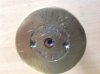
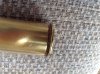
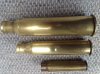
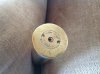
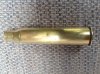
This little case turned up recently, with a dried flower in it! I have tried to provide the best possible photos, it is 167mm long, rim diameter of 37.6mm, rim thickness 2mm and mouth 21.3mm. The only markings on the case are: R.L, A and a very faint 8. The primer is better marked: No5P, 8/27, W 10/27, I and N. I would offer the case is from work undertaken in the 1920s to develop an anti-tank capability for the British Army. Very glad to be corrected and if anybody has more information it would be much appreciated. Pictured alongside a 20mm Hispano and 25mm French AT cases for comparison.
 

Attachments
  • image.jpg
    image.jpg
    321.8 KB · Views: 113
  • image.jpg
    image.jpg
    312 KB · Views: 108
  • image.jpg
    image.jpg
    313.6 KB · Views: 84
  • image.jpg
    image.jpg
    312.5 KB · Views: 103
  • image.jpg
    image.jpg
    295.2 KB · Views: 94
Last edited:
Nice find! You have a .8 inch Elswick.

This is an extract from something I wrote in the most recent issue of The Cartridge Researcher, concerning the British search for a portable anti-tank gun:

"From 1927, attention focused on the .8 inch calibre. Vickers Ltd had already developed a non-automatic hopper-fed .8 inch gun (further details unknown) and this was acquired for testing but proved unsatisfactory. In parallel with this, a new cartridge was designed, DD/L/3468 (20.3 x 167SR). In 1927, 65 and 70 calibre test barrels designed to use this round were ordered from Vickers Ltd., but in 1928 guns made by EOC were received for trial. As a result, this cartridge is generally known as the .8 inch Elswick. It fired a 2,260 grain (146 g) bullet at 2,850 fps (869 m/s); a great deal of experimentation was carried out to determine the optimum case size and chamber pressure, although the case seems very large for the performance. The water-cooled and strip-fed (5 or 10 rounds) gun used an automatic mechanism said to be similar to the 37 mm Browning (and therefore presumably a long-recoil type). Trials continued until the early 1930s."
 
Top