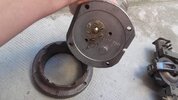
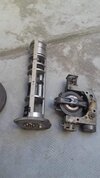
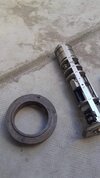
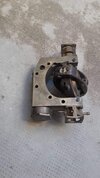
And this object is only used in test torpedoes, right? But... does it transmit data in some way, or do they recover the torpedo afterwards? Forgive my ignorance...
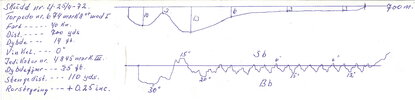
It's a mechanical depth- and roll recorder. It's located in the exersicehead to record the behaviour of the torpedo in regards to roll and depthkeeping (ie effects on vertical/horosintal rudders). The movements are detected by pendolums controlling a pen or a needle writing/scribing the movements on a roll of paper that is transferred from one roll to another controlled by a mechanical mechanism run by a spring which is wound up before the unit is installed in the head. The waterflap on top flips back from the waterpressure, unlocking the spring and pendolums, so that the drive starts moving the paper and record the torpedo's movements.
The attached images are scans from 1972 with Mk VIII exersice torpedoes at Kaholmen torpedobattery (Oscarsborg fortress). It's not the original papers from the recorders, but traces of them on ordinary paper made with a pen. However, it shows what such recordings look like with the running distance at the x-axis (m), the depth (m) on top, and roll (degrees at the in the y-axses.
Different navies might use different terms, but in my opinion you have the following categories of torpedoes:
* Dummy (torpedo with an "empty" head, or even a model, which replicate a torpedo in terms of phyisical dimensions/weight for various use like testing and certification of loading/launch equpiment etc.)
* Exersice (an ordinary torpedo with an exersicehead, which is used to conduct exersices in regards to launching/steering and verifying all functions of the torpedo. The head can be equipped with various types of instrumention for recording relevant data to be analyzed after the run).
* War (a torpedo with warhead for use in actual combat)
Instruments in the exersicehead might be recording (mechanical/electromechanical/digital) and/or transmitting depending on the type/era, but the D/R-recorders shown here are typically devices from around 1900 and forwards, with only mechanical registration as described above.