What's new
British Ordnance Collectors Network

Join over 14,000 collectors of inert military ordnance. Get expert identification help for shells, fuzes, grenades, and more — plus access our classifieds marketplace and decades of archived knowledge. Free to register, takes seconds.

Help with 47 X 384mm Round Please

ordnance

Well-Known Member
Premium Member
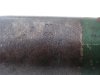
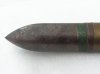
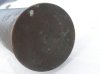
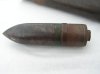
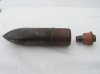
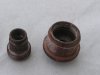
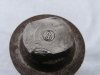
I recently acquired this 47mm explosive round and need some identification help. The case is 384mm long and headstamped "ENZ 1915 20". The projectile is a high explosive type with a base fuze. It is 175,5mm long without the fuze installed and has a deep explosive cavity about 141mm long. There is a proof mark visible on the projectile body and bottom of fuze that appears to be an intertwined S and W within a circle.

I think the ENZ headstamp means the case was made by Enzesfelder Metalwerke in Enzesfeld, Austria but that's as much as I currently know. Is the round for use by Austrian Forces or export to another country? Significance of green band? Is the S-W proof identifiable to anyone? Naval? Coastal defense? Other use? Any help appreciated.PICT0001.JPGPICT0002.jpgPICT0003.jpgPICT0004.jpgPICT0005.jpgPICT0006.jpgPICT0009.jpgPICT0010.jpg

 
S W= Skoda Werke, Austria. 384mm is close to my Hotchkiss 3 pdr, so it could be an Austrian production Hotchkiss long 3 pdr. There is a shorter 47 x128R for the revolving gun.. Probably Naval use as the 3 pdr was a common Navy weapon. Sure looks like a 3 pdr. Going to put it up on auction?
 
Hello,

I'm sure Fert could give us more details on this round.
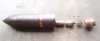
I think it's an autro-hungarian 4.7cm naval round with M/15 base fuze.

Regards

Austro Hung 4.7 naval.jpgnaval fuze 4.7 austro.jpg
 
I show 3 Austrian 47mm naval guns in use in WW1. One was a license built Hotchkiss, 47mm SFK L33 H of 1890. The other 2 were Skoda guns of 1914 L44 and the 47mm SFK L44 S introduced in 1897. This gun was the standard Austro-Hungarian rapid fire gun up to 1918. The projectile was 4 calibres long or 3.5 calibres for a steel Common shell. Hope this helps.
 
Great information and it sure appears to be the Austro-Hungarian Naval round. Guess my initial thought wasn't too far off. I told the seller I couldn't identify it but guessed it might be Austrian or Italian, or at least European. I wish I knew how it found its way to the American West coast 100 years later. Thanks again to all who responded.

Rick
 
Top