Join over 14,000 collectors of inert military ordnance. Get expert identification help for shells, fuzes, grenades, and more — plus access our classifieds marketplace and decades of archived knowledge. Free to register, takes seconds.
Torpedo or may be British air dropped mine? The diameter may fit "A type" mines although the length is rather short (the body was generally over 2m long)
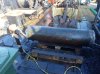
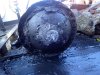
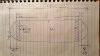
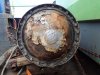
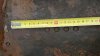
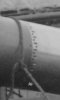
Hi everyone, I've just returned from the Uxo job on the Ems River and have taken some more pictures and measured some sizes, maybe we can do more with that.
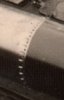
It's very hard to give an exact ID from just an airtank (which this is - definately no mine)... There are numerous 18"/45cm torpedoes from both WW1 and WW2 to choose from, including both naval and air-delivered examples from several nations.
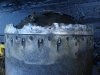
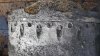
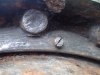
However, there's one detail on your photo that draws my attention: The "wholes"/"dimples" between the fastening bolts for the warhead (the head has obvioulsy separated from the airtank due to corrosion).
The exact same features can be found on german G/7, G/7 AV, G/7* and G/7** torpedoes (all are pretty much identical in terms of exterior hull). Also, the next developments - G7v and G7v* - had this feature. One big problem though: These are all 50cm torpedoes (ie made before the standardization on 21"/53,34cm in the early 1920's).
The G/7 predecessor G/6 (and variants) was 18"/45cm, and although I'm not sure it shared the same features of the airtank, it could be a valid candidate. As your airtank (and remaining part of the warheadflange) seems to be made of steel, it's most likely a torpedo made during/after WW1.
The tailsection is always the best way to make an ID of a torpedo, and with that missing it's difficult unless you happen to find markings etc.
Apart from the 45cm G/125 and G/250 (Whitehead-torpedoes) there are no german 18"/45cm "G" torpedo.
The letter is part of the designation introduced by Kriegsmarine, were the first letter indicates the diameter:
G = 53,34cm/21" (including also older 50 and 52cm torpedoes used in WW2)
F = 45cm/17.7")
H = 60cm/23.7")
M = 75cm/30")
The number indicates the approximate length:
7 = 7m
6 = 6m
5 = 5m
The small letter following indicated type of propulsion and method of control. The T-number (roman) was a running number given to types as they were been introduced to operational service.
Examples:
G7a(TI) = Operational Kriegsmarine torpedo #1: 53,34cm torpedo with 7,163m length and wet-heater propulsion.
G7ef(TX) = Operational Kriegsmarine torpedo #10: 53,34cm torpedo with 7,163m length, electric propulsion and remote control.
I'm not sure the "G" in earlier torpedoes (like the G/6 and G/7) was part of a system, but I'm suspecting it also would indicate the diameter.
The G/7 predecessor G/6 (and variants) was 18"/45cm, and although I'm not sure it shared the same features of the airtank, it could be a valid candidate
Probably not... The attached image is a still from a video captured at the Malta War Museum who have the sole (?) existing example of a G/6 AV torpedo:
This site uses cookies to help personalise content, tailor your experience and to keep you logged in if you register.
By continuing to use this site, you are consenting to our use of cookies.