British Ordnance Collectors Network
You are using an out of date browser. It may not display this or other websites correctly.
You should upgrade or use an alternative browser.
You should upgrade or use an alternative browser.
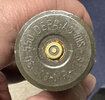
ID on a 30x113B
- Thread starter US-Subs
- Start date
Eggburt1969
Well-Known Member
A sectional image (photograph) and sectional diagram of the round is within the book 'Les canons de bord à barillet 30 mm DEFA', by Philippe Ballarini.
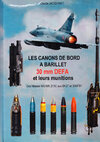
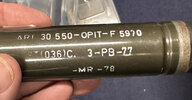
Going by the book, the 30-550-OPIT F5970 is a second generation armour-piecing incendiary tracer (API-T) round. OPIT being the French designation for API-T, which is presumably short for 'Obus Perforant Incendiaire Traceuse', but don't quote me on it.
The book shows the F5970 OPIT round's projectile as being an API-T design, which has a false aluminium alloy ogive, steel main body, and a rear tracer assembly.
Internally a hardened steel-core is present within most of the nose, with an incendiary charge sitting behind it and within the steel body. The seemingly screwed-in tracer assembly holds the pressed-in tracer composition charge.
Here are some example some link found when searching for the book.
 www.aerobiblio.com
Going by the book, the 30-550-OPIT F5970 is a second generation armour-piecing incendiary tracer (API-T) round. OPIT being the French designation for API-T, which is presumably short for 'Obus Perforant Incendiaire Traceuse', but don't quote me on it.
The book shows the F5970 OPIT round's projectile as being an API-T design, which has a false aluminium alloy ogive, steel main body, and a rear tracer assembly.
Internally a hardened steel-core is present within most of the nose, with an incendiary charge sitting behind it and within the steel body. The seemingly screwed-in tracer assembly holds the pressed-in tracer composition charge.
Here are some example some link found when searching for the book.
Les canons de bord à barillet 30 mm DEFA – Aérobibliothèque
Les canons de bord à barillet 30 mm DEFA - Contrairement à la plupart des ouvrages en autoédition qui se reconnaissent généralement assez vite à leur mise en page qui transpire l’amateurisme et aux déséquilibres dans leur organisation, le livre Les canons de bord à barillet 30 mm DEFA donne...
www.aerobiblio.com
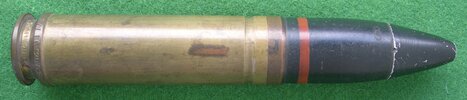
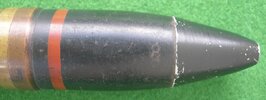
This 30mm reminds me of my Aden that has a similar colour and was never identified here or on IAA forum.
30 x 111B Aden.
000 below fuze (unified threads)
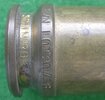
SWN LOT 20/56
30MM RG 56
Did UK load any API rounds oe ant thoughts on my cartridge ?
30 x 111B Aden.
000 below fuze (unified threads)
SWN LOT 20/56
30MM RG 56
Did UK load any API rounds oe ant thoughts on my cartridge ?
Attachments
Eggburt1969
Well-Known Member
I can't say if it's exactly the same projectile from the 30-550-OPIT F5970 round, but the earlier BOCN post linked below might be of use.
French Projectile (27 January 2023)
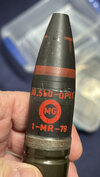
The text visible on the projectile, 30-550-OPIT, and its design is pretty much the same as that shown in the aforementioned book.
To make things simpler, I have added the images from the post below.
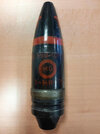
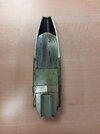
French Projectile (27 January 2023)
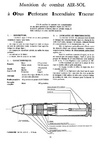
The text visible on the projectile, 30-550-OPIT, and its design is pretty much the same as that shown in the aforementioned book.
To make things simpler, I have added the images from the post below.
Eggburt1969
Well-Known Member
Yes, I have this too, but the diagram and text are for the 30-550-OPIT F5960 round, and not the 30-550-OPIT F5970 shown by US Subs.
However, the differences between the F5960 round and the F5970 round are, as far as I can tell, minor. Going by the book I have, and the F5960 and F5970 designations, the difference is the driving band.
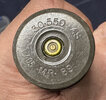
For the F5960 this uses a sintered iron driving band, which has a lower melting point wax impregnated into the sintered (and hence porous) iron band. For the F5970, this also uses a sintered iron driving band, but the band has a high temperature (HT) melting point microcrystalline wax impregnated into it.
The change was made as the earlier wax would exude from the sintered iron driving band when the rounds were subjected to the high temperatures experienced during flight.

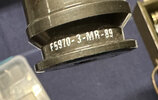
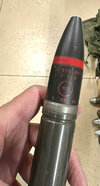
Thanks everyone, a great help as always. I'm feeling a little foolish as I actually have that book and forgot. I'll have to dig it out and ensure that it is correctly entered into the database. I also have two of the rounds, same item but slightly different style of markings.