
Hi, thanks for allowing me into your group of expertise! I just joined to ask you about the item in these photos. My brother has 2 of these, and he has asked me to try to get them identified. He bought them at Wimborne Market possibly 50 years ago, thinking they were shell cases. Now he’s not so sure because they are unmarked and because he now thinks they are made of copper(?). Length without base 25.5cms; with base 28cms; diameter 7cms. The basal nut looks like it has been struck. Do you have any idea what they could be please? Are they even military? Thanks for any help or guidance!
British Ordnance Collectors Network
You are using an out of date browser. It may not display this or other websites correctly.
You should upgrade or use an alternative browser.
You should upgrade or use an alternative browser.
Identification please - is it even military?
- Thread starter trendier1
- Start date
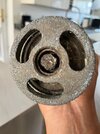
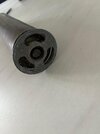
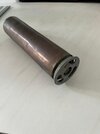
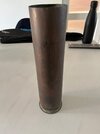

Looks to be a from a fire extinguisher , theres been a few on site over the years
Similar here...
Similar here...
Cartridge Case
Hoping to identify the following.....apologies in advance. Dimensions will be updated tomorrow
www.bocn.co.uk
Yes, Fire Extinguisher.. I forget who made them, but they were an early form of dry powder extinguisher.. There was a pistol grip firing device that clipped on to the back. They were often found in commercial kitchens and were mounted on a board on the wall holding 4 cartridges and the firing trigger.. All painted red.
This is an earlier version of the device.
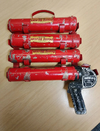
This is an earlier version of the device.
Just in the interest of accuracy of conclusion Bombdoc or anyone else, though now obviously off-subject for this ordnance group, can you find one of those pistol extinguisher canisters to be 70mm diameter which my item is, or of the same length including base? I can find one like you picture on a Bristol Museum site to be only 50mm diameter. They are also obviously red, with identifying markings, and made of steel. My item is copper or brass with not a trace of colour or marking.Yes, Fire Extinguisher.. I forget who made them, but they were an early form of dry powder extinguisher.. There was a pistol grip firing device that clipped on to the back. They were often found in commercial kitchens and were mounted on a board on the wall holding 4 cartridges and the firing trigger.. All painted red.
This is an earlier version of the device.
View attachment 210910
Alternatively, in my hunt, the nearest I got before giving up was it might be the inner cylinder of a marine chemical foam fire extinguisher (see attached diagrams). My item’s cylinder being copper or brass would resist the outer and inner chemical solutions it is bathed in, and there is mention of holes in the end through which the chemicals could mix when required. Being an inner part it would not need identifying markings. Don’t I also remember another occurrence of one of these, was it on this group, being fished out of a harbour(!) in New Zealand?
Attachments

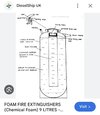
I’ve now found this as another strong possibility, but with no accompanying images of what is being described to match my item against. Tantalisingly close but still inconclusive!Just in the interest of accuracy of conclusion Bombdoc or anyone else, though now obviously off-subject for this ordnance group, can you find one of those pistol extinguisher canisters to be 70mm diameter which my item is, or of the same length including base? I can find one like you picture on a Bristol Museum site to be only 50mm diameter. They are also obviously red, with identifying markings, and made of steel. My item is copper or brass with not a trace of colour or marking.
Alternatively, in my hunt, the nearest I got before giving up was it might be the inner cylinder of a marine chemical foam fire extinguisher (see attached diagrams). My item’s cylinder being copper or brass would resist the outer and inner chemical solutions it is bathed in, and there is mention of holes in the end through which the chemicals could mix when required. Being an inner part it would not need identifying markings. Don’t I also remember another occurrence of one of these, was it on this group, being fished out of a harbour(!) in New Zealand?
Attachments
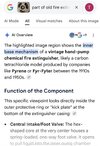
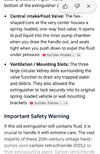
Just in the interest of accuracy of conclusion Bombdoc or anyone else, though now obviously off-subject for this ordnance group, can you find one of those pistol extinguisher canisters to be 70mm diameter which my item is, or of the same length including base? I can find one like you picture on a Bristol Museum site to be only 50mm diameter. They are also obviously red, with identifying markings, and made of steel. My item is copper or brass with not a trace of colour or marking.
Alternatively, in my hunt, the nearest I got before giving up was it might be the inner cylinder of a marine chemical foam fire extinguisher (see attached diagrams). My item’s cylinder being copper or brass would resist the outer and inner chemical solutions it is bathed in, and there is mention of holes in the end through which the chemicals could mix when required. Being an inner part it would not need identifying markings. Don’t I also remember another occurrence of one of these, was it on this group, being fished out of a harbour(!) in New Zealand?
Attachments
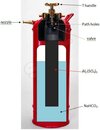
This is the style of extinguisher, the 'cart' is fitted upside down and pierced for use. A couple were extracted from Wellington Harbour near an old flying boat/naval base. These are for the older style large extinguishers, i tried researching for diagrams but very scarce, this is the best that illustrates what's going on.
Previous thread;
Is this a Recoilless rifle cartridge?
Just wondering if anyone can help identify this object found on the bottom of a harbour in New Zealand this week. I am thinking it might be some type of recoilless rifle cartridge perhaps, with what look like vents at the rear? Cheers
www.bocn.co.uk