What's new
British Ordnance Collectors Network

This is a sample guest message. Register a free account today to become a member! Once signed in, you'll be able to participate on this site by adding your own topics and posts, as well as connect with other members through your own private inbox!

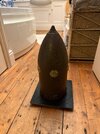
Info on this 7inch shell

Tuney

Well-Known Member
Can anyone tell me what I have here it has zinc top studs and copper lower studs it’s 16 inches high and 7inch across the base and weighs 48kg
 

Attachments

  • bb883991-10b9-47f1-bfc7-d547788d27f1.jpeg
    bb883991-10b9-47f1-bfc7-d547788d27f1.jpeg
    540.6 KB · Views: 30
  • 92141054-ec06-4b47-a805-083f5a714d44.jpeg
    92141054-ec06-4b47-a805-083f5a714d44.jpeg
    307.5 KB · Views: 30
Improvements in engineering and technology during the industrial revolution would bring about the greatest changes in artillery for 300 years, one of which was rifling. Steel became commercially available in the 1850s - 1860s and a steel tube could have a number of spiral grooves running down its length, called rifling. When used in a barrel, these grooves would spin the projectile, markedly increasing its range and accuracy, making smooth-bore guns obsolete. Some large smooth-bore guns were ground out and had a rifled tube inserted , but new ones, were purpose-built.
As the guns themselves changed dramatically, so did the ammunition they fired. Round shot gave way to longer, more aerodynamic shells. To engage the rifling, to spin the shell and make it more accurate, early shells were fitted with studs. These shells with studs were muzzle loaded.

 
Improvements in engineering and technology during the industrial revolution would bring about the greatest changes in artillery for 300 years, one of which was rifling. Steel became commercially available in the 1850s - 1860s and a steel tube could have a number of spiral grooves running down its length, called rifling. When used in a barrel, these grooves would spin the projectile, markedly increasing its range and accuracy, making smooth-bore guns obsolete. Some large smooth-bore guns were ground out and had a rifled tube inserted , but new ones, were purpose-built.
As the guns themselves changed dramatically, so did the ammunition they fired. Round shot gave way to longer, more aerodynamic shells. To engage the rifling, to spin the shell and make it more accurate, early shells were fitted with studs. These shells with studs were muzzle loaded.
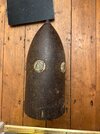
Yes I know all that I was asking why it has zinc studs at the top and copper studs at the bottom when normally they ether have all zinc studs or all copper . And also origin country would be a great help
 
As regards British ordnance this is most similar to two projectiles that are almost identical to each other, the 'Shell, Rifled Muzzle Loading, Palliser, 7 in' and the 'Shot, Rifled Muzzle Loading, Palliser, 7 in'. Those have a similar profile & dimensions, however they are fuzed/plugged at the base, not the nose, and have 2 rows of 3 studs, not 2 rows of 4 studs. They are also a couple of kilos lighter, weighing 112 1/2 lbs and 113 3/8 lbs empty respectively. So I think that eliminates England as the country of origin, if that helps.
 
Top