
pzgr40
Well-Known Member
Purpose :
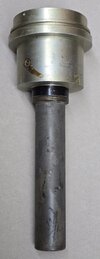
Water pressure initiated, pyrotechnic delay depth charge fuze for the Russian BB-1, BPS, RBM and rocket launched RGB-12 depth charges.
Construction :
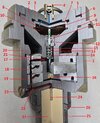
1 - Fuze housing, steel.
2 - Depth setting mechanism housing, steel.
3 - Cover, steel.
4 - Closing cap, brass.
5 - Threaded locking ring, steel.
6 - Greased watertight washers, felt.
7 - Lock up disc, steel.
8 - Membrane with pusher pin, brass/steel.
9 - Wet space above membrane.
10 - Dry space below membrane.
11 - Locking ball housing, steel.
12 - Locking balls (2x), steel.
13 - Firing pin, steel.
14 - Firing pin spring, steel.
15 - Membrane balance spring, steel.
16 - Firing cap.
17 - Upper pyrotechnic time disc, Aluminum. Moves synchronal to lower disc, part 19.
18 - Middle pyrotechnic time disc, Aluminum. Fixated ring.
19 - Lower pyrotechnic time disc, Aluminum. Moves synchronal to upper disc, part 17.
20 - Threaded cock up ring for pyrotechnic time discs, steel.
21 - Flash channel.
22 - Lower flash channel
23 - Closing screw, steel.
24 - Detonator, brass.
25 - Booster bushing, steel.
26 - Booster bushing locking ring, steel.
27 - booster charge, 4 stacked cylinders of Tetryl.
Function :
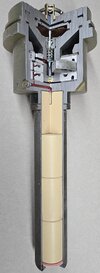
Before launching the BB-1 depth charge into the water, the depth is set by rotating the Depth setting mechanism (2) on the desired depth setting, ranging from 10 meters (minimal depth) to 330 meters (maximum depth). The Closing cap (4) is screwed off, allowing water to enter the fuze through the small hole in the center of the cover(3). The water enters the fuze , following the path depicted by the blue arrows into the wet space (9) above the membrane (8) and starts pushing on the membrane, pushing the steel rod in the center of the membrane downward (green arrow). The steel rod is wider at the base than near the top; the wider part keeps two steel balls (12) fixated in the outward position, thus fixating the firing pin (13). When the rod of the membrane has been pushed in far enough to allow the tow steel balls to move inward, this releases the firing pin, which is driven into the firing cap (16) by the firing pin spring (14). Inside the firing pin a spring (15) is placed, pressing the rod upward, this spring regulates the minimum water pressure needed to allow the membrane to be pushed downward.
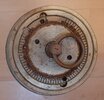
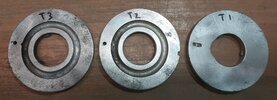
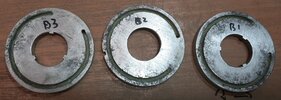
The outside of the stem of the depth setting mechanism housing (2) has three keyways in way of the upper (17) and lower (19) pyrotechnic time discs, fixating the discs to the depth setting mechanism housing when rotating. The middle pyrotechnic time disc (18) is fixated to the fuze housing (1) by means of a screw, and cannot be rotated. The flame of the firing cap (16) moves into the upper pyrotechnic time delay disc (17) through the flash hole (21) and starts to expire, passing over the middle and lower discs, until burning time has expired. The flame of the lower pyrotechnic time disc (19) passes into the flash hole (22) and into the detonator (24), which explodes, initiating the booster charge (27), which ignites the depth charge.
Additional info:
Except for the K3M, here is also the K3 depth charge fuze , which differs that the K3M has a depth setting from 10-330 meters, and the K3 has a depth setting from 10-210 meters. As the functioning depth of the K3 is less deep, it has two pyrotechnic time discs only. The visual difference however between the K3 and K3M however can be observed in the maximum depth setting on the top of the fuze.
Water pressure initiated, pyrotechnic delay depth charge fuze for the Russian BB-1, BPS, RBM and rocket launched RGB-12 depth charges.
Construction :
1 - Fuze housing, steel.
2 - Depth setting mechanism housing, steel.
3 - Cover, steel.
4 - Closing cap, brass.
5 - Threaded locking ring, steel.
6 - Greased watertight washers, felt.
7 - Lock up disc, steel.
8 - Membrane with pusher pin, brass/steel.
9 - Wet space above membrane.
10 - Dry space below membrane.
11 - Locking ball housing, steel.
12 - Locking balls (2x), steel.
13 - Firing pin, steel.
14 - Firing pin spring, steel.
15 - Membrane balance spring, steel.
16 - Firing cap.
17 - Upper pyrotechnic time disc, Aluminum. Moves synchronal to lower disc, part 19.
18 - Middle pyrotechnic time disc, Aluminum. Fixated ring.
19 - Lower pyrotechnic time disc, Aluminum. Moves synchronal to upper disc, part 17.
20 - Threaded cock up ring for pyrotechnic time discs, steel.
21 - Flash channel.
22 - Lower flash channel
23 - Closing screw, steel.
24 - Detonator, brass.
25 - Booster bushing, steel.
26 - Booster bushing locking ring, steel.
27 - booster charge, 4 stacked cylinders of Tetryl.
Function :
Before launching the BB-1 depth charge into the water, the depth is set by rotating the Depth setting mechanism (2) on the desired depth setting, ranging from 10 meters (minimal depth) to 330 meters (maximum depth). The Closing cap (4) is screwed off, allowing water to enter the fuze through the small hole in the center of the cover(3). The water enters the fuze , following the path depicted by the blue arrows into the wet space (9) above the membrane (8) and starts pushing on the membrane, pushing the steel rod in the center of the membrane downward (green arrow). The steel rod is wider at the base than near the top; the wider part keeps two steel balls (12) fixated in the outward position, thus fixating the firing pin (13). When the rod of the membrane has been pushed in far enough to allow the tow steel balls to move inward, this releases the firing pin, which is driven into the firing cap (16) by the firing pin spring (14). Inside the firing pin a spring (15) is placed, pressing the rod upward, this spring regulates the minimum water pressure needed to allow the membrane to be pushed downward.
The outside of the stem of the depth setting mechanism housing (2) has three keyways in way of the upper (17) and lower (19) pyrotechnic time discs, fixating the discs to the depth setting mechanism housing when rotating. The middle pyrotechnic time disc (18) is fixated to the fuze housing (1) by means of a screw, and cannot be rotated. The flame of the firing cap (16) moves into the upper pyrotechnic time delay disc (17) through the flash hole (21) and starts to expire, passing over the middle and lower discs, until burning time has expired. The flame of the lower pyrotechnic time disc (19) passes into the flash hole (22) and into the detonator (24), which explodes, initiating the booster charge (27), which ignites the depth charge.
Additional info:
Except for the K3M, here is also the K3 depth charge fuze , which differs that the K3M has a depth setting from 10-330 meters, and the K3 has a depth setting from 10-210 meters. As the functioning depth of the K3 is less deep, it has two pyrotechnic time discs only. The visual difference however between the K3 and K3M however can be observed in the maximum depth setting on the top of the fuze.