
pzgr40
Well-Known Member
Purpose:
Grenade with hydrostatic fuze against divers, acoustic mine clearance and submarine sound signaling.
Construction:
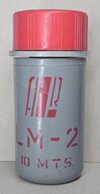
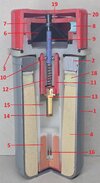
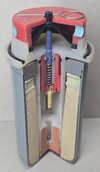
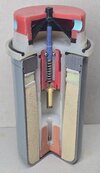
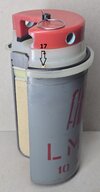
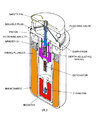
The grenade consists of a pressed steel cup (1) with a steel flange (2) screwed in top. In this flange a hydrostatic fuze (3) is placed which is completely made of plastic. The steel cup houses the main charge (4) which has a hole in the middle to receive the fuze with the booster (5), which is placed at the lower end of the fuze. The steel cup is painted grey and has red stenciling containing the name of the manufacturer (ALR) , the type of grenade (LM-2), and the depth of detonation (10 mtrs).
In top of the fuze housing the rubber diaphragm (6) which reacts on the water pressure is placed. It is locked up by a plastic cap (7) with six flooding valves(8) in the circumference that allow water to enter the top part of the fuze. In the diaphragm the piston (9) is placed. The lower -wide- side of the piston forces four steel retaining balls (10) in the outward position, thus fixating the firing plunger (11). A depth adjusting spring (12) in the firing plunger pushes the piston upward and regulates the detonation depth. Below the firing plunger the brass duplex detonator -a detonator (13) with firing cap (14) at the base is placed in a void space (15). This ensures that if the detonator is accidentally activated, the main charge in the grenade is not activated. At the base of the fuze a plastic container housing the booster charge (5) is placed, housing the firing pin (16) in the center, facing the firing cap of the detonator.
On the side of the fuze housing a small hole is drilled which is filled with a soluble plug (17). It ends below the diaphragm. A spacer (18) is placed between the main charge and the fuze, preventing the main charge from movement.
A safety pin (19) is placed through the top part of the diaphragm protruding above the top of the fuze. A watertight safety cap (20) is screwed over the fuze housing.
Function :
Before throwing, the safety cap is screwed off and the safety pin is removed. The LM-2 is thrown into the water, which should be at least 10 meters deep. Water enters the flooding valves and while sinking the pressure on top of the diaphragm rises, pressing it downward, together with the piston, compressing the spring. When the piston has moved downward so far that the wider diameter of the piston has passed the steel locking balls these move inward, releasing the firing plunger. The firing plunger is now pushed downward by the spring, launching the firing cap of the detonator into the firing pin. This will initiate the detonator, which ignites the booster charge and the main charge.
If the fuze -for some reason- does not function, the soluble plug will slowly dissolve after some time and water will enter the fuze body below the diaphragm, rendering the grenade safe as the water pressure below the diaphragm is the same as above the diaphragm.
Additional info :
The LM-2 an be thrown by hand over the railing of a ship or a quay to ward off enemy divers in harbors, thrown from a moving vessel, either from helicopters.
Length with cap : 175 mm
Length w/o cap : 166 mm
Diameter flange: 86 mm
Diameter steel bushing : 77mm
Regards, DJH
Grenade with hydrostatic fuze against divers, acoustic mine clearance and submarine sound signaling.
Construction:
The grenade consists of a pressed steel cup (1) with a steel flange (2) screwed in top. In this flange a hydrostatic fuze (3) is placed which is completely made of plastic. The steel cup houses the main charge (4) which has a hole in the middle to receive the fuze with the booster (5), which is placed at the lower end of the fuze. The steel cup is painted grey and has red stenciling containing the name of the manufacturer (ALR) , the type of grenade (LM-2), and the depth of detonation (10 mtrs).
In top of the fuze housing the rubber diaphragm (6) which reacts on the water pressure is placed. It is locked up by a plastic cap (7) with six flooding valves(8) in the circumference that allow water to enter the top part of the fuze. In the diaphragm the piston (9) is placed. The lower -wide- side of the piston forces four steel retaining balls (10) in the outward position, thus fixating the firing plunger (11). A depth adjusting spring (12) in the firing plunger pushes the piston upward and regulates the detonation depth. Below the firing plunger the brass duplex detonator -a detonator (13) with firing cap (14) at the base is placed in a void space (15). This ensures that if the detonator is accidentally activated, the main charge in the grenade is not activated. At the base of the fuze a plastic container housing the booster charge (5) is placed, housing the firing pin (16) in the center, facing the firing cap of the detonator.
On the side of the fuze housing a small hole is drilled which is filled with a soluble plug (17). It ends below the diaphragm. A spacer (18) is placed between the main charge and the fuze, preventing the main charge from movement.
A safety pin (19) is placed through the top part of the diaphragm protruding above the top of the fuze. A watertight safety cap (20) is screwed over the fuze housing.
Function :
Before throwing, the safety cap is screwed off and the safety pin is removed. The LM-2 is thrown into the water, which should be at least 10 meters deep. Water enters the flooding valves and while sinking the pressure on top of the diaphragm rises, pressing it downward, together with the piston, compressing the spring. When the piston has moved downward so far that the wider diameter of the piston has passed the steel locking balls these move inward, releasing the firing plunger. The firing plunger is now pushed downward by the spring, launching the firing cap of the detonator into the firing pin. This will initiate the detonator, which ignites the booster charge and the main charge.
If the fuze -for some reason- does not function, the soluble plug will slowly dissolve after some time and water will enter the fuze body below the diaphragm, rendering the grenade safe as the water pressure below the diaphragm is the same as above the diaphragm.
Additional info :
The LM-2 an be thrown by hand over the railing of a ship or a quay to ward off enemy divers in harbors, thrown from a moving vessel, either from helicopters.
Length with cap : 175 mm
Length w/o cap : 166 mm
Diameter flange: 86 mm
Diameter steel bushing : 77mm
Regards, DJH