Join over 14,000 collectors of inert military ordnance. Get expert identification help for shells, fuzes, grenades, and more — plus access our classifieds marketplace and decades of archived knowledge. Free to register, takes seconds.
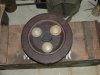
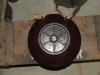
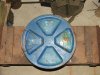
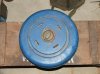
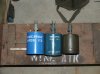
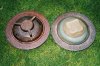
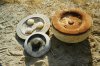
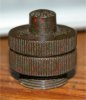
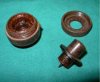
heres a few pic's of other mines I have would love a correct identification on the brown plastic one I have been told that it is Eygptian but would love to know for sure
Regards Daryl
I looked the SACI 54 Series of AT Mines in Janes and according to the write up Egypt produced the SACI 54/7 with a 7kg main charge under licence and designated it B Mk 1.
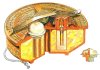
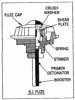
SACI is an obsolete minimum-metal Anti-Tank (AT) blast mine that has been manufactured in several variants. The specifications given below are for the SACI 54/7, which was copied by Egypt as the B Mk 1. The mines have a Bakelite casing in the shape of an inverted truncated cone, which is filled with TNT. This is covered by a dished plate in which there are three evenly spaced threaded fuze wells; a variant has different sized threads and an additional central well. Beneath each of the wells is a cylindrical booster with a central cavity to accept a stab-sensitive detonator. Two types of fuzes were made (see diagram), both using strikers retained by circular shear disks encapsulated in thin plastic domes; one type also has a striker spring. The fuzes are covered by a pressure plate, which may either be thin Bakelite with three prominent ribs, or hard rubber with a raised cruciform shape. The mine has 2 auxiliary fuze wells, one in the base and one in the side. A rope carrying handle is attached through lugs near the base and a retaining strap is sometimes present across the pressure plate. The majority of the casing is the brown colour of unpainted Bakelite.
Specifications
Weight
8.23 kg Diameter
282 mm Explosive weight
7 kg Height
205 mm Explosive type
TNT Operating pressure
100-200 kg (estimated)
General information Used in
Jordan, Nicaragua, Somalia Emplacement
Manual Detectability
Difficult to detect with minimum-metal fuze Anti-handling
Yes; auxiliary fuze wells in side and base Blast resistance
Susceptible to overpressure Cross reference
Also produced in Egypt as the B Mk 1.
This site uses cookies to help personalise content, tailor your experience and to keep you logged in if you register.
By continuing to use this site, you are consenting to our use of cookies.