

pzgr40
Well-Known Member
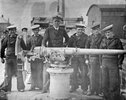
The 47 mm Nordenfelt 3 pounder gun was a rapid firing Gun, meant as protection for large battle ships from fast torpedo boats. The Gun was designed in 1880 by the Nordenfelt Guns and and ammunition company as the replacement of the Nordenfelt 1 inch multi barreled gun due to the fact that torpedo boats were increasingly better armored and the steel quality of the armor was improving rapidly. Early 3 pounder shellcases were filled with black powder as propelling charge, but around 1895 the black powder was replaced by cordite sticks. As this gives a higher peak pressure in the weapon, the cordite powder charges in the shellcases were considerably smaller.
The Nordenfelt ‘3 pounder common pointed shell’ is a chilled iron projectile fuzed with the Hotchkiss Mk VI base fuze. The projectile is filled with black powder. It is a semi armor piercing projectile that allows the piercing of light armor before exploding.
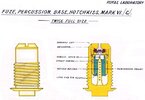
The ‘Hotchkiss Mk VI base percussion fuze’ consists of a brass fuze body. A lead pellet, cast around the firing pin with dovetails is surrounded by a stepped brass pipe. This forms the set-back safety. When safe, the tip of the firing pin is in a position where it cannot reach the detonator. Upon firing, the lead weight in the brass tube sets back over the firing pin, thus releasing the tip of the firing pin. The combination firing pin and set back weight is kept in the afterward position by a spring. Upon impact, the set-back weight with the firing pin moves forward -riding the spring- into the detonator.
The Hotchkiss Mk IV base percussion fuze was used in many typs of -semi- armor piercing shells, including the 37 mm (1 pounder), the 40 mm Pom pom (2 pounder), the 47 mm shells of Nordenfelt, Vickers and Hotchkiss and the 57 mm (6 pounder).
Diameter projectile : 47 mm
Cartridge length : 511 mm
Shellcase length : 375 mm
Diameter base shellcase : 63 mm
Projectile length : 171 mm with fuze, 166 mm w/o base fuze
Length from nose to below driving belt : 133 mm
Width drivingband : 20 mm
The Nordenfelt 3 pounder shrapnel shell consists of a steel projectile body with a brass top part that is riveted to the projectile body by means of five brass shear pins. The lower inner part of the body has a reduced diameter which forms the black powder chamber for the expulsion charge. On top of this chamber a flang with a -powder filled- pipe is placed. The rest of the projectile body is filled with lead balls.
Before firing, the 8 seconds time fuze is set to the desired time. Upon firing the fuze is activated. When the time has expired the fuze sends a fame down into the pipe. The powder in the pipe amplifies the flame into the expulsion powder charge. As pressure rises, the brass shear pins break and the flange, pipe , brass upper part with fuze and the lead balls are projected forward. The rotation of the shell spreads the lead balls into a cone shaped pattern.
Diameter projectile : 47 mm
Cartridge length : 510 mm
Shellcase length : 375 mm
Diameter base shellcase : 63 mm
Projectile length : 171 mm
Fuze length (on projectile) : 53 mm
Length from nose to below driving belt : 134 mm
Width drivingbelt : 20 mm
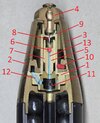
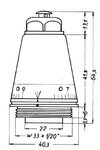
The Nordenfelt 8 second time fuze (picture 05) is fully brass made. It consist of a fuze housing (1), the pyrotechnic time ring (2), a nose cap (3) and the closing nut on top (4). Inside the fuze body an concussion fuze is placed, consisting of an inertia weight (5) with a firing cap (6) in top, fixated in the afterward position by a tight fitting set back bushing (7) with a longitude slot, placed over the upper part of the inertia weight (5). A firing pin (8) in top of the fuze body faces the firing cap (6). A tight fit set back bushing with a longitude slot (9) is placed over the upper part of the fuze body. This bushing ignites the firing cap (10) of the pyrotechnic time ring (2) upon firing.
In the base of the fuze body a black powder magazine (11) is screwed which amplifies the flame of the Pyrotechnic time ring, either the concussion fuze.
Before firing, the Pyrotechnic time ring (2) is rotated to the desired time lapse. Upon firing, both tight fitting inertia rings (7 & 9 ) set back, igniting the firing cap (10) of the pyrotechnic time ring, and arming the concussion fuze (5 & 6). When time of the pyrotechnic fuze has expired, a flame travels down the angled hole (12) into the magazine (11), which transfers the flame into the pipe down into the expulsion charge of the shell. If the time fuze is not set, either fails for some reason, the concussion fuze will function upon impact, passing the flame of the firing cap down through the hole (13) into the magazine (11).
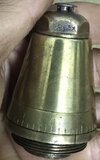
The Nordenfelt 8 seconds time fuze was used on the 47 mm Shrapnel projectile as well as on the Nordenfelt 57 mm Shrapnel projectile used by the Russian Navy. During the 1905 Russian -Japanese war -which ended in disaster for Russia- many 57 mm Nordenfelt Guns and shells were captured by the Japanese as spoils of war, and taken into Japanese service. Thus, the Nordenfelt 8 seconds time fuze can also be found with Japanese marking.
The Nordenfelt ‘3 pounder common pointed shell’ is a chilled iron projectile fuzed with the Hotchkiss Mk VI base fuze. The projectile is filled with black powder. It is a semi armor piercing projectile that allows the piercing of light armor before exploding.
The ‘Hotchkiss Mk VI base percussion fuze’ consists of a brass fuze body. A lead pellet, cast around the firing pin with dovetails is surrounded by a stepped brass pipe. This forms the set-back safety. When safe, the tip of the firing pin is in a position where it cannot reach the detonator. Upon firing, the lead weight in the brass tube sets back over the firing pin, thus releasing the tip of the firing pin. The combination firing pin and set back weight is kept in the afterward position by a spring. Upon impact, the set-back weight with the firing pin moves forward -riding the spring- into the detonator.
The Hotchkiss Mk IV base percussion fuze was used in many typs of -semi- armor piercing shells, including the 37 mm (1 pounder), the 40 mm Pom pom (2 pounder), the 47 mm shells of Nordenfelt, Vickers and Hotchkiss and the 57 mm (6 pounder).
Diameter projectile : 47 mm
Cartridge length : 511 mm
Shellcase length : 375 mm
Diameter base shellcase : 63 mm
Projectile length : 171 mm with fuze, 166 mm w/o base fuze
Length from nose to below driving belt : 133 mm
Width drivingband : 20 mm
The Nordenfelt 3 pounder shrapnel shell consists of a steel projectile body with a brass top part that is riveted to the projectile body by means of five brass shear pins. The lower inner part of the body has a reduced diameter which forms the black powder chamber for the expulsion charge. On top of this chamber a flang with a -powder filled- pipe is placed. The rest of the projectile body is filled with lead balls.
Before firing, the 8 seconds time fuze is set to the desired time. Upon firing the fuze is activated. When the time has expired the fuze sends a fame down into the pipe. The powder in the pipe amplifies the flame into the expulsion powder charge. As pressure rises, the brass shear pins break and the flange, pipe , brass upper part with fuze and the lead balls are projected forward. The rotation of the shell spreads the lead balls into a cone shaped pattern.
Diameter projectile : 47 mm
Cartridge length : 510 mm
Shellcase length : 375 mm
Diameter base shellcase : 63 mm
Projectile length : 171 mm
Fuze length (on projectile) : 53 mm
Length from nose to below driving belt : 134 mm
Width drivingbelt : 20 mm
The Nordenfelt 8 second time fuze (picture 05) is fully brass made. It consist of a fuze housing (1), the pyrotechnic time ring (2), a nose cap (3) and the closing nut on top (4). Inside the fuze body an concussion fuze is placed, consisting of an inertia weight (5) with a firing cap (6) in top, fixated in the afterward position by a tight fitting set back bushing (7) with a longitude slot, placed over the upper part of the inertia weight (5). A firing pin (8) in top of the fuze body faces the firing cap (6). A tight fit set back bushing with a longitude slot (9) is placed over the upper part of the fuze body. This bushing ignites the firing cap (10) of the pyrotechnic time ring (2) upon firing.
In the base of the fuze body a black powder magazine (11) is screwed which amplifies the flame of the Pyrotechnic time ring, either the concussion fuze.
Before firing, the Pyrotechnic time ring (2) is rotated to the desired time lapse. Upon firing, both tight fitting inertia rings (7 & 9 ) set back, igniting the firing cap (10) of the pyrotechnic time ring, and arming the concussion fuze (5 & 6). When time of the pyrotechnic fuze has expired, a flame travels down the angled hole (12) into the magazine (11), which transfers the flame into the pipe down into the expulsion charge of the shell. If the time fuze is not set, either fails for some reason, the concussion fuze will function upon impact, passing the flame of the firing cap down through the hole (13) into the magazine (11).
The Nordenfelt 8 seconds time fuze was used on the 47 mm Shrapnel projectile as well as on the Nordenfelt 57 mm Shrapnel projectile used by the Russian Navy. During the 1905 Russian -Japanese war -which ended in disaster for Russia- many 57 mm Nordenfelt Guns and shells were captured by the Japanese as spoils of war, and taken into Japanese service. Thus, the Nordenfelt 8 seconds time fuze can also be found with Japanese marking.
Attachments
-
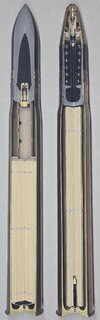 01 - Nordenfelt 3 pounder Common pointed shell and shrapnell shell.jpg1.3 MB · Views: 53
 -
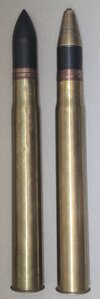 02 - Nordenfelt 3 pounder common pointed shell and Shrapnell shell.jpg855.8 KB · Views: 57
 -
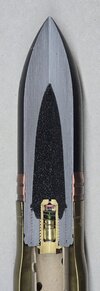 03 - Nordenfelt 3 pounder common pointed shell cutaway detail.jpg935.8 KB · Views: 57
 -
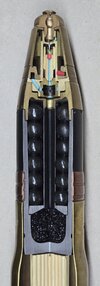 04 - Nordenfelt 3 pounder Shrapnell shell cutaway.jpg879 KB · Views: 57
 -
 05 - Nordenfelt 8 seconds time fuze.jpg533.8 KB · Views: 54
 -
 06 - Nordenfelt 8 seconds time fuze with Japanese markings.jpeg61.6 KB · Views: 51
 -
 07 - Nordenfelt 8 seconds time fuze.jpeg25.3 KB · Views: 44
 -
 08 - Hotchkiss Mk VI base fuze.jpg72.6 KB · Views: 42
 -
 09 - QF 3pdr Hotchkiss RN 1915.jpeg186.6 KB · Views: 49
