
pzgr40
Well-Known Member
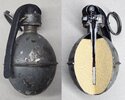
OF1 : Anti-personnel blast grenade
Construction:
The grenade is made of two halves pressed thin sheet steel hemispheres. The upper half is a better quality steel as it houses the threaded part for the fuze, the lower part is made from a lesser quality thin sheet steel.
The grenade weighs 250 grams, of which 150 grams Cheditte. Later versions used improved explosives; 120 grams Schneiderite, either 105 grams NTMX. Therefore the later versions of the grenade were lighter.
The grenade is fuzed with the ‘bouchon Allumineur automatique MLe 1916’ , also called the ‘Billiand’ fuze. It could however also be fuzed with the percussion igniter Modele 1915.
Function (pict 03):
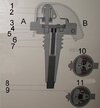
Before throwing, the spoon (6) of the grenade is pressed against the grenade body, and the safety pin is removed. When thrown, The spring (2) loaded pin (1) moves upward, pushing away the spoon. The spring pushes the pin free from the fuze body (7), allowing the sharp ends of the peg spring (3) to move into the two firing caps (11) upon expanding. These detonate, igniting the wick (5) , which ignites the detonator (8).
Additional info:
The French OF 1 (Offensive No.1) grenade was introduced into service in 1915. It was designed for trench warfare where close quarter fighting with classical fragmentation grenades was often equally dangerous for the thrower and the target due to shrapnel. Therefore a grenade was designed that had no shrapnel effect, but caused a large blast that was less dangerous for the thrower.
Complete length : 111 mm
Body length : 82 mm
Body diameter/ rim diameter : 60 mm / 65 mm
Fuze height : 24 mm
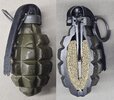
F1 Anti-personnel fragmentation grenade
Construction:
The grenade body consists of a grooved cast iron body. In the base a threaded hole is drilled, housing a steel screw. In top a threaded hole is drilled housing either the ‘bouchon Allumineur automatique MLe 1916’ , also called the ‘Billiand’ fuze.
Additional info :
The F1 grenade was designed and introduced in 1915 in limited numbers. The first model was fuzed with a wick ignition plug, later models with the ‘model 1915 percussion ignition plug’, the last type of fuze used was the ‘bouchon Allumineur automatique MLe 1916’ , also called the ‘Billiand’ fuze.
Complete length : 112 mm
Body length : 88 mm
Body diameter : 54 mm
Fuze height : 24 mm
Construction:
The grenade is made of two halves pressed thin sheet steel hemispheres. The upper half is a better quality steel as it houses the threaded part for the fuze, the lower part is made from a lesser quality thin sheet steel.
The grenade weighs 250 grams, of which 150 grams Cheditte. Later versions used improved explosives; 120 grams Schneiderite, either 105 grams NTMX. Therefore the later versions of the grenade were lighter.
The grenade is fuzed with the ‘bouchon Allumineur automatique MLe 1916’ , also called the ‘Billiand’ fuze. It could however also be fuzed with the percussion igniter Modele 1915.
Function (pict 03):
Before throwing, the spoon (6) of the grenade is pressed against the grenade body, and the safety pin is removed. When thrown, The spring (2) loaded pin (1) moves upward, pushing away the spoon. The spring pushes the pin free from the fuze body (7), allowing the sharp ends of the peg spring (3) to move into the two firing caps (11) upon expanding. These detonate, igniting the wick (5) , which ignites the detonator (8).
Additional info:
The French OF 1 (Offensive No.1) grenade was introduced into service in 1915. It was designed for trench warfare where close quarter fighting with classical fragmentation grenades was often equally dangerous for the thrower and the target due to shrapnel. Therefore a grenade was designed that had no shrapnel effect, but caused a large blast that was less dangerous for the thrower.
Complete length : 111 mm
Body length : 82 mm
Body diameter/ rim diameter : 60 mm / 65 mm
Fuze height : 24 mm
F1 Anti-personnel fragmentation grenade
Construction:
The grenade body consists of a grooved cast iron body. In the base a threaded hole is drilled, housing a steel screw. In top a threaded hole is drilled housing either the ‘bouchon Allumineur automatique MLe 1916’ , also called the ‘Billiand’ fuze.
Additional info :
The F1 grenade was designed and introduced in 1915 in limited numbers. The first model was fuzed with a wick ignition plug, later models with the ‘model 1915 percussion ignition plug’, the last type of fuze used was the ‘bouchon Allumineur automatique MLe 1916’ , also called the ‘Billiand’ fuze.
Complete length : 112 mm
Body length : 88 mm
Body diameter : 54 mm
Fuze height : 24 mm