
British Ordnance Collectors Network
You are using an out of date browser. It may not display this or other websites correctly.
You should upgrade or use an alternative browser.
You should upgrade or use an alternative browser.
Original paint 37MM M51?
- Thread starter KMLS
- Start date
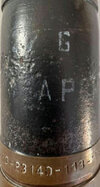
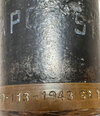
You cannot judge if the markings are original or not by the lack of "with tracer" markings. Ammunition lots that were loaded specifically for testing, as well as for proofing both armor and guns, was typically not loaded with tracer, and may or may not have been marked "without tracer". In your example there appears to be heavy pitting. If there is black paint over the pits it would indicate it was repainted (and therefor remarked). Additionally the vertical gap between the letter rows of the markings appears to be pretty far out of spec. In any case, its nice to have some markings (and paint!) even if they are not original.
Last edited:
In fairness, original paint does not fall into rust pitting holes. This looks to have been painted over rust pits and then restencilled. But I suspect that most of us would much rather see a shell, or shot, in all its glory rather than something that has so much body filler that you really have no idea what is beneath it all
Hello,
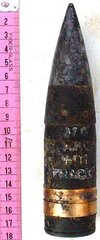
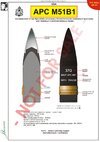
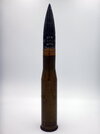
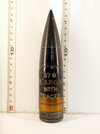
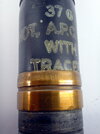
Here are some pictures of an M51 with tracer and its original paint.
Furthermore, I'm still looking for the exact meaning of the suffixes A1, A2, B1, P1-PA, B2, etc.
Are these related to a technical development of the 37mm M51? And if so, which ones?
Thanks for your help.
Here are some pictures of an M51 with tracer and its original paint.
Furthermore, I'm still looking for the exact meaning of the suffixes A1, A2, B1, P1-PA, B2, etc.
Are these related to a technical development of the 37mm M51? And if so, which ones?
Thanks for your help.
Attachments
FWIW
From TM 9-1904, Ammunition Inspection Guide (1944): "The model number marked on the projectile may be either M51, M51B1 or M51B2 ; rounds so marked are identical in functioning, the B1 or B2 designations signifying only that the projectiles are manufacturing alternatives of the M51."
(from my notes)
M51 (no suffix) design had the ballistic cap (windscreen) crimped on the piercing cap. In service the windscreen had problems with occasionally separating from the projectile before it was supposed to - including in the barrel. It was thought that this occurred partly due to the light construction of, and poor crimping of, the windscreen - and partly due to damage during transit and handling in the field.
M51B1 & B2 designs had a stronger drawn and machined ballistic cap which screwed onto the piercing cap. The piercing caps were of a slightly different shape in order to allow for the screw threads for the ballistic cap.
I think I remember reading that the piercing cap of the B1 was joined to the core differently than on the B2 (one was soldered on?, and one sintered?), but I am not sure.
M51A1 was a training projectile with the core & piercing cap made in one piece from mild steel, without the ballistic cap of the standard M51 service round.
M51A2 was a training projectile with the core, piercing cap, & ballistic cap, all machined as one piece from mild steel, having the same ballistic shape as for the M51/B1/B2 projectiles.
From TM 9-1904, Ammunition Inspection Guide (1944): "The model number marked on the projectile may be either M51, M51B1 or M51B2 ; rounds so marked are identical in functioning, the B1 or B2 designations signifying only that the projectiles are manufacturing alternatives of the M51."
(from my notes)
M51 (no suffix) design had the ballistic cap (windscreen) crimped on the piercing cap. In service the windscreen had problems with occasionally separating from the projectile before it was supposed to - including in the barrel. It was thought that this occurred partly due to the light construction of, and poor crimping of, the windscreen - and partly due to damage during transit and handling in the field.
M51B1 & B2 designs had a stronger drawn and machined ballistic cap which screwed onto the piercing cap. The piercing caps were of a slightly different shape in order to allow for the screw threads for the ballistic cap.
I think I remember reading that the piercing cap of the B1 was joined to the core differently than on the B2 (one was soldered on?, and one sintered?), but I am not sure.
M51A1 was a training projectile with the core & piercing cap made in one piece from mild steel, without the ballistic cap of the standard M51 service round.
M51A2 was a training projectile with the core, piercing cap, & ballistic cap, all machined as one piece from mild steel, having the same ballistic shape as for the M51/B1/B2 projectiles.
Last edited:
Browningautorifle
Active Member
Exactly. A repaint...WHEN would be more the question.If there is black paint over the pits it would indicate it was repainted
Hi all,
Sorry for the lack of response. Was on holiday with practically no reception. Taking a closer look I agree it's been repainted. Initially I thought it might just be oxidation or grime that made the pitting dark, but it looks a little too similar to the black paint. Combined with the incorrect stenciling it definitely seems to be repainted.
@37bis , many thanks for those pictures. I've saved those for future reference.
Sorry for the lack of response. Was on holiday with practically no reception. Taking a closer look I agree it's been repainted. Initially I thought it might just be oxidation or grime that made the pitting dark, but it looks a little too similar to the black paint. Combined with the incorrect stenciling it definitely seems to be repainted.
@37bis , many thanks for those pictures. I've saved those for future reference.