microplastic
Well-Known Member
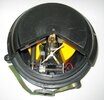
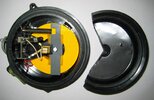
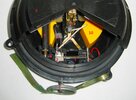
Cutaway model of a PPM-2 antipersonnel mine manufactured in East Germany (GDR). This mine was specially developed for use along the inner-German border; it features retaining eyelets to prevent it from being washed away in heavy rain or snowmelt and a removable aluminum detection foil for easier location during recovery. The mines were laid in three staggered rows spaced 30 cm apart, with a distance of 15 cm between each mine. A total of approximately 400,000 PPM-2 mines were laid along this border.
The PPM-2 mine was used as a replacement for the Russian PMN, which turned out to be not as durable as expected. The PPM-2 had a lifespan of five years and was laid starting in 1977. The mines were cleared due to international pressure in 1985. After the collapse of the Eastern Bloc, the formerly mined areas were cleared again, and numerous mines were still found.
The mine consists of two waterproof black plastic halves containing the ring-shaped explosive charge, the piezoelectric trigger mechanism, the electric detonator (MEZ-5), and the arming delay mechanism. The two casing halves are screwed together and sealed with a rubber O-ring.
The mine was manufactured at the “VEB Chemiewerk Kapen”
Funktion: After the safety pin(1) is removed, the lead shear plate(2) is cut by the pre-tensioned spring(3) of the delay mechanism. This disables the electrical short-circuit protection(4) in the detonator circuit and arms the mine.
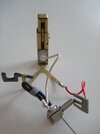
Pressing down the pressure plate(5) activates the pressure igniter(6), which triggers a current pulse in the piezoelectric element, similar to an electric lighter. The current flowing through the connecting wire(7) and conductive rubber contacts(8) activates the MEZ-5 detonator(9), which explodes the main charge(10).
Height: 65 mm
Diameter: 140 mm
Weight: 400 g
Charge: 100 g TNT
Delay time: 2.5 to 120 minutes, temperature-dependent
Operating pressure: 5 to 30 kg, temperature-dependent
Areas of operation: Angola, Namibia, Mozambique, Somalia, Cambodia, Ethiopia, Iraq, and Lebanon
The PPM-2 mine was used as a replacement for the Russian PMN, which turned out to be not as durable as expected. The PPM-2 had a lifespan of five years and was laid starting in 1977. The mines were cleared due to international pressure in 1985. After the collapse of the Eastern Bloc, the formerly mined areas were cleared again, and numerous mines were still found.
The mine consists of two waterproof black plastic halves containing the ring-shaped explosive charge, the piezoelectric trigger mechanism, the electric detonator (MEZ-5), and the arming delay mechanism. The two casing halves are screwed together and sealed with a rubber O-ring.
The mine was manufactured at the “VEB Chemiewerk Kapen”
Funktion: After the safety pin(1) is removed, the lead shear plate(2) is cut by the pre-tensioned spring(3) of the delay mechanism. This disables the electrical short-circuit protection(4) in the detonator circuit and arms the mine.
Pressing down the pressure plate(5) activates the pressure igniter(6), which triggers a current pulse in the piezoelectric element, similar to an electric lighter. The current flowing through the connecting wire(7) and conductive rubber contacts(8) activates the MEZ-5 detonator(9), which explodes the main charge(10).
Height: 65 mm
Diameter: 140 mm
Weight: 400 g
Charge: 100 g TNT
Delay time: 2.5 to 120 minutes, temperature-dependent
Operating pressure: 5 to 30 kg, temperature-dependent
Areas of operation: Angola, Namibia, Mozambique, Somalia, Cambodia, Ethiopia, Iraq, and Lebanon