British Ordnance Collectors Network
You are using an out of date browser. It may not display this or other websites correctly.
You should upgrade or use an alternative browser.
You should upgrade or use an alternative browser.
Practice-Drill and Training Mills Grenades
- Thread starter roller63
- Start date

gothica7
Well-Known Member
Hi Tony,
my pleasure bud, ile do one for you shortly.
Further to my comments re the galvanation or not re the Gibbons, i have been thinking about this and i actually dont think that the Govt at the time would have spent a great deal of time and money rustproofing these grens in any way. Certainly i dont think that they would have ever dipped the grens in molten zinc, ime not sure they would have used electrolysis, nor would i feel there have been much available by way of zinc paint available, could be wrong but lead based seems more likely. Nor do i feel that just because the info is in a book will i trust such info, i would rather see the proof, i.e, specific detailed info from the grenade specifications and this info is certainly not in the Govt specs i have in my hands. I think they were just painted blue, which has oxidised to green and the majority has worn off with use. Molten zinc would have been a bit thicker on the gren body and lasted a lot longer i feel. I would need to see the evidence that they were so plated and inference from a 'book' is not enough for me, especially as i have a gren with blue paint on it which i can see with my own eyes.
Andy
my pleasure bud, ile do one for you shortly.
Further to my comments re the galvanation or not re the Gibbons, i have been thinking about this and i actually dont think that the Govt at the time would have spent a great deal of time and money rustproofing these grens in any way. Certainly i dont think that they would have ever dipped the grens in molten zinc, ime not sure they would have used electrolysis, nor would i feel there have been much available by way of zinc paint available, could be wrong but lead based seems more likely. Nor do i feel that just because the info is in a book will i trust such info, i would rather see the proof, i.e, specific detailed info from the grenade specifications and this info is certainly not in the Govt specs i have in my hands. I think they were just painted blue, which has oxidised to green and the majority has worn off with use. Molten zinc would have been a bit thicker on the gren body and lasted a lot longer i feel. I would need to see the evidence that they were so plated and inference from a 'book' is not enough for me, especially as i have a gren with blue paint on it which i can see with my own eyes.
Andy
gothica7
Well-Known Member
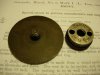
MK 11 gascheck & plug
Hi again Tony,
here is a picture of a MK 11 gascheck and steel base plug made by SMC which i believe was from Australia dated 1941. Could be wrong though, perhaps the experts on the forum could confirm this?
I have also a cast iron 23 mk11 plug made by Munitions Footscray[the M & F being seperate] and this is definately an Aussie plug.
Andy
Hi again Tony,
here is a picture of a MK 11 gascheck and steel base plug made by SMC which i believe was from Australia dated 1941. Could be wrong though, perhaps the experts on the forum could confirm this?
I have also a cast iron 23 mk11 plug made by Munitions Footscray[the M & F being seperate] and this is definately an Aussie plug.
Andy
Attachments

paul the grenade
Well-Known Member
hi gothica.
can you scan a copy of the specification you mention? sounds very interesting. Can you also do a close up of your blue gren?
I would imagine ricks book is very well researched. Rick, Norman and Gary are some of the top experts on grens and im sure one of them will have the proof we need. ive sent out some emails asking for the apropriate documentation. hopefully we'll have some answers soon.
Cheers, paul.
can you scan a copy of the specification you mention? sounds very interesting. Can you also do a close up of your blue gren?
I would imagine ricks book is very well researched. Rick, Norman and Gary are some of the top experts on grens and im sure one of them will have the proof we need. ive sent out some emails asking for the apropriate documentation. hopefully we'll have some answers soon.
Cheers, paul.
gothica7
Well-Known Member
Hi Paul,
will do a close up piccy of the blue but now green gren tonight and lets hope some light can be shed on this as i just cant imagine that if these things were galvanised, why isnt the inside done as well?
As for my documentation, well, theres 30+ pages and at the moment i havnt the time to scan them for you. I will try and do some photocopying but at my last attempt to use my photocopier it refused to function and ime not sure whats wrong.
The details i have cover the No5, 23, all marks and the 36 and cover just about everything from the type of iron to be used to the actual make up of the shellac and the Pettman cement used to seal the filler screw. Very interesting reading.
Andy
PS did you get the spring?
AA
will do a close up piccy of the blue but now green gren tonight and lets hope some light can be shed on this as i just cant imagine that if these things were galvanised, why isnt the inside done as well?
As for my documentation, well, theres 30+ pages and at the moment i havnt the time to scan them for you. I will try and do some photocopying but at my last attempt to use my photocopier it refused to function and ime not sure whats wrong.
The details i have cover the No5, 23, all marks and the 36 and cover just about everything from the type of iron to be used to the actual make up of the shellac and the Pettman cement used to seal the filler screw. Very interesting reading.
Andy
PS did you get the spring?
AA
gothica7
Well-Known Member
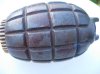
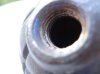
Unusual no 23 Mk 11
Hi Paul,
here are a couple of close ups of my 23 mk 11 as promised. It has exactly the same colouration as the Gibbons and i reccon its paint not Zinc. Dosnt have any on the inside either. You can see some deeper blue on the inside of the filler hole.
I think it was used as some sort of training gren in its own right. It would easily convert into a Gibbons but then it would have lost some of its uniqueness so ile leave it as it is.
Andy
Hi Paul,
here are a couple of close ups of my 23 mk 11 as promised. It has exactly the same colouration as the Gibbons and i reccon its paint not Zinc. Dosnt have any on the inside either. You can see some deeper blue on the inside of the filler hole.
I think it was used as some sort of training gren in its own right. It would easily convert into a Gibbons but then it would have lost some of its uniqueness so ile leave it as it is.
Andy
Attachments
paul the grenade
Well-Known Member
hi gothica.
got the spring today thanks. i just need to find a big brass screw now.
your gren definately has a bit of blue paint.
the plot thickens!!
paul.
got the spring today thanks. i just need to find a big brass screw now.
your gren definately has a bit of blue paint.
the plot thickens!!
paul.
paul the grenade
Well-Known Member
Hi gothica.
Do you have documentation that says blue paint was used for 1 ww grenades as i can find no references until the 60's when everything was standardised for nato and drill colours were changed from white to blue.
Cheers, paul.
Do you have documentation that says blue paint was used for 1 ww grenades as i can find no references until the 60's when everything was standardised for nato and drill colours were changed from white to blue.
Cheers, paul.

paul the grenade
Well-Known Member
gothica7
Well-Known Member
aHi Paul,
sorry about not responding earlier, took the day off to go to the War n Peace show, luckily only 20 mins drive from me but had to catch up over the last couple of days.
You know, i could be wrong over the colouration of grens! I did see on Darryl Lynn's website under 'Markings' that either blue or light blue was used for British Grens, however there is no date. I have a mate who is currently researching at Kew who may be able to throw some light on this shortly but as you can see my 23 was not painted white and looks very much like a Gibbons in colouration. Perhaps we will never know.
Andy
sorry about not responding earlier, took the day off to go to the War n Peace show, luckily only 20 mins drive from me but had to catch up over the last couple of days.
You know, i could be wrong over the colouration of grens! I did see on Darryl Lynn's website under 'Markings' that either blue or light blue was used for British Grens, however there is no date. I have a mate who is currently researching at Kew who may be able to throw some light on this shortly but as you can see my 23 was not painted white and looks very much like a Gibbons in colouration. Perhaps we will never know.
Andy