
pzgr40
Well-Known Member
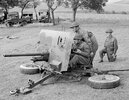
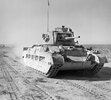
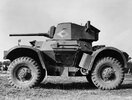
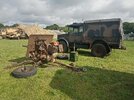
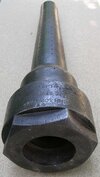
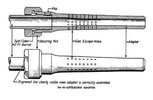
The ordnance QF 2 pounder gun was developed in 1935 in England with both the purpose as a tank gun and an anti tank gun. As an anti-tank gun it used a three legged carriage that enabled the gun a 360 degree traverse when the wheel were removed. The gun was alo used in the Cruiser Mk.I tank, the Valentine tank, the Mathilda tank and the Daimler armoured car. WIth the Diamler armoured car it was sometimes fitted with the LittleJohn adepter, a tapered bore screwed to the front of the barrel that enabled the usa of AP/NCR ammuition, increasing the penetrating capability on enemy armour.
As the 2 pounder was phased out on the western front, not able to penetrate the frontal armour of German tanks above the PzKw.II, it was kept in use in the Asian theatre throughout the war as the Japanese tanks were lightly armoured and the 2 pounder could kill them from any angle. On the western front the 2 pounder was soon replaced by the 6 pounder and later by the 17 pounder.
Calibre of the 2 pounder projectiles is 40mm (1.575 inch), shellcase length is 304 mm.
The brass shellcases are filled with sticks of cordite WT 144 – 048. A primer with a magazine is screwed into the base of the shellcase.
Germany captured 2 pounder guns at dunkirk and took them in their own service as the 4,0 cm Pak 192 (e).
The maximum rate of fire is 22 rounds per minute.
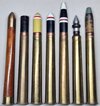
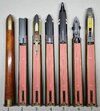
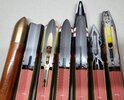
From left to right:
No.1 - 2 pouner drill round made from oak wood, with a brass nosepiece and base. Used in the barracks to train gunners with the drill of handling ammunition and loading the gun.
Cartridge length : 417 mm. Projectile length : N/A.
No.2 - Shot, flathead, practice Mk. 1T, QF, 2 pounder. Used as practice shots on short shooting ranges and to test the gun after repair.
Projectile weight is 2.375 Lb (1,077 Kg). Vo= 610 mtrs/sec (2000 ft/sec)
Cartridge length : 392 mm. Projectile length : 112 mm.
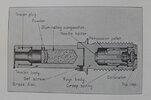
No.3 - Shell QF armour piercing 2 pr Mk. 1T. A hardened steel body with a pointed nose with a radius of 1,4 calibres. Inside the shell has a parallel cavity filled with 19 grams Lyditte, and the remaining space between the explosive charge and the fuze is filled with a rubber bag containing 2,5 dram picric acid. The projectile is fuzed with the ‘base fuze percussion tracer No.281 Mk1’. This brass fuze houses a firing pin, kept is safe position by a lead cilinder that is cast around the upper part of the firing pin, preventing the firing pin from reaching the firing cap. Upon firing the lead cilinder moves back due to the set back force, kept in backward position by a creep spring. The firing pin now protrudes from the lead weight at the front, and upon impact the firing pin and lead cilinder move forward –riding the spring- into the firing cap which ignites the bag of pricric acid.
Projectile weight is 2.375 Lb (1,077 Kg) , Vo = 807 mtrs/sec (2.650 ft/sec).
Penetration (@ 30 degrees from vertical) is 53 mm @ 91 mtrs, 47 mm @ 460 mtrs, 40 mm @ 910 mtrs, 34 mm @ 1400 mtrs.
Colour of the projectile is yellow, with a white red white band on the ogive, Yellow means high explosive, white means hardened steel, the red band means tracer.
Cartridge length : 418 mm. Projectile length : 132 mm w/o fuze, 182 mm with tracer fuze.
No.4 - Shot, AP-T Mk.1. A hardened steel projectile with a drilled hole in the base that houses the tracer composition.
Projectile weight is 2.4 Lb (1,08 Kg), Vo= 792 mtrs/sec (2600 ft/sec)
Penetration (@ 30 degrees from vertical) is 53 mm @ 91 mtrs, 47 mm @ 460 mtrs, 40 mm @ 910 mtrs, 34 mm @ 1400 mtrs.
Colour of the projectile is black with a white red white band on the ogive, black means solid shot, white means hardened steel, the red band means tracer.
Cartridge length : 418 mm. Projectile length : 132 mm.
No.5 - Shot APCBC/T Mk.1. A hardened steel projectile with a piercing cap and a ballistic cap to improve penetration and speed. A hole is drilled in the base of the projectile housing the tracer composition.
Projectile weight is 2.7 Lb (1,22 Kg), Vo= 792 mtrs/sec (2600 ft/sec).
Penetration (@ 30 degrees from vertical) is 58 mm @ 91 mtrs, 53 mm @ 460 mtrs, 49 mm @ 910 mtrs, 44 mm @ 1400 mtrs.
Cartridge length : 470 mm. Projectile length : 183 mm.
No.6 – AP/CNR Mk1
AP/CNR stands for Armor Piercing/Composition Non Ridgid.
This projectile is fired from a barrel with a tapered barrel piece screwed onto the front of the barrel. The projectile consists of a conical lower flange into which a tracer element is screwed. The tungsten carbide penetrator is placed in the aluminum upper part of the projectile body. The aluminum upper part is roll crimped over the conical lower flange. A mild steel sleeve, 40 mm in diameter, is placed around the aluminum upper part.
When the projectile is fired, it initially travels through the straight section of the barrel. As it enters this tapered section, the front flange is compressed all around, utilizing the space forward to become smaller in diameter but larger in length. The lower flange is also compressed all around. This significantly increases the barrel pressure, resulting in a higher muzzle velocity. After leaving the conical part of the barrel the diameter has decreased from 40 to 30 mm.
Projectile weight is 1.037 Lb (0,470 Kg), Vo= 1280 mtrs/sec (4.200 ft/sec)
Penetration (@ 30 degrees from vertical) is 105mm @ 91 mtrs, 90 mm @ 460 mtrs, 74 mm @ 910 mtrs, 60 mm @ 1400 mtrs.
Cartridge length : 407 mm. Projectile length : 120 mm.
No.7 – HE-T Mk2
When in use as a tank gun, one flaw of the QF 2 pounder gun in the role of infantry support came to light; the lack of a high exlosive shell. This was solved by taking the HE shell from the 2 pounder pom pom anti aircraft gun, and use it for the QF 2 pounder . The projectile is made from mild steel and uses the nose fuze DA No.243, as well as a tracer igniter No.7 Mk.IV in the base of the projectile.
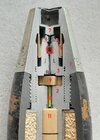
Functioning of impact fuze D.A No.243. (D.A = Direct Action);
The fuze consists of a fuze housing (1), the booster housing (2), and the housing (3) for the set back safety mechanism (4,5,6) and the firing cap (8).
Upon firing, the conical part of the safety ferulle (4) bends open and moves downward together with the arming ring (5). This releases the two collar halves (6), enabeling them to move outward due to the centrifugal force. The firing pin (7) can now reach the firing cap (8) upon impact. After firing, the shutter (9) rotates around it’s pivot pin, replacing the blind hole in the centerline of the fuze for a detonator. The fuze is now fully armed. Below the shutter (9), a stemming charge (10) is placed in a steel insert, ending in the booster charge (11).
Upon inpact, the firing pin (7) is pushed in the firing cap (8) which explodes. The flame travels down the channel into the detonator of the shutter (9), which explodes. The flame travels down the stemming section (10) into the booster charge (11), exploding the main charge of the shell.
In the base of the projectile the “tracer and igniter shell No.7 Mk.IV” is screwed. This mechanism has a set back firing cap and the burning tracer is now visable. After burning up, the tracer composition ignites the gunpowder in the brass cup in top of the tracer igniter mechanism. This initiates the self destruction of the shell.
Above the tracer igniter a black powder pellet is placed with a cartboard disc above it. A TNT pellet is placed installed, fixated by a stirrup spring. This assembly is placed into a cup with an internal firing pin, locked up by a lead (melting) ring in the base of the projectile. Upon firing, the firing cap moves downward into the firing pin, igniting the tracer composition. After leaving the barrel, the pressure in the igniter rises due to the burning tracer composition until the cup together with the set back firing cap are thrown out below the booster. Around this central exploder assembly ,a cartboard tube is placed. The main filling of the shell is cast TNT.
Projectile weight : 1.9 Lb (0.89 Kg). Vo= 792 mtrs/sec (2.600 ft/sec)
Cartridge length : 441 mm. Projectile length : 155 mm
The QF 2 pounder gun was used by the following countries :
Australia, Egypt, England, Germany (as spoils of war), Ireland, Malasya.
Regards, DJH.
As the 2 pounder was phased out on the western front, not able to penetrate the frontal armour of German tanks above the PzKw.II, it was kept in use in the Asian theatre throughout the war as the Japanese tanks were lightly armoured and the 2 pounder could kill them from any angle. On the western front the 2 pounder was soon replaced by the 6 pounder and later by the 17 pounder.
Calibre of the 2 pounder projectiles is 40mm (1.575 inch), shellcase length is 304 mm.
The brass shellcases are filled with sticks of cordite WT 144 – 048. A primer with a magazine is screwed into the base of the shellcase.
Germany captured 2 pounder guns at dunkirk and took them in their own service as the 4,0 cm Pak 192 (e).
The maximum rate of fire is 22 rounds per minute.
From left to right:
No.1 - 2 pouner drill round made from oak wood, with a brass nosepiece and base. Used in the barracks to train gunners with the drill of handling ammunition and loading the gun.
Cartridge length : 417 mm. Projectile length : N/A.
No.2 - Shot, flathead, practice Mk. 1T, QF, 2 pounder. Used as practice shots on short shooting ranges and to test the gun after repair.
Projectile weight is 2.375 Lb (1,077 Kg). Vo= 610 mtrs/sec (2000 ft/sec)
Cartridge length : 392 mm. Projectile length : 112 mm.
No.3 - Shell QF armour piercing 2 pr Mk. 1T. A hardened steel body with a pointed nose with a radius of 1,4 calibres. Inside the shell has a parallel cavity filled with 19 grams Lyditte, and the remaining space between the explosive charge and the fuze is filled with a rubber bag containing 2,5 dram picric acid. The projectile is fuzed with the ‘base fuze percussion tracer No.281 Mk1’. This brass fuze houses a firing pin, kept is safe position by a lead cilinder that is cast around the upper part of the firing pin, preventing the firing pin from reaching the firing cap. Upon firing the lead cilinder moves back due to the set back force, kept in backward position by a creep spring. The firing pin now protrudes from the lead weight at the front, and upon impact the firing pin and lead cilinder move forward –riding the spring- into the firing cap which ignites the bag of pricric acid.
Projectile weight is 2.375 Lb (1,077 Kg) , Vo = 807 mtrs/sec (2.650 ft/sec).
Penetration (@ 30 degrees from vertical) is 53 mm @ 91 mtrs, 47 mm @ 460 mtrs, 40 mm @ 910 mtrs, 34 mm @ 1400 mtrs.
Colour of the projectile is yellow, with a white red white band on the ogive, Yellow means high explosive, white means hardened steel, the red band means tracer.
Cartridge length : 418 mm. Projectile length : 132 mm w/o fuze, 182 mm with tracer fuze.
No.4 - Shot, AP-T Mk.1. A hardened steel projectile with a drilled hole in the base that houses the tracer composition.
Projectile weight is 2.4 Lb (1,08 Kg), Vo= 792 mtrs/sec (2600 ft/sec)
Penetration (@ 30 degrees from vertical) is 53 mm @ 91 mtrs, 47 mm @ 460 mtrs, 40 mm @ 910 mtrs, 34 mm @ 1400 mtrs.
Colour of the projectile is black with a white red white band on the ogive, black means solid shot, white means hardened steel, the red band means tracer.
Cartridge length : 418 mm. Projectile length : 132 mm.
No.5 - Shot APCBC/T Mk.1. A hardened steel projectile with a piercing cap and a ballistic cap to improve penetration and speed. A hole is drilled in the base of the projectile housing the tracer composition.
Projectile weight is 2.7 Lb (1,22 Kg), Vo= 792 mtrs/sec (2600 ft/sec).
Penetration (@ 30 degrees from vertical) is 58 mm @ 91 mtrs, 53 mm @ 460 mtrs, 49 mm @ 910 mtrs, 44 mm @ 1400 mtrs.
Cartridge length : 470 mm. Projectile length : 183 mm.
No.6 – AP/CNR Mk1
AP/CNR stands for Armor Piercing/Composition Non Ridgid.
This projectile is fired from a barrel with a tapered barrel piece screwed onto the front of the barrel. The projectile consists of a conical lower flange into which a tracer element is screwed. The tungsten carbide penetrator is placed in the aluminum upper part of the projectile body. The aluminum upper part is roll crimped over the conical lower flange. A mild steel sleeve, 40 mm in diameter, is placed around the aluminum upper part.
When the projectile is fired, it initially travels through the straight section of the barrel. As it enters this tapered section, the front flange is compressed all around, utilizing the space forward to become smaller in diameter but larger in length. The lower flange is also compressed all around. This significantly increases the barrel pressure, resulting in a higher muzzle velocity. After leaving the conical part of the barrel the diameter has decreased from 40 to 30 mm.
Projectile weight is 1.037 Lb (0,470 Kg), Vo= 1280 mtrs/sec (4.200 ft/sec)
Penetration (@ 30 degrees from vertical) is 105mm @ 91 mtrs, 90 mm @ 460 mtrs, 74 mm @ 910 mtrs, 60 mm @ 1400 mtrs.
Cartridge length : 407 mm. Projectile length : 120 mm.
No.7 – HE-T Mk2
When in use as a tank gun, one flaw of the QF 2 pounder gun in the role of infantry support came to light; the lack of a high exlosive shell. This was solved by taking the HE shell from the 2 pounder pom pom anti aircraft gun, and use it for the QF 2 pounder . The projectile is made from mild steel and uses the nose fuze DA No.243, as well as a tracer igniter No.7 Mk.IV in the base of the projectile.
Functioning of impact fuze D.A No.243. (D.A = Direct Action);
The fuze consists of a fuze housing (1), the booster housing (2), and the housing (3) for the set back safety mechanism (4,5,6) and the firing cap (8).
Upon firing, the conical part of the safety ferulle (4) bends open and moves downward together with the arming ring (5). This releases the two collar halves (6), enabeling them to move outward due to the centrifugal force. The firing pin (7) can now reach the firing cap (8) upon impact. After firing, the shutter (9) rotates around it’s pivot pin, replacing the blind hole in the centerline of the fuze for a detonator. The fuze is now fully armed. Below the shutter (9), a stemming charge (10) is placed in a steel insert, ending in the booster charge (11).
Upon inpact, the firing pin (7) is pushed in the firing cap (8) which explodes. The flame travels down the channel into the detonator of the shutter (9), which explodes. The flame travels down the stemming section (10) into the booster charge (11), exploding the main charge of the shell.
In the base of the projectile the “tracer and igniter shell No.7 Mk.IV” is screwed. This mechanism has a set back firing cap and the burning tracer is now visable. After burning up, the tracer composition ignites the gunpowder in the brass cup in top of the tracer igniter mechanism. This initiates the self destruction of the shell.
Above the tracer igniter a black powder pellet is placed with a cartboard disc above it. A TNT pellet is placed installed, fixated by a stirrup spring. This assembly is placed into a cup with an internal firing pin, locked up by a lead (melting) ring in the base of the projectile. Upon firing, the firing cap moves downward into the firing pin, igniting the tracer composition. After leaving the barrel, the pressure in the igniter rises due to the burning tracer composition until the cup together with the set back firing cap are thrown out below the booster. Around this central exploder assembly ,a cartboard tube is placed. The main filling of the shell is cast TNT.
Projectile weight : 1.9 Lb (0.89 Kg). Vo= 792 mtrs/sec (2.600 ft/sec)
Cartridge length : 441 mm. Projectile length : 155 mm
The QF 2 pounder gun was used by the following countries :
Australia, Egypt, England, Germany (as spoils of war), Ireland, Malasya.
Regards, DJH.
Attachments
-
 01 - QF 2 pounders series.jpg1.2 MB · Views: 152
 -
 02 - QF 2 pounders cutaways.jpg1.5 MB · Views: 153
 -
 03 - QF 2 pounder details.jpg1.4 MB · Views: 137
 -
 04 - 2 pounder HE fuze No.243.jpg725.4 KB · Views: 119
 -
 05 - 2 Pdr No 281 base fuse for APHE.jpg143 KB · Views: 103
 -
 06 - QF 2 pounder anti tank gun.jpg177.9 KB · Views: 89
 -
 07 - Matilda tank.jpg199.4 KB · Views: 79
 -
 08 - Daimler armoured car.jpg76.3 KB · Views: 121


![DSCN1081[1].JPG](https://www.bocn.co.uk/data/attachments/183/183624-313bbbb2b4b1338e368d1c07bd14ba12.jpg "DSCN1081[1].JPG")