microplastic
Well-Known Member
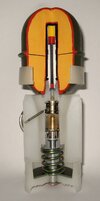
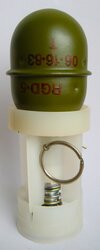
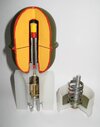
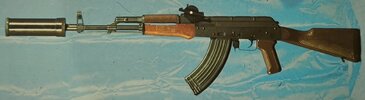
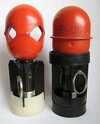
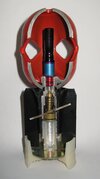
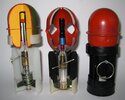
Cutaway model of an RGD-5 anti-personnel grenade (Bechergranate 73), which was used as a rifle grenade with the AK-47 Kalashnikov assault rifle. It was deployed using a launching cup and an additional sight (ZV76). The system was developed in the early 1970s and manufactured in the German Democratic Republic. The grenade itself was produced under license.
It can be fired at a range of 50m to 150m, precise engagement of targets such as doorways or windows is possible at distances of up to 80 m.
The manufacturer incl. sight and launching device was VEB Königswartha (05)
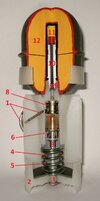
The rifle grenade consists of the RGD-5 grenade body, the AS73-V fuze, the fin assembly(plastic) with the striker mechanism, and the sabot(plastic). A plastic ring ensures better guidance within the launching cup. The fuze has a 0.2 to 1.0 sec delay and has the same dimensions as the DS-62 fuze for hand grenades. Because the threat is smaller, it can only be used with this rifle grenade, making any confusion impossible.
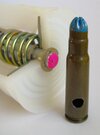
Before firing, the safety pin(1) is removed and the rifle grenade is inserted into the launching cup. (The safety pin prevents the striker from moving forward). The grenade is then fired using a special blank cartridge; the propellant gases push the sabot(2) with its retaining pin(3) upward into the finned tail section, causing the two shear pins(4) to break. When the grenade has left the launching cup and the acceleration stops, the sabot with its retaining pin is ejected rearward by the spring(5). This releases the two safety balls(6) that hold the striker(7) in place and the grenade is armed. On impact, the striker moves forward against the spring force(8) and hits the primer(9), igniting the delay train(10), the detonator(11) and the main charge(12).
Length : 152mm
Diameter: 51,3mm
Weight: 405 grams
Explosive charge: 110 grams of TNT
Delay : 0.2 to 1.0 sec
Range: 150mtrs
Max. speed: 40 m/s
Lethal radius : 25 mtr
source: GDR Manual DV52/78 and VEB Königswartha