What's new
British Ordnance Collectors Network

Join over 14,000 collectors of inert military ordnance. Get expert identification help for shells, fuzes, grenades, and more — plus access our classifieds marketplace and decades of archived knowledge. Free to register, takes seconds.
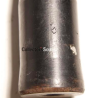
Rocket Head ? Canadian marked Identification

Gspragge

Well-Known Member
Premium Member
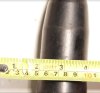
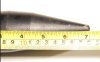
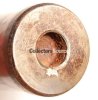
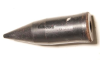
I have been asked what this is. To me it looks
like a solid rocket head ? The marking indicates
Canadian issue of a more modern nature.
 

Attachments

  • Thing-1.png
    Thing-1.png
    129.3 KB · Views: 49
  • Thing-2.png
    Thing-2.png
    164.9 KB · Views: 43
  • thing-3.jpg
    thing-3.jpg
    42.6 KB · Views: 35
  • thing-4.jpg
    thing-4.jpg
    37.8 KB · Views: 30
  • thing-5.jpg
    thing-5.jpg
    37.5 KB · Views: 30
That is really interesting. Hope someone here has more info on it and possibly some photos of the complete rocket.

Jason
PS: I just put it together after so many years, but one of my favorite torpedo artifacts was purchased from you 15+ years ago. LOL
 
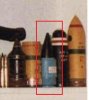
Has a similarity to the 20pdr AP penetrator, carried in the sabot. Maybe look in that direction?
 
Yep I agee with Kahu1 - 20pdr or maybe 17pdr core from a APDS

I had 20pdr core with the base petal at one stage - this is the only photo of it.
 

Attachments

  • 20pdr.jpg
    20pdr.jpg
    45.7 KB · Views: 40
Last edited:
With that style of mark on it, it will be a 20 not 17pr., too modern.
Thanks to all, now the price will double no doubt from the absurd to the ridiculous !
 
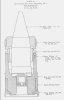
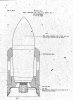
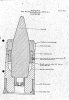
It's very close to the sub-projectile of the Mk. 3 DS practice, but different in a couple of ways.

The first is that tracer or tracer housing is screwed into a recess in the base of the sub-projectile, whereas in the Mk. 3 the tracer is housed in an extension of the base of the sub-projectile as seen in the image (plate) posted by kahul1 which is probably taken from page the publication 'Regulations For Army Ordnance Services - Volume 4 - Ammunition - Pamphlet 8 - QF Fixed Ammunition - Part 9 - Cartridge QF 20-pr (1957)'.

Another difference, though this just might not be shown in the plate, is the knurled of the bottom edge of the sub-projectile. This is present so that on firing the setback forces push the ridges into the softer aluminium alloy sabot pot. This results in a good mating between the two and insuring the transfer of torque to the sub-projectile and hence making sure it spins up to the same rate as the sabot.

So it might be that this a later mark of 20-pr DS-Prac, it's certainly not earlier (see images), a Canadian variant of the 20-pr DS-Prac Mk. 3, a later Canadian variant of the 20-pr DS-Prac, or some other DS-Prac sub-projectile.

20-pr DS-Prac Mk. 1

20-pr Mk. 1 DS practice.jpg

20-pr DS-Prac Mk. 2

20-pr Mk. 2 DS practice.jpg
 
Last edited:
Top