
British Ordnance Collectors Network
You are using an out of date browser. It may not display this or other websites correctly.
You should upgrade or use an alternative browser.
You should upgrade or use an alternative browser.
Romanian bombs 1915
- Thread starter Dreamk
- Start date
Hello!
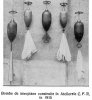
Yes, these are Romanian aircraft bombs produced on a small scale between 1915-1916. So far not much is known about them.
The photo you posted comes from a short memoir book "Amintiri de colaborare cu Vintilă Brătianu la fabricarea de muniții și armament în țară" published in 1936. It publishes memoirs about the activity of research, development and production of various ammunition and military products in the neutrality period, before Romania joined ww1, and also during ww1. The photo can be found at page 65.
Not much is known about those bombs. The text mentions that there were two weights that were experimented, namely 15 and 25kg, as you mentioned. This is the full weight of the bomb, including the shell, fuze and explosive content. The text also mentions that they experimented with various fillings (fast burning black powder, sodium chlorate, potassium chlorate, ammonal, etc) but does not say what was the final decision. The bombs were manufactured in the CFR - București Nord workshops, with some of the explosive, like the sodium chlorate being manufactured at CFR - Grivița. (CFR stands for Căile Ferate Române - Romanian National Railways. Their repair shops had sufficient workforce and tooling to start production on various military projects, like fuzes, artillery shells, etc.) .
Another fragment from an article published in the "România Aeriană" magazine mentions that there were two bombs developed, the Drosescu incendiary bomb (named after its inventor, engineer I. Drosescu working at Pirotehnia Armatei / Military Pyrotechnic works). This was a sheet metal bomb, with walls of 0,8mm steel sheet. This is the only information i have so far, and from this we can be sure that the bombs in that image are not the Drosescu ones. The second bomb was invented by I. Recuciu, quality assurance engineer at Pirotehnia Armatei.
Unfortunately this is the only info i have so far. If i will be able to find more, i`ll chime back in.
Yes, these are Romanian aircraft bombs produced on a small scale between 1915-1916. So far not much is known about them.
The photo you posted comes from a short memoir book "Amintiri de colaborare cu Vintilă Brătianu la fabricarea de muniții și armament în țară" published in 1936. It publishes memoirs about the activity of research, development and production of various ammunition and military products in the neutrality period, before Romania joined ww1, and also during ww1. The photo can be found at page 65.
Not much is known about those bombs. The text mentions that there were two weights that were experimented, namely 15 and 25kg, as you mentioned. This is the full weight of the bomb, including the shell, fuze and explosive content. The text also mentions that they experimented with various fillings (fast burning black powder, sodium chlorate, potassium chlorate, ammonal, etc) but does not say what was the final decision. The bombs were manufactured in the CFR - București Nord workshops, with some of the explosive, like the sodium chlorate being manufactured at CFR - Grivița. (CFR stands for Căile Ferate Române - Romanian National Railways. Their repair shops had sufficient workforce and tooling to start production on various military projects, like fuzes, artillery shells, etc.) .
Another fragment from an article published in the "România Aeriană" magazine mentions that there were two bombs developed, the Drosescu incendiary bomb (named after its inventor, engineer I. Drosescu working at Pirotehnia Armatei / Military Pyrotechnic works). This was a sheet metal bomb, with walls of 0,8mm steel sheet. This is the only information i have so far, and from this we can be sure that the bombs in that image are not the Drosescu ones. The second bomb was invented by I. Recuciu, quality assurance engineer at Pirotehnia Armatei.
Unfortunately this is the only info i have so far. If i will be able to find more, i`ll chime back in.
Last edited:
Some new info, this time without photos.
There was another incendiary bomb designed by eng. M. Cioc, which was homologated and the first 1000 bombs were produced at Arsenalul Armatei by the end of october 1916. These were sent to the recce aviation units.
Source: Valeriu Avram, Aeronautica română în Războiul de Întregire Națională (1916-1919), 2012, Editura Militară, p. 82
There was another incendiary bomb designed by eng. M. Cioc, which was homologated and the first 1000 bombs were produced at Arsenalul Armatei by the end of october 1916. These were sent to the recce aviation units.
Source: Valeriu Avram, Aeronautica română în Războiul de Întregire Națională (1916-1919), 2012, Editura Militară, p. 82
There may be a confusion concerning these last bombs:
Engineer M. Cioc was in charge of coordinating the transformation of some civilian factories (such as „Fabrica de Ustensile de Menaj de Tablă Emailată Ing. J.Katz" in Filaret, Bucharest) to produce bomb bodies and ammunition elements.
In 1928 he published in the "Buletinul Societății Politehnice" a concluding report of this activity under teh title „Contribuția industriei naționale la fabricarea materialelor de război și rolul ei în timpul războiului de dezrobirea neamului” ["The contribution of the national industry to the manufacture of war materials and its role during the war for the emancipation of the nation"]
In this report there is mention in July 1916 of a command for 20 000 aviation bombs of 16kg made locally.
Such 16kg bombs appear sometimes under the denomination "bombs M. Cioc"
However, there seems to be a confusion here with what is often designated as the heavy variant of the "Drogescu" bombs
The "Drosescu" bomb, designed by engineer Drosescu, was first used in the fall of 1916, being hand dropped fusiform bombs with fragmentation and incendiary/destructive effect.
The "Drosescu" bombs were produced in light variants, the most documented being the 10 kg and 12 kg models and a heavier 16 kg variant .
In September 1916 In response to German zeppelin attacks on Bucharest, Romanian aviators (including Lieutenant Eugeniu Iorgulescu) carried out long-range strategic raids. Three 16 kg "Drosescu" type bombs directly hit a wing of the Royal Palace in Sofia (Bulgaria), causing a major fire and a strong psychological effect on the enemy.
BTW there is also a much less documented "Negrescu" bomb represents one of the first models of aviation ammunition of Romanian design, being created out of necessity in the improvised workshops of the Romanian Aviation Corps in the fall of 1916. Named after its designer, Captain Engineer (later General) Gheorghe Negrescu , the third licensed aviator in Romania and one of the country's first military aviation engineers, the "Negrescu" bomb was made by adapting artillery projectiles.
There is also mention of an earlier improvised device, the "Nicolescu" bomb, designed by Lt. Vasile Niculescu.
Concerning M. Cioc, it is worth to mention that the historic contract through which the IAR (Romanian Aeronautical Industry) factories began operating in Brașov was signed on behalf of the company by L. Fabre and engineer M. Cioc , alongside the Minister of War at the time, General Gheorghe Mărdărescu.
Engineer M. Cioc was in charge of coordinating the transformation of some civilian factories (such as „Fabrica de Ustensile de Menaj de Tablă Emailată Ing. J.Katz" in Filaret, Bucharest) to produce bomb bodies and ammunition elements.
In 1928 he published in the "Buletinul Societății Politehnice" a concluding report of this activity under teh title „Contribuția industriei naționale la fabricarea materialelor de război și rolul ei în timpul războiului de dezrobirea neamului” ["The contribution of the national industry to the manufacture of war materials and its role during the war for the emancipation of the nation"]
In this report there is mention in July 1916 of a command for 20 000 aviation bombs of 16kg made locally.
Such 16kg bombs appear sometimes under the denomination "bombs M. Cioc"
However, there seems to be a confusion here with what is often designated as the heavy variant of the "Drogescu" bombs
The "Drosescu" bomb, designed by engineer Drosescu, was first used in the fall of 1916, being hand dropped fusiform bombs with fragmentation and incendiary/destructive effect.
The "Drosescu" bombs were produced in light variants, the most documented being the 10 kg and 12 kg models and a heavier 16 kg variant .
In September 1916 In response to German zeppelin attacks on Bucharest, Romanian aviators (including Lieutenant Eugeniu Iorgulescu) carried out long-range strategic raids. Three 16 kg "Drosescu" type bombs directly hit a wing of the Royal Palace in Sofia (Bulgaria), causing a major fire and a strong psychological effect on the enemy.
BTW there is also a much less documented "Negrescu" bomb represents one of the first models of aviation ammunition of Romanian design, being created out of necessity in the improvised workshops of the Romanian Aviation Corps in the fall of 1916. Named after its designer, Captain Engineer (later General) Gheorghe Negrescu , the third licensed aviator in Romania and one of the country's first military aviation engineers, the "Negrescu" bomb was made by adapting artillery projectiles.
There is also mention of an earlier improvised device, the "Nicolescu" bomb, designed by Lt. Vasile Niculescu.
Concerning M. Cioc, it is worth to mention that the historic contract through which the IAR (Romanian Aeronautical Industry) factories began operating in Brașov was signed on behalf of the company by L. Fabre and engineer M. Cioc , alongside the Minister of War at the time, General Gheorghe Mărdărescu.
A Quick recap of what we know until now (July 2026) about Romanian ww1 bomb types:
1. CFR HE bomb, 15 kg (cast body, nose fuze, no tail). Produced at CFR-Nord works. Unknown quantity.
2. CFR HE bomb, 25 kg (cast body, nose fuze, no tail). Produced at CFR-Nord works. Unknown quantity.
3. Drosescu Incendiary bomb, 7.8 kg (0.8mm sheet metal body, 38 cm length, 22cm max diameter, filled with black powder for initiation, ). Production at Pirotehnia Armatei. Unknown quantity.
4. Drosescu HE bomb, 10 kg, unknown details.
5. Drosescu HE bomb, 12 kg, unknown details.
6. Drosescu HE bomb, 16 kg, unknown details.
7. Recuciu frag bomb, 4,2 kg, (brass cylinder described as having an aerodynamic shape and filled with 225 frag balls of 7g each. 37cm length, 7cm diameter). Production possibly at Pirotehnia Armatei. Unknown quantity.
8. Recuciu HE bomb, 18 kg (cast iron body, picric acid filling, described as having a tail with four fins angled in a helix shape, probably inspired by PuW bombs. 670mm total height, 142mm maximum diameter,5mm walls, 100mm length of fins).
9. Cioc (?) bomb, unknown details, possibly 16 kg. Production at Arsenalul Armatei, at least 1000 produced until october 1916.
10. Negrescu (?) bomb, unknown details.
Another paragraph in the same book by Valeriu Avram, at p. 27 gives us some details about the three bomb models previously mentioned in the topic. (Drosescu incendiary, Recuciu frag bomb, Recuciu HE bomb). I have included the data in the analysis above.
PS I have read Cioc`s article that you mentioned („Contribuția industriei naționale la fabricarea materialelor de război și rolul ei în timpul războiului de dezrobirea neamului”) and there is absolutely no mention of the bombs. I assume this was given as a footnote for the source in the article that you read the information. Would you mind sharing the source, if you still remember?
1. CFR HE bomb, 15 kg (cast body, nose fuze, no tail). Produced at CFR-Nord works. Unknown quantity.
2. CFR HE bomb, 25 kg (cast body, nose fuze, no tail). Produced at CFR-Nord works. Unknown quantity.
3. Drosescu Incendiary bomb, 7.8 kg (0.8mm sheet metal body, 38 cm length, 22cm max diameter, filled with black powder for initiation, ). Production at Pirotehnia Armatei. Unknown quantity.
4. Drosescu HE bomb, 10 kg, unknown details.
5. Drosescu HE bomb, 12 kg, unknown details.
6. Drosescu HE bomb, 16 kg, unknown details.
7. Recuciu frag bomb, 4,2 kg, (brass cylinder described as having an aerodynamic shape and filled with 225 frag balls of 7g each. 37cm length, 7cm diameter). Production possibly at Pirotehnia Armatei. Unknown quantity.
8. Recuciu HE bomb, 18 kg (cast iron body, picric acid filling, described as having a tail with four fins angled in a helix shape, probably inspired by PuW bombs. 670mm total height, 142mm maximum diameter,5mm walls, 100mm length of fins).
9. Cioc (?) bomb, unknown details, possibly 16 kg. Production at Arsenalul Armatei, at least 1000 produced until october 1916.
10. Negrescu (?) bomb, unknown details.
Another paragraph in the same book by Valeriu Avram, at p. 27 gives us some details about the three bomb models previously mentioned in the topic. (Drosescu incendiary, Recuciu frag bomb, Recuciu HE bomb). I have included the data in the analysis above.
PS I have read Cioc`s article that you mentioned („Contribuția industriei naționale la fabricarea materialelor de război și rolul ei în timpul războiului de dezrobirea neamului”) and there is absolutely no mention of the bombs. I assume this was given as a footnote for the source in the article that you read the information. Would you mind sharing the source, if you still remember?
Last edited:
Besides the cited article by Enginneer Mihai Cioc, I used data concerning bomb production orders from the (very lengthy and much detailed) article by Cornel I. Scafeş "Efortul depus în vederea asigurării Necesarului de armament, tehnică de luptă Şi muniţii al armatei române În anii neutralităţii (1914-1916)" (Ensuring armament, combat means and ammunition for the Romanian army during the neutrality years (1914-1916)) in: Materiale de istorie Şi muzeografie, Xxvii, Muzeul Municipiului Bucureşti , 2013