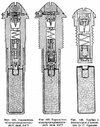
Numbers and placement of weapons on ships in 1916... or possibly on the coast.120/50-mm Guns of the First and Second Patterns
The appearance of 120/50-mm guns in Russian artillery was connected with the experience of the Russo-Japanese War. Initially, the War Ministry attempted to obtain 120/45-mm Canet guns from the Naval Ministry, but this was unsuccessful. Therefore, in 1905, Russia purchased 24 guns from Vickers, with a caliber of 120 mm and a barrel length of 50 calibers. They arrived in Libava that summer, after which 22 guns were sent to Harbin. They saw practically no combat during the war against Japan.
120/50-mm Gun of the First Pattern
The guns purchased from Vickers received the designation 120/50-mm Gun of the First Pattern from the Main Artillery Directorate (GAU). Production of the same type of gun was subsequently established at the Obukhov Steel Works. The gun was primarily a naval system and was installed on various ships of the Russian fleet.
Thus, the First Pattern became the original design on which later variants of the 120/50-mm gun were developed for different operating conditions.
120/50-mm Gun of the Second Pattern
The Second Pattern was not a fundamentally new system; rather, it was a further development of the 120/50-mm gun of the First Pattern. The main artillery components were retained, but the design was modified to meet the requirements of the War Ministry and to allow the gun to be used as coastal artillery.
Particular attention was paid to the gun mounting and to the possibility of installing it on different types of foundations. The gun had good ballistic performance and relatively low weight, allowing it to be mounted on both concrete and wooden foundations.
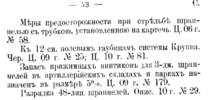
The first Second Pattern gun was tested at the Main Artillery Test Range in 1912–1913. A total of 230 rounds were fired during the trials, with a muzzle velocity reaching 930 m/s. However, the trials revealed a deficiency in the mounting: firing caused significant displacement of the aiming mechanisms, reaching up to 40° in elevation and 50° in traverse. This deficiency required structural corrections.
As a result, by the beginning of the First World War there were two closely related variants of the same 120/50-mm artillery system: the First Pattern, representing the original Vickers design and its Russian production, and the Second Pattern, a modified version adapted primarily for coastal use.
The subsequent widespread use of 120/50-mm guns led to their employment not only in coastal defense and aboard ships, but also on the land front.
the photos of the canon are related to the second model of the russian vickers 120mm thats adopted for the land use.
Basically its the same gun wich verifies my thesis , but its been produced diffrently wich lead to ballistical improvement.
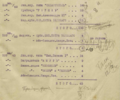

Russia placed orders with Japan for shell casings and other components for 120mm weapons—systems that were also in service there...
---


An enormous quantity...
Akon
Last edited: