
pzgr40
Well-Known Member
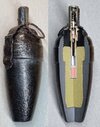
Cutaway model of a Russian "Morkovka" grenade made from a rejected 50mm mortar shell body. This grenade was introduced in 1941 and was designated 57-G-721MCH in the Russian grenade index. A Bakelite adapter was fitted to the top of the shell body to accommodate a Koveshnikov grenade fuze.
Some hand grenades had a blind threaded hole in the bottom for the tail, others did not.
With a variation of this grenade, a blind bakelite cap was fitted to the top of the grenade body, and the Koveshnikov fuze was placed in the hole where the tail would normally be.
Length grenade with Koveshnikov fuse: 142 mm
Length grenade body with bakelite adapter: 112 mm
Length grenade body without adapter: 104 mm.
Grenade body diameter : 51 mm.
Grenade weight (without fuse): 759 grams.
Explosive charge: 54 grams of TNT.
Lethal radius: 25 meters, danger zone up to 200 meters.
Functioning Koveshnikov fuze :
The fuze consists of a brass tube housing a spring loaded firing pin, secured by a steel ball that is partially inserted into the firing pin and partially into a hole in the tube. The steel ball is secured by a brass cap to which the grenade spoon is soldered, which is placed over the tube. Under the cap is a spring that pushes the cap off the tube. The cap is secured to the tube by a split pin. A striking feature of the spoon is its two ridges that can be used to clamp fingers behind.
The brass fuse holder is screwed into the bottom of the tube, with the primer cap in top. The flame-sensitive detonator is crimped over the bottom of the fuse holder.
Before throwing the grenade, the spoon is clamped against the grenade body. The split pin is removed, and the grenade is thrown. The spring between the brass tube and the cap pushes the cap up and off the tube. This releases the steel ball, which falls outward and releases the firing pin, which moves down into the primer. This ignites the fuse, which ignites the detonator after approximately 3.5 seconds.
Regards, DJH
Some hand grenades had a blind threaded hole in the bottom for the tail, others did not.
With a variation of this grenade, a blind bakelite cap was fitted to the top of the grenade body, and the Koveshnikov fuze was placed in the hole where the tail would normally be.
Length grenade with Koveshnikov fuse: 142 mm
Length grenade body with bakelite adapter: 112 mm
Length grenade body without adapter: 104 mm.
Grenade body diameter : 51 mm.
Grenade weight (without fuse): 759 grams.
Explosive charge: 54 grams of TNT.
Lethal radius: 25 meters, danger zone up to 200 meters.
Functioning Koveshnikov fuze :
The fuze consists of a brass tube housing a spring loaded firing pin, secured by a steel ball that is partially inserted into the firing pin and partially into a hole in the tube. The steel ball is secured by a brass cap to which the grenade spoon is soldered, which is placed over the tube. Under the cap is a spring that pushes the cap off the tube. The cap is secured to the tube by a split pin. A striking feature of the spoon is its two ridges that can be used to clamp fingers behind.
The brass fuse holder is screwed into the bottom of the tube, with the primer cap in top. The flame-sensitive detonator is crimped over the bottom of the fuse holder.
Before throwing the grenade, the spoon is clamped against the grenade body. The split pin is removed, and the grenade is thrown. The spring between the brass tube and the cap pushes the cap up and off the tube. This releases the steel ball, which falls outward and releases the firing pin, which moves down into the primer. This ignites the fuse, which ignites the detonator after approximately 3.5 seconds.
Regards, DJH