This is the info I gathered a long time ago from a thread in the defunct wk2ammo.com forum and from the "secret projects" forum.
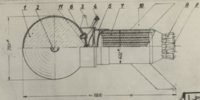
SB 800 RS "Prismen Rollbombe" (also initially designated as Kugelbombe/RZ 100) Kurt 1 (spherical bouncing bomb and initial RZ100 rpopelled model) and Kurt 2 (with added imnproved rocket section)
Designed to be used attacking Russian dams, inspired by Barne Wallis bouncing bomb.
Weight: Approximately 780 kg to 800 kg, including the spherical warhead approximately 750mm in diameter and weighing 400-450 kg.
Thickness of case : 12-mm thick ST-52R welded steel.
Filling: Filled with 385kg cast hexanite
Propulsion: Equipped with a rocket engine designed to accelerate the device up to speeds of 330 m/s within 3 seconds.
Propulsing Body: The cylindrical mid-section housed a gyro unit which is operated by a gas evolved from a burning element.
It also housed the lifting lug and the explosive coupling which severed the warhead from the propulsion unit.
The rocket section is a steel cylinder housing the RZ 100 rocket engine with 420-mm of diameter, 846-mm length and 85 kg of Diglycol propellant, rated at 7,000 kg peak thrust and 2.8 seconds life. It included 18 venturi.
The weight of the propellant was approximately 90 kg.
The RZ 100 rocket engine was soon replaced by a steel cylinder with a length of 600-mm and a diameter of 300-mm containing the engines of fourteen R4M air-to-air rockets each rated at 245 kg peak thrust.
The new design included significant aerodynamic modifications to reduce drag: the box tailplane assembly was replaced by four tailfins made of 7.5-mm thick plywood and a detachable nose cone was added.
A warhead separation system was also installed consisting of springs compressed to 1,000 kg that were released by means of an explosive bolt.
Tail: The initial air tail was the same as used with the BT bombentorpedo. Made of plywood, its elevators were controlled by the gyro.
Dimensions of the nitial air tail : 370 x 560 x 1,270 mm
Flight tests of the Kurtbombe showed that the drag generated by the tailplane limited the speed of the Fw 190 G to less than 500 km/h and the effective range to only 1,400 m.
A modified box tailplane assembly was fitted around the nozzles section, to maintain the flight altitude, one elevator preset to an angle of 7-degrees was gyro-controlled.
Modified Tailfin span: 1,315-mm, length: 2,265-mm, height: 750-mm.
Overall length of the Kurt apparatus was : 2,030 mm
Fuzing:
In the original Sperical projectile without propulsion, two hydrostatic fuzes were used:
One time-fuse ZZ59 with 23-second delay and one hydrostatic fuse Krupp Wasserdruckzünder Type 44.designed to operate at a depth of 8 meters.
The sphere was later modified to accommodate two Krupp fuzes for normal hydrostatic operation at 8 meters, and an electrical time delay fuze in case the missile penetrated the ship’s hull .
The rocket propulsed model contained two fuze pockets:
A transverse pocket ran through the sphere and was open at both ends.
The second pocket wa set at an angle of 45° to the transverse pocket and contained a type 44 hydrostatic fuze.
The condenser fuze functioned in the following manner:
1 . Ignited an explosive element which starts the gyro immediately upon release of the missile from the plane.
2 . Ignited the rocket propellant by exploding a 1-kg black powder charge after a delay of 0.5 seconds
3. Allowed either one of two possible types of electric fuzes used, to be armed (electric hydrostatic or electric time delay) .
4. Fired the explosive coupling after a delay of 4.5 seconds.
When the rocket propellant is ignited it burnt from 3 to 4 seconds.
One-half second after the rocket impulse ceased, the explosive coupling fired, severing the sphere from the after body.
The rocket section dropped off and the spherical warhead continued toward the target . The missile then hit the target and sank. When at a depth of 8 meters, one of the hydrostatic fuzes actuated to fire the main charge.
The initial model consisted of only the sphere designed to be used as a bouncing bomb.
The modified model with rocket assistance included an air tail with its elevators preset to an angle of 10 degrees.
Range/Speed: To increase the operational distance/speed range to roughly 4,500 meters a rocket propulsion unit was fitted to the sphere.
Initial tests without rocket propulsion were unsatisfactory; later tests improved, but the project was officially canceled and stopped in August 1944. Only two prototypes were tested. This did not prevent Rheinmetall-Borsig, without waiting the results of the testing, to begin producing a batch of 560 Kurt bombs that obviously never saw operational service.
Without a rocket propulsion, the ideal altitude for the attacking plane with the initial spherical bouncing bomb was calculated at 20 meters (max 50m) and at a speed of 700 km/h.
It was found that under ideal conditions, the effective range was 400 meters .
With rocket propulsion, the ideal launch altitude and speed remained identical , but the range increased to 2500-3500 m .
The rocket ignited 0.7 seconds after release and burned for 1.8 seconds.
0.5 seconds after the rocket impulse ceases, the explosive bolt severed the warhead from the after body. The rocket section dropped and the sphere continued towards the target.
When released from a Fw190 at 250m per second, the range was 2500m, when dropped from a Me410 at 300mps the range was 3500m.
The speed in flight of the projectile with rocket assistance was 330 m/second. and at impact 320 m/second.
The initial spherical model proved unstable in flight as the assembly proved unsuitable because the sphere retained the rotational movement transverse to the flight path and when it hit the water it deviated to starboard, completely missing the target.
Rheinmetall engineers decided to eliminate rotation by modifying the angle of the venturis
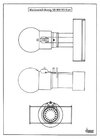
The new design, called the SB 800 RS Kurtbombe, was provided with a new 555-mm diameter cylindrical section located between the sphere and the rocket engine. This section contained a pneumatic operated gyroscope stabilizing unit (which would have been run up before the bomb was dropped) to give the missile directional stability and the explosive bolt which severs the warhead from the propulsion unit.
Between autumn 1943 and summer 1944, a number of Kugelbombe and Kurt prototypes were flight tested at E-Stelle Travemünde and Waffenprüfplatz-Leba testing stations using Messerschmitt Me 410 B-5 and Focke-Wulf Fw 190 G-1 launch planes fitted with TSA2D bomb release computers
Trial of the initial spherical bouncing bomb dropped from a FW190 in Leba, Pomerania (In present day Poland, Leba was a rocket testing site)
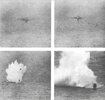
There is a movie on Youtube of this trial youtube.com/watch?v=J1JBYIClEd0
www.youtube.com/watch?v=J1JBYIClEd0
And of the trial of the rocket propulsed model (a rare color short take) at youtube.com/shorts/Yc4Ftx2Cmls
www.youtube.com/shorts/Yc4Ftx2Cmls
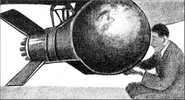
Heavy retouched photograph of the later model
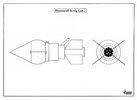
Test reports in teh Bundesarchive::
Tests of the Kurt bouncing bomb conducted between July and August 1944.
RL 36/86; Page: 424, 464, 480
invenio.bundesarchiv.de/invenio/direktlink/b2b7a313-243b-47b5-acd0-961ecdc43be8/
Tests of the Kurt bouncing bomb conducted at the E-Stelle Travemünde between September and November 1944. A Focke-Wulf 190 was used for the tests.
RL 36/24; Page: 28, 32, 86, 88
invenio.bundesarchiv.de/invenio/direktlink/65287e47-879c-445e-9324-f9c33c7ef8a6/