Forum Member Tim has shown interest in my ramblings so here goes…
I should perhaps begin by reiterating the design criteria of the anti personnel mine which is best summed up by the acronym DNA-Disability Not Death. A corpse on the battlefield is a failure of that criteria. A dead soldier is readily removed and disposed of and relatively soon forgotten. A young man with a missing foot or leg, bleeding profusely, screaming and crying for his mother is never forgotten and an instant deterrent. Additionally this is an asset which MUST be removed quickly regardless of the danger, must be cared for, rehabilitated and looked after for the rest of his (or her) life and will continue to be an economic drain to the opposing forces for many years.
As harsh, cruel and inhuman as this sounds, it was this philosophy which bought the RANGER system into existence and accounted for its inclusion in the armouries of many countries for decades.
It was the Royal Ordnance Factory at Chorley which had responsibility for the explosive filling of the mine (I am assuming readers with an interest will already be aware of the mine and how it worked? I can supply details if required?.) following extensive trials at the facility whereby a simple pole and base plate served as a human leg upon which numerous varieties of Military boot from various countries were placed before being exposed to an explosion which demonstrated the ability of the boot to protect -or not-the wearer from the effects of the explosion. Arriving at a weight of explosive which would cause the sufficient amount of damage without total destruction was a surprisingly arduous task, which kept me living at “The Pines” hotel in Chorley (long gone I suspect) for a considerable time-their rollmop herrings were very good I recall!
I should explain that in those heady days MOD Contracts were on a “costs plus” basis, so living the high life on trials was accepted, and indeed expected!
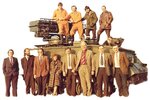
Returning to the factory at Hayes, this was were the mine layer itself was fabricated and trial fit to the British Army FV432 platform, and indeed we had one of these vehicles on permanent loan. I have fond memories of driving it a breakneck speed around the enormous field which formed part of the factory complex then-great fun.
The 432 was not the only platform investigated by us and the MOD. For transport out of the factory, the launcher would be mounted on a long wheelbase V8 flatbed land rover, and on one occasion I drove the vehicle to the army base at Tidworth where a CENTAUR was made available to me and a trial fit conducted.( The Centaur was a half track vehicle again based on a land rover (google it!))
Inevitably, marketing of the product led to interest from many countries particularly in the Middle East, all of these forces using the the American M113 Armoured Personnel Carrier as its weapons platform. ( still in production by BAE Systems!)
This in turn led me on another fascinating jaunt to the Tank Museum in Bovington, they at the time having the only M113 example in the uk, so that photographs and dimensions could be taken such that a suitable adaptor plate could be fabricated to enable fitting of the launcher to this platform. As a result of this, once the adaptor was made, I was required to drive our adapted long wheel base Land Rover, complete with fully loaded launcher ( peat practice mines!) down to Dover, across on the ferry to Calais then onward to an American base in Fulda, in the Hesse district of Germany. (The amount of paperwork required to do this was remarkably small, we required only an “ATA Carnet” from customs and we were waved through without query-imagine doing that today! )Once in Fulda it was possible here to strip the launcher from our land rover and test fit it, using the adaptor plate, to an American M113. The base in Fulda had an associated test track round which we could drive to check fit and suitability of the kit, however this track was some 3 miles from the base itself. This required driving our adapted M113 on public roads, for which, at the time, we required two personnel with red flags to walk in front of us all the way there and back! Sounds ridiculous, but I promise you, it happened!
I will leave it there, but if people show interest, there’s plenty more!