What's new
British Ordnance Collectors Network

This is a sample guest message. Register a free account today to become a member! Once signed in, you'll be able to participate on this site by adding your own topics and posts, as well as connect with other members through your own private inbox!

Unidentified 8,7cm fuze

Guns1418

Member
Good morning

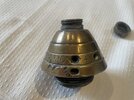
I've been struggling for many time to identify this fuze

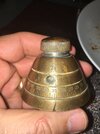
Material is brass, tail thread diameter around 35 mm, cone base diameter close to 60mm. Ring markings range 0 to 43 with 0.5 intervals. A Cross mark for percussion behavior selection designates this fuze as a Time and Percussion one

The screwable cap on the top might very well be the original percussion system casing, or a cover replacing the original cap when this was perhaps transformed into a Trench Art inkwell

The only visible marking is "8,7cm"

Markings, material and technology makes me think of a pre-WW1 fuze, maybe Italian, Belgian, German, or from a non fighting nation ?

Any help or idea are welcome
IMG_4098.JPG IMG_7007.jpeg

Regards

Bernard
 
Fuzes are not my expertise, but 8,7 cm is a pretty rare calibre so from a shell case point of view, it could maybe be the German 8,7 cm Feldkanone L/24 M1891 or the Italian 8,7 cm M1880/M1889. I think Italy would not write "cm" personally so I would go for German.
 
I can definitely say with full confidence this is a commercial time-and-percussion Krupp fuze from the early 1890s for an export variant of the Krupp 9cm Feldkanone C/80 (actual calibre 87mm).

However, this is where the problems start, because this was a very widely used gun and I have no idea which country this belongs to, so I propose we narrow it down.

I can definitely exclude a few whose fuzes are well known right off the bat - it's not German, Russian, Italian, Belgian, Spanish, Swedish or Boer. It could be Turkish since I'm not too cognisant of what their fuzes look like, but I'd expect it to be marked with Ottoman script so it's a low likelihood. The Dutch also used this gun, but in 84mm calibre, so they're out as well.

What it could definitely be is Romanian, Bulgarian, Serbian or any of the many South-American nations who used this gun.

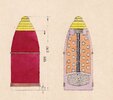
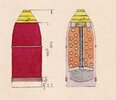
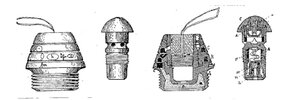
I know for a fact Romania used this particular fuze with our Tun de câmp „Krupp” de 87 mm, model 1880 (Krupp 87mm field gun, M.1880) since it appears in a hand-illustrated 1930s volume from the library of the Bucharest Military Museum about obsolete ammunition. I've never actually seen an example until now, but if it were Romanian I'd expect it to be marked "87mm" rather than "8,7cm".

img_23011331.jpg

There is also the possibility we never actually adopted it and it could be from another nation that somehow made it's way in our inventory during WW1, since, as far as I can tell, during the war we mainly made do with the old "10s fuze M.1880" adapted for T&P operation in 1892 and further modified in 1915 which we put on everything we could find including 53 and 57mm former fortress guns. Furthermore, this mystery fuze and the 10s one are NOT interchangeable as the former seems to have a different thread and even the shrapnel body shape is slightly different.

img_23011340.jpg

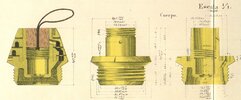
As far as i can tell, the closest I can get to this particular fuze in terms of construction details seems to combine the external shape of the Spanish "Espoleta de Doble Efecto modelo 1896" made by Krupp which used this type of insertable detonator:

img_23011341.jpg
img_23011342.jpg

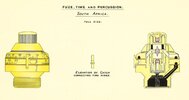
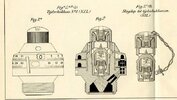
But used instead with this type of detonator - the first drawing is from a British manual about a Boer 120mm Krupp howitzer, the second from a Dutch manual of the same, and we in Romania also used this particular fuze "M.1891" on a variety of 120mm Krupp guns and howitzers. It's interesting to note the Dutch version has an extra safety pin, were the Boer and the Romanian version didn't, because the fuzes are delivered with the detonators already inserted as opposed to the Dutch and Spanish.

img_23011343.jpg

img_23011337.jpg
 
Last edited:
Turkish is not possible, around that time Ottoman language was used. So we can exclude that one as well.
Just as I suspected, thanks for confirming it.

I think we can exclude Serbia as well, since it turns out they never adopted this gun and instead went for the French DeBange 80 and 90mm - all of the Krupp guns they used during WW1 were Bulgarian and Turkish captures from the Balkan Wars.

So that leaves Bulgaria, and I'm starting to suspect very strongly this fuze might be Bulgarian and that's how it found its way into Romanian inventory as well.

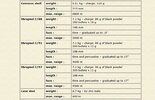
Another clue lies on www.bulgarianartillery.it where the Bulgarian shrapnels are all given as "188mm" long, exactly like the Romanian drawing. And since one of them is "C/97" and that's exactly the type of Krupp fuze I'd expect to see around that time, I'd be tempted to say "that's it"... except the same source gives that particular fuze as graduated to 17 seconds, and we know our mystery fuze is marked to 43s... Also, this other table gives time-of-flight up to 4500m as 20.57s seconds, so 17 sounds to me a bit too short.

img_23011344.jpg

img_23011345.jpg
 
Last edited:
Top