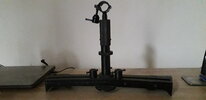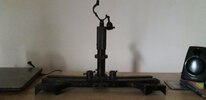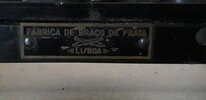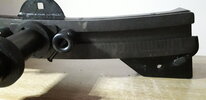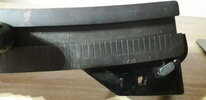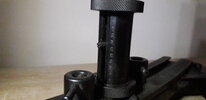
I must have somewhere a picture of the Levasseur PL-7b torpedo sight that may have been the inspiration of this Portuguese object.
The standard British torpedo sight was a much primitive one (even on the Barracuda of 1944) - a simple straight horizontal bar with light bulbs at regular intervals, and this may have pushed the Portugues to devlop their own version of a more "modern" and efficient torpedo sight.
The Levasseur was relatively more complex than the British sight (a simplified form of teh Levasseur was developped in Japan and became standard on the Japanese Navy's torpedo bombers, and similarly the Japanese copy of the STAe bombsight became standard equiment of the IJN's bombers, till the entry in service of a more modern copy of the Goertz 'automatic" bombsight). the Levasseur was coupled to a primitive (but quite advanced for teh period) mechanical computer, to enable its adaptation to various targets' speeds.
The US recognized early the need to develop a more advanced torpedo sight and their standard equipment in ww2 was definitively more advanced that their european parallels. However it is only near the end of ww2 that a really efficient torpedo sight was developped...when the aerial torpedo was becoming an obsolete weapon, at teh dawn of the era of rockets and missiles.
One must add that the real problem of torpedo bombers was not so much the torpedo sight as the exploder of the torpedo - the British and Italians had excellent hardware (copied by Russians and Germans) but the French exploder was widekly known for its infamous tendency to...spontaneously self-activate in mid air with the consequences one may expect. Therefore French crews used to fly with "locally inactivated" exploder through an arrangement of metal wire that held the prongs of the exploder, even in wartime. No operational torpedo launch was ever made by French torpedo bombers and the existing photographs show consistently exercise torpedoes (without the characteristic prongs of the real exploder). Even the celebrated Latecoere 298 was used operationally as a semi-dive bomber over land objectives.
The woes of the exploder of the US Mk13 torpedo are also well known - early versions demonstrating a deplorable tendency to explode at every angle of hit except around 90 degrees, so the better the aim the worst the result. This was already corrected by 1943, the other flaws of the Mk13 torpedo itself being then corrected in 1944-45.
Having said all this, there is yet no proof that teh bove object is indeed a torpedo sight.