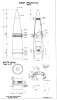
I have had this for quite some time and have not been able to identify it. It is about 17 1/2 inches (440mm) long and 3 1/2 inches (88 mm) in diameter. A lot of markings but they have not helped me in identification.
British Ordnance Collectors Network
You are using an out of date browser. It may not display this or other websites correctly.
You should upgrade or use an alternative browser.
You should upgrade or use an alternative browser.
Unknown Projectile
- Thread starter EODGUY
- Start date

Evening EOD,
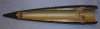
By the taking a first look at it, (especially at the cut away) It seem to me that you got a Projectile HEER (HE, Extended Range), as the wall of the proj. get thinner as it goes toward the nose. The shape is particular as well, as it's less bulky like normal proj. Instead, its more linear, more aerodynamic. And you got a space or cavity for a BBU (Base Bleed Unit) under the driving band. We do have in the Cdn Forces, a 105mm C132 HEER version of it. The cavity below the driving band is filled up with propergol cast composite propellant, which is a gas generator. The gas generated fills the wake at the base of the projectile thereby reducing the base drag and increasing the projectile range.
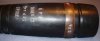
Note on the marking... I noted that all of your marking is stamped, not paint and near the driving band it is marked FES which should indicate iron rotating band (if my memory is good) which is marked on most of German proj. that I seen so far. And you mention that the diameter is 88mm... So I was thinking maybe German 8.8cm flak or artillery. I checked in what I have for German ref's and could not find anything related too or about it. Then again I'm kind of limited in ref's. So maybe this could put you on a new track... if you did not already went that way that is !?! lol...
Hope I have been in any help
Cheers.
FCAT.
By the taking a first look at it, (especially at the cut away) It seem to me that you got a Projectile HEER (HE, Extended Range), as the wall of the proj. get thinner as it goes toward the nose. The shape is particular as well, as it's less bulky like normal proj. Instead, its more linear, more aerodynamic. And you got a space or cavity for a BBU (Base Bleed Unit) under the driving band. We do have in the Cdn Forces, a 105mm C132 HEER version of it. The cavity below the driving band is filled up with propergol cast composite propellant, which is a gas generator. The gas generated fills the wake at the base of the projectile thereby reducing the base drag and increasing the projectile range.
Note on the marking... I noted that all of your marking is stamped, not paint and near the driving band it is marked FES which should indicate iron rotating band (if my memory is good) which is marked on most of German proj. that I seen so far. And you mention that the diameter is 88mm... So I was thinking maybe German 8.8cm flak or artillery. I checked in what I have for German ref's and could not find anything related too or about it. Then again I'm kind of limited in ref's. So maybe this could put you on a new track... if you did not already went that way that is !?! lol...
Hope I have been in any help
Cheers.
FCAT.

I think also its from ww2 German more like 10,5 cm Triebspiegel geschosse (SABOT).
There some in the TM9-1985
There some in the TM9-1985

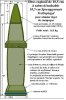
Yes Yoda you are right.
Last edited:

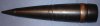
John, I don't have a thread gauge at hand right now. I have always thought it was German but could never pin it down. At one time I am sure it had a bore riding sabot about half way up the ogive. There are two deep grooves in the body that in my mind would serve no purpose other than holding on a sabot. The fuze itself is small. About 1.52 inches (38mm) in diameter and 3.56 inches (90mm) overall length. The exposed length is about 3 inches (76mm). The stampings on the body are also strange to me. This to me is obviously a test round because all of the markings appear handstamped in the metal in a somewhat hap-hazard manner. The black paint is a re-paint, but it was done a long time ago I think.

Perhaps its a trick of the light, but that doesn't look like a sintered iron driving band - is it magnetic?
BD
BD
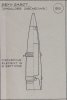
Waow, very interesting, Madbomber !
I think you've got it !
Thanks for document.
Yoda
I think you've got it !
Thanks for document.
Yoda